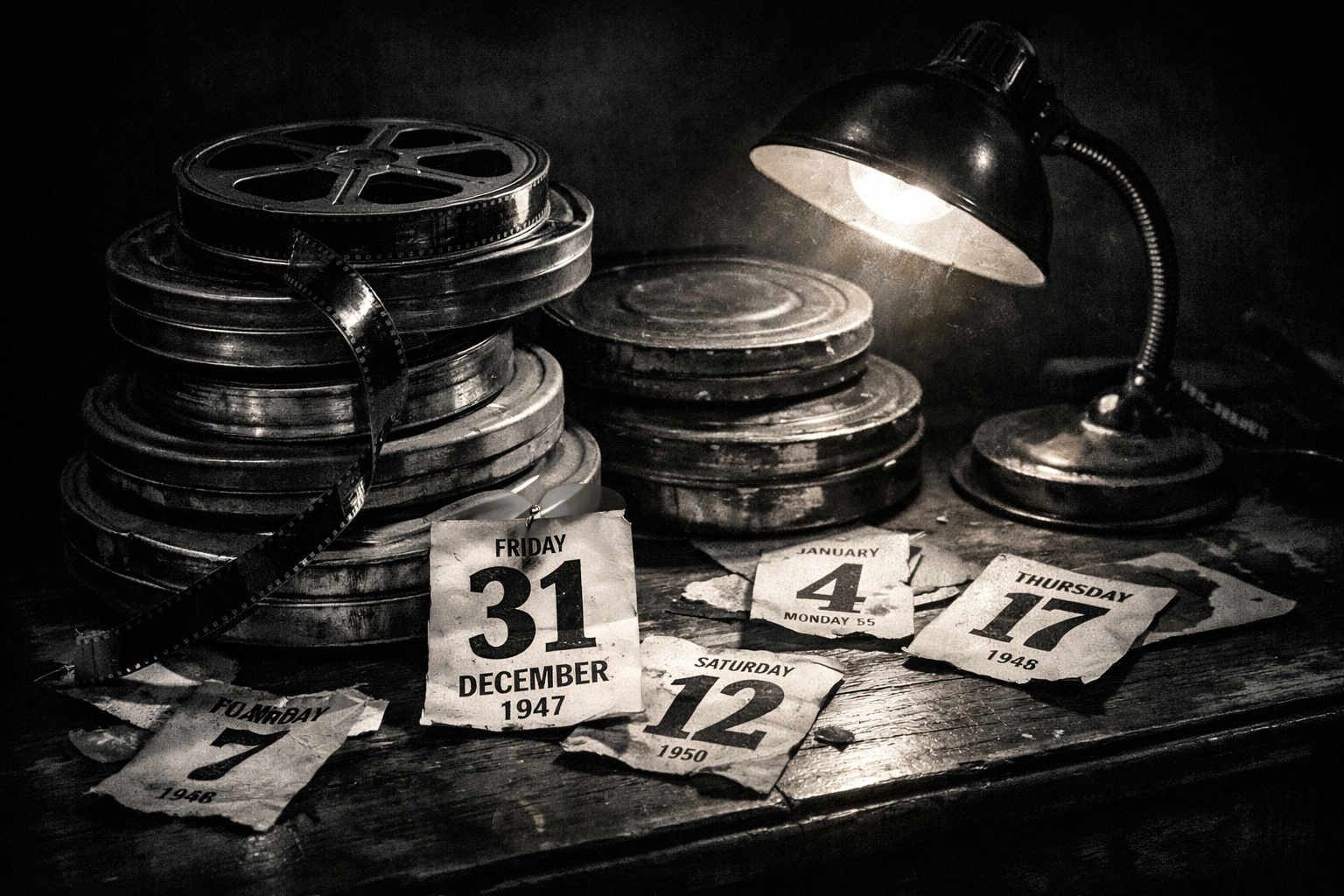
Best of Film Noir (By Year)

  • 1940: Stranger on the Third Floor (RKO Radio Pictures)
  • Stars: Peter Lorre, John McGuire, Margaret Chapman
  • Description: Often cited as one of the first true film noirs, Stranger on the Third Floor establishes the genre’s visual language with its stark shadows and claustrophobic atmosphere. The film follows a reporter who becomes entangled in a murder case, highlighting themes of paranoia and wrongful accusation that are central to noir. Peter Lorre’s unsettling performance as the mysterious neighbor adds to the film’s eerie and suspenseful tone. Its low-budget production and focus on psychological tension paved the way for many subsequent noirs. The film’s concise storytelling and bleak outlook encapsulate the early characteristics of the genre.
  • 1941: The Maltese Falcon (Warner Bros.)
  • Stars: Humphrey Bogart, Mary Astor, Sydney Greenstreet
  • Description: John Huston’s adaptation of Dashiell Hammett’s novel is a foundational work of film noir, introducing the cynical private detective Sam Spade and the alluring femme fatale Brigid O’Shaughnessy. The quest for a valuable and mysterious statuette drives a complex plot filled with deception and moral ambiguity. Humphrey Bogart’s iconic portrayal of Spade set the standard for the hard-boiled protagonist. The film’s sharp dialogue, shadowy cinematography, and intricate narrative structure established many of the genre’s key conventions. Its enduring popularity and critical acclaim solidify its place as a cornerstone of film noir.
  • 1942: This Gun for Hire (Paramount Pictures)
  • Stars: Alan Ladd, Veronica Lake, Robert Preston
  • Description: This stylish noir features Alan Ladd as Philip Raven, a cold-blooded but ultimately sympathetic hitman, and Veronica Lake as a captivating singer who becomes an unexpected ally. The film’s dark and atmospheric visuals, combined with Ladd’s breakout performance as a morally ambiguous protagonist, are hallmarks of the genre. The narrative explores themes of betrayal and the possibility of redemption within a shadowy underworld. Its influence can be seen in subsequent films featuring alienated anti-heroes. This Gun for Hire solidified Ladd and Lake as iconic figures in the film noir landscape.
  • 1943: Shadow of a Doubt (Universal Pictures)
  • Stars: Teresa Wright, Joseph Cotten, Macdonald Carey
  • Description: Alfred Hitchcock masterfully blends suspense and noir in this chilling tale of a young woman who comes to suspect her charming Uncle Charlie is a serial killer. The film expertly contrasts the idyllic facade of a small American town with the dark secrets lurking beneath the surface, a common theme in noir. Joseph Cotten’s portrayal of the charismatic yet sinister uncle is deeply unsettling. The narrative explores themes of innocence lost and the inherent darkness that can reside within seemingly normal individuals. Hitchcock’s directorial brilliance and the film’s psychological depth contribute to its status as a significant noir.
  • 1944: Double Indemnity (Paramount Pictures)
  • Stars: Fred MacMurray, Barbara Stanwyck, Edward G. Robinson
  • Description: Billy Wilder’s quintessential noir is a dark and cynical tale of adultery and murder driven by greed and fatal attraction. Barbara Stanwyck delivers an iconic performance as the manipulative femme fatale Phyllis Dietrichson, who seduces insurance salesman Walter Neff (Fred MacMurray) into a deadly plot. The film’s sharp, cynical narration, stark black and white cinematography, and morally compromised characters are defining elements of the genre. Its exploration of the destructive power of desire and the inevitability of consequences remains timeless. Double Indemnity is widely considered one of the greatest film noirs ever made.
  • 1945: Detour (Producers Releasing Corporation – PRC)
  • Stars: Tom Neal, Ann Savage, Claudia Drake
  • Description: This low-budget but highly effective noir is a bleak and fatalistic descent into misfortune. Al Roberts (Tom Neal), a pianist hitchhiking across the country, becomes entangled in a series of unfortunate events and a dangerous, manipulative woman named Vera (Ann Savage). The film’s raw and gritty style, combined with its sense of inescapable doom, perfectly encapsulates the darker aspects of noir. Its limited resources only enhance the feeling of desperation and confinement. Detour stands as a testament to the power of atmosphere and fatalistic storytelling within the genre.
  • 1946: The Killers (Universal Pictures)
  • Stars: Burt Lancaster, Ava Gardner, Edmond O’Brien
  • Description: Robert Siodmak’s stylish and suspenseful noir opens with a shocking murder and unfolds through a series of flashbacks as an insurance investigator (Edmond O’Brien) attempts to unravel the victim’s mysterious past. Burt Lancaster makes a striking debut as “Swede” Anderson, the enigmatic victim, and Ava Gardner embodies the alluring and dangerous femme fatale Kitty Collins. The film’s complex narrative structure, dramatic lighting, and exploration of betrayal and fate are classic noir elements. Its impact on subsequent crime films and its iconic performances solidify its place in the genre’s pantheon.
  • 1947: Out of the Past (RKO Radio Pictures)
  • Stars: Robert Mitchum, Jane Greer, Kirk Douglas
  • Description: Often considered one of the most poetic and romantic of the noirs, Jacques Tourneur’s film stars Robert Mitchum as Jeff Bailey, a former private investigator with a shadowy past who is drawn back into a web of deceit by the captivating and dangerous Kathie Moffat (Jane Greer). The film’s atmospheric cinematography, exotic locations, and fatalistic tone contribute to its enduring appeal. The complex relationship between Jeff and Kathie, marked by both intense attraction and betrayal, is a quintessential noir dynamic. Out of the Past beautifully captures the genre’s themes of doomed romance and the impossibility of escaping one’s past.
  • 1948: Key Largo (Warner Bros.)
  • Stars: Humphrey Bogart, Lauren Bacall, Edward G. Robinson
  • Description: John Huston directs this tense and atmospheric noir set in a Florida hotel during a hurricane, where a returning war veteran (Humphrey Bogart) confronts a ruthless gangster (Edward G. Robinson) and his crew. The confined setting amplifies the sense of claustrophobia and impending violence, characteristic of many noirs. The interplay between the cynical war veteran, the resilient woman he loves (Lauren Bacall), and the menacing gangster creates a compelling dramatic tension. Key Largo effectively blends elements of crime drama and noir within a pressure-cooker environment. Its strong performances and taut direction make it a standout in the genre.
  • 1949: Thieves’ Highway (20th Century Fox)
  • Stars: Richard Conte, Valentina Cortese, Lee J. Cobb
  • Description: Jules Dassin’s gritty and intense noir offers a more socially conscious perspective, focusing on a war veteran (Richard Conte) who returns home to find corruption and exploitation in the San Francisco produce market. His quest for revenge against a ruthless produce buyer (Lee J. Cobb) drives the narrative, highlighting the dark underbelly of seemingly legitimate businesses. The film’s realistic portrayal of working-class struggles and its exploration of systemic corruption set it apart within the genre. Valentina Cortese’s portrayal of a complex and alluring woman adds a classic noir element. Thieves’ Highway combines the genre’s cynicism with a strong sense of social commentary.
  • 1950: Sunset Boulevard (Paramount Pictures)
  • Stars: Gloria Swanson, William Holden, Erich von Stroheim
  • Description: Billy Wilder’s darkly satirical masterpiece is a biting commentary on Hollywood’s obsession with fame and youth, told through the eyes of a dead screenwriter (William Holden) who is entangled with a faded silent film star (Gloria Swanson). The film’s gothic atmosphere, sharp wit, and tragic characters make it an unforgettable noir. Gloria Swanson’s iconic performance as Norma Desmond is a definitive portrayal of faded glory and delusion. The cynical view of Hollywood and the destructive nature of ambition align perfectly with noir sensibilities. Sunset Boulevard remains a powerful and enduring critique of the dream factory.
  • 1951: Ace in the Hole (The Big Carnival) (Paramount Pictures)
  • Stars: Kirk Douglas, Jan Sterling, Porter Hall
  • Description: Billy Wilder delivers another cynical and morally complex noir, this time focusing on a manipulative and unscrupulous journalist (Kirk Douglas) who exploits a man trapped in a cave for his own career advancement. The film offers a scathing critique of media sensationalism and the public’s morbid fascination with tragedy. Kirk Douglas’s intense portrayal of the ethically bankrupt reporter is a highlight. The bleak and unforgiving view of human nature and the corrupting influence of ambition are central to the noir ethos. Ace in the Hole remains a relevant and disturbing commentary on the power of the press.
  • 1952: The Bad and the Beautiful (Metro-Goldwyn-Mayer – MGM)
  • Stars: Kirk Douglas, Lana Turner, Dick Powell
  • Description: While perhaps more of a melodrama about Hollywood, Vincente Minnelli’s film noir elements are undeniable, particularly in its exploration of ambition, betrayal, and the destructive nature of a powerful and ruthless film producer (Kirk Douglas). Told through flashbacks from the perspectives of those he has used and discarded, the film paints a cynical picture of the dream factory’s dark underbelly. Lana Turner’s portrayal of a troubled star and Dick Powell’s cynical writer contribute to the film’s noir atmosphere. The themes of moral compromise and the corrosive effects of power firmly place it within the genre’s landscape.
  • 1953: The Big Heat (Columbia Pictures)
  • Stars: Glenn Ford, Gloria Grahame, Lee Marvin
  • Description: Fritz Lang’s hard-boiled and brutal noir stars Glenn Ford as a determined police sergeant who takes on a powerful and corrupt crime syndicate after his wife is murdered. The film is notable for its stark violence and morally ambiguous characters, even on the side of law enforcement. Gloria Grahame’s portrayal of a gangster’s moll caught in the crossfire is particularly memorable. The themes of revenge, corruption, and the difficulty of maintaining morality in a criminal underworld are central to the genre. The Big Heat is a visceral and unflinching example of post-war noir.
  • 1954: Night of the Hunter (United Artists)
  • Stars: Robert Mitchum, Shelley Winters, Lillian Gish
  • Description: Directed by Charles Laughton, this unique and unsettling film noir blends elements of fairy tale and Southern Gothic with the genre’s dark themes. Robert Mitchum delivers a terrifying and iconic performance as Reverend Harry Powell, a predatory traveling preacher who marries and plots to kill a widow and her children for their hidden money. The film’s striking visual style, with its stark contrasts of light and shadow, and its atmosphere of pervasive dread are hallmarks of noir. Lillian Gish’s powerful portrayal of a protective matriarch adds a mythical quality to the narrative. Night of the Hunter remains a singular and haunting masterpiece of the genre.
  • 1955: Kiss Me Deadly (United Artists)
  • Stars: Ralph Meeker, Albert Dekker, Paul Stewart
  • Description: Robert Aldrich’s pulpish and paranoid noir features Mickey Spillane’s hard-boiled detective Mike Hammer (Ralph Meeker) stumbling into a dangerous conspiracy involving a mysterious and highly coveted box. The film’s cynical and violent tone, combined with its undercurrent of Cold War anxiety and atomic age paranoia, gives it a unique edge within the genre. The morally ambiguous protagonist and the pervasive sense of threat are classic noir elements amplified to an almost feverish pitch. Kiss Me Deadly is a quintessential example of the genre’s darker and more nihilistic tendencies in the mid-1950s.
  • 1956: The Killing (United Artists)
  • Stars: Sterling Hayden, Coleen Gray, Vince Edwards
  • Description: Stanley Kubrick’s early heist film is a tightly constructed and suspenseful noir that follows a group of criminals planning a meticulously detailed racetrack robbery. The film’s non-linear narrative structure, a hallmark of Kubrick’s early work, adds to the sense of disorientation and eventual downfall. Sterling Hayden’s portrayal of the aging criminal mastermind is compelling. The focus on the precise mechanics of the crime and the inevitable human error that leads to its failure are classic noir themes of fate and flawed plans. The Killing is a stylish and influential entry in the heist subgenre of noir.
  • 1957: Sweet Smell of Success (United Artists)
  • Stars: Burt Lancaster, Tony Curtis, Susan Harrison
  • Description: Alexander Mackendrick’s sharp and cynical noir delves into the dark and manipulative world of Broadway gossip and power. Burt Lancaster delivers a commanding performance as the ruthless columnist J.J. Hunsecker, who uses his influence to control and destroy those around him. Tony Curtis gives a standout performance as the ambitious press agent Sidney Falco, who compromises his morals in his pursuit of success. The film’s stark black and white cinematography, snappy and biting dialogue, and exploration of moral compromise make it a potent and unforgettable noir experience. Sweet Smell of Success offers a particularly jaded view of ambition and the corrupting nature of power.
  • 1958: Touch of Evil (Universal-International)
  • Stars: Orson Welles, Charlton Heston, Janet Leigh
  • Description: Orson Welles’s visually stunning and atmospherically rich noir is set in a corrupt border town and explores themes of power, corruption, and morality through the intertwined stories of a Mexican drug enforcement agent (Charlton Heston) and a morally compromised American police captain (Orson Welles). Welles’s innovative cinematography, including its famous opening long take, and his compelling portrayal of the menacing Hank Quinlan are iconic. The film’s complex narrative and exploration of the blurred lines between justice and corruption mark it as one of the last great films of the classic noir era. Touch of Evil is a visually and thematically complex masterpiece.
  • 1959: The Crimson Kimono (Columbia Pictures)
  • Stars: Victoria Shaw, Glenn Corbett, James Shigeta
  • Description: Samuel Fuller’s interracial noir set in Los Angeles’s Little Tokyo explores themes of love, jealousy, and cultural tensions within the framework of a murder mystery involving two white detectives who both fall for the same Japanese woman. The film’s unique setting and its exploration of racial dynamics, unusual for the time, set it apart within the genre. Fuller’s signature raw and energetic style adds a distinctive edge to the narrative. While perhaps less celebrated than some other noirs, The Crimson Kimono offers a compelling and thought-provoking look at complex human relationships within a noir context.
  • 1960: Murder, Inc. (20th Century Fox)
  • Stars: Stuart Whitman, May Britt, Henry Morgan
  • Description: This gritty and fact-based crime noir delves into the inner workings of Murder, Inc., a notorious group of contract killers who operated in the 1930s and 1940s. The film follows District Attorney Burton Turkus (Henry Morgan) as he relentlessly investigates and attempts to bring down the organization, facing threats and corruption at every turn. Stuart Whitman plays Joey Collins, one of the hitmen who eventually becomes a key witness, caught between his loyalty to the mob and his desire for a different life. The film’s stark portrayal of organized crime, betrayal, and the difficult pursuit of justice aligns with classic noir themes. Its semi-documentary style and focus on real-world violence contribute to its grim and impactful atmosphere, marking a darker turn in the genre as the traditional era waned.

The city never sleeps, and neither do we.