Courtrooms
The courtroom in film noir is a theater where truth is the last thing anyone is looking for. Lawyers, witnesses, and jury members alike are compromised by desire, fear, or corruption, and the formal machinery of justice grinds on oblivious to the truth it supposedly exists to find. These films share a deep skepticism about whether institutional justice is even possible — the guilty often go free while innocent men are convicted by circumstantial evidence and the subtle forces of prejudice. Noir’s courtrooms are spaces where the most powerful performance wins, regardless of facts.
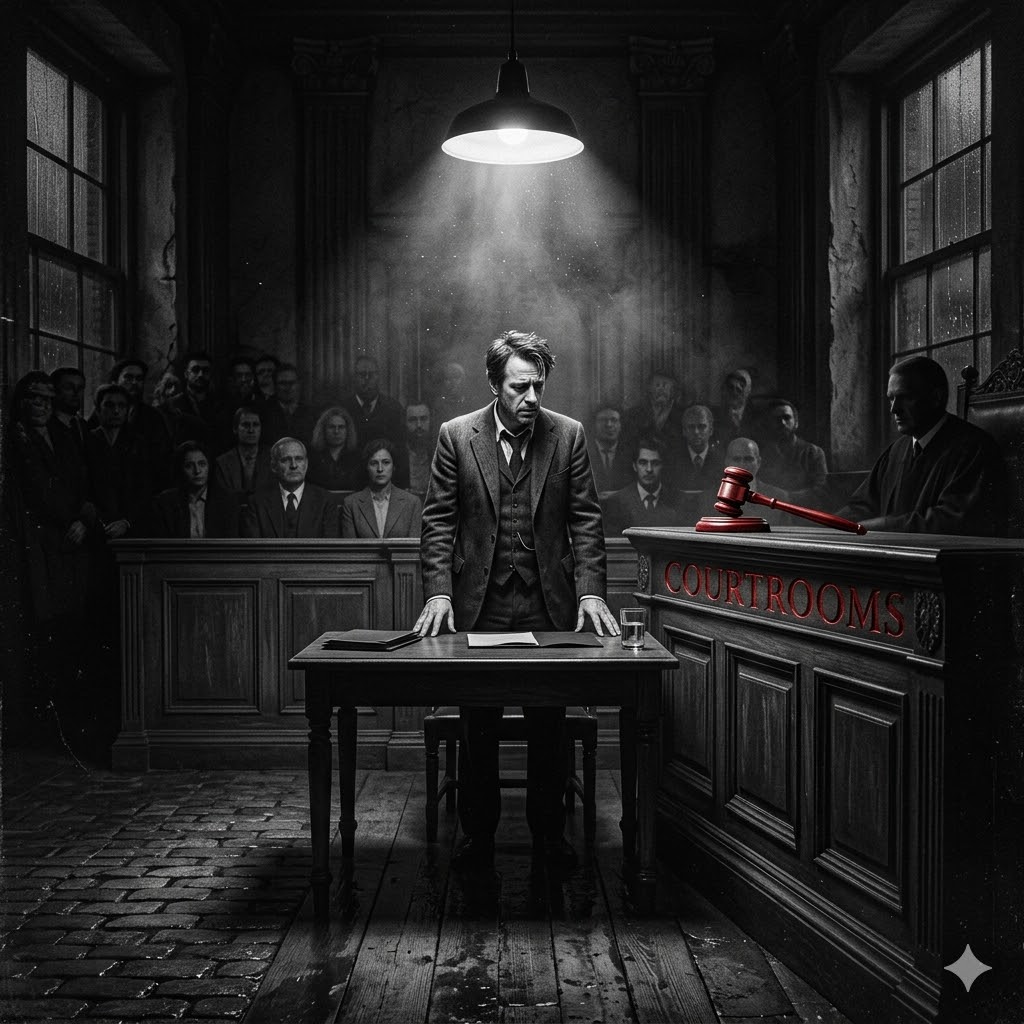
10 Courtrooms Noir Films:
Anatomy of a Murder
A small-town Michigan lawyer defends an army lieutenant who killed a man he claims raped his wife, in a landmark legal drama that treats the courtroom as a battleground of competing performances. James Stewart delivers one of the finest courtroom performances in cinema history.
Beyond a Reasonable Doubt
A novelist plants circumstantial evidence implicating himself in a murder to expose the weakness of the legal system, only for the real truth to emerge in a devastating reversal. Fritz Lang’s final American film is a cold and cynical meditation on guilt and the failure of justice.
Witness for the Prosecution
An aging barrister takes the case of a man accused of murder, only to be devastated by the testimony of his client’s wife in a courtroom battle of extraordinary cunning. Based on Agatha Christie’s story, Wilder makes every scene crackle with the energy of withheld information.
Crossfire
The investigation of a soldier’s murder of a Jewish man in a Washington hotel becomes a razor-sharp indictment of anti-Semitism in postwar America. Robert Young and Robert Ryan create one of the most morally focused confrontations in noir.
Call Northside 777
A Chicago newspaper reporter investigates the case of a man who has spent eleven years in prison for a cop killing he insists he did not commit. James Stewart is quietly heroic as the journalist who forces the justice system to confront its own errors.
I Want to Live!
The story of Barbara Graham, convicted of murder and executed in the gas chamber, told as a searing indictment of capital punishment and the sensationalist press. Susan Hayward won an Oscar for her ferocious portrayal of a woman destroyed by a system that had decided her guilt before the trial began.
The Accused
A psychology professor kills a student who attempts to assault her and then must navigate the investigation of his disappearance while keeping her guilt buried. Loretta Young’s performance as a woman trapped by a secret is unusually nuanced for a studio picture of this era.
Black Tuesday
A convicted murderer orchestrates a spectacular escape from death row and takes hostages in a desperate flight from justice. Edward G. Robinson plays this unrepentant killer with complete conviction and without a single gesture toward audience sympathy.
The Paradine Case
A brilliant London barrister becomes obsessed with the beautiful woman he is defending for murder, losing his objectivity and his marriage in pursuit of a client who despises him. Gregory Peck’s performance as a man destroyed by his own infatuation is a study in elegant self-destruction.
Boomerang!
A Connecticut state’s attorney refuses to prosecute a man for murder despite overwhelming political and public pressure because the evidence does not satisfy him. Kazan’s semi-documentary style grounds this civic thriller in a rare noir faith in institutional integrity.
 CLASSIC NOIR