Crime of Passion
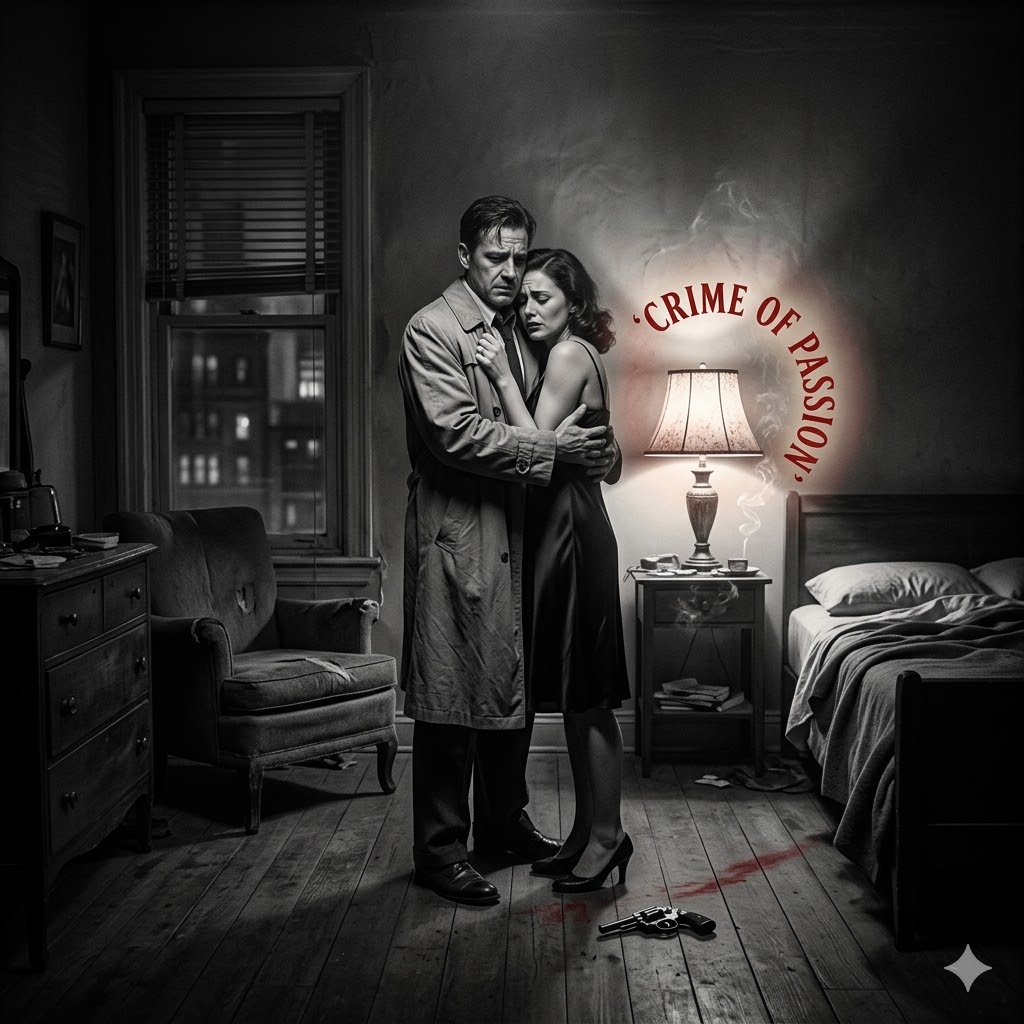
The crime of passion in film noir is rarely as spontaneous as the name suggests — it is usually the final payment on a long debt of frustrated desire, wounded pride, or intolerable loss. These films explore the frightening proximity of love and violence, showing how the same emotions that create intimacy can, when obstructed or betrayed, generate the capacity for murder. The noir protagonist who kills in passion rarely gains anything from it; the crime simply completes the tragedy that was already underway. In the noir universe, passion is not an exculpation — it is the very mechanism of doom.
10 Crime of Passion Noir Films:
Crime of Passion
A resourceful newspaper columnist marries a police detective and then, unable to bear the limits of their middle-class life, begins sleeping with his superior to further her husband’s career, ultimately murdering the man when he rejects her. Barbara Stanwyck brings unusual complexity to a role that critiques both domestic confinement and ruthless ambition.
Possessed
A mentally unstable nurse becomes dangerously obsessed with a man who rejects her love, leading to psychotic violence told through a series of stunning flashbacks. Joan Crawford earned an Oscar nomination for this harrowing portrait of a woman whose love has crossed into madness.
Sudden Fear
A wealthy playwright discovers her younger husband and his former lover are plotting to kill her for her inheritance, and she resolves to outmaneuver them. Joan Crawford’s fear and determination in the film’s second half create one of noir’s most gripping nail-biting sequences.
The File on Thelma Jordon
A married assistant district attorney falls for a mysterious woman who may be manipulating him to protect herself in a murder case she is actually guilty of. Barbara Stanwyck plays a femme fatale with unusual ambivalence about her own destructive power.
Niagara
A woman on honeymoon at Niagara Falls plots to murder her psychologically damaged husband with her lover, but the plan goes lethally wrong. Marilyn Monroe’s incandescent sexuality is deployed here in the service of noir’s coldest purposes.
Cause for Alarm!
A bedridden, paranoid husband accuses his wife and doctor of plotting to kill him and mails a letter to the DA before dying, leaving his terrified wife to try to intercept the letter before it triggers an investigation. Loretta Young carries the entire film’s suspense on her increasingly frantic attempts to outrun the mail.
Angel Face
An ambulance driver becomes fatally entangled with a beautiful woman whose patricidal obsession makes her one of noir’s most genuinely terrifying femme fatales. Jean Simmons’s glacial malevolence and Robert Mitchum’s helpless attraction create an extraordinary psychological portrait.
Human Desire
A train engineer is drawn into a murder plot by a railroad worker’s wife who used him as a weapon against her husband and then discards him when his usefulness ends. Fritz Lang’s remake of Renoir’s La Bête Humaine strips the original to its noir essence.
Drive a Crooked Road
A lonely mechanic and racing driver is targeted by a femme fatale whose gang needs his skills for a bank robbery, and who discards him once he has served his purpose. Mickey Rooney plays against type in a genuinely affecting portrait of a man destroyed by his own need for love.
Detour
A hitchhiking pianist is trapped by a series of fatal accidents and then by a hard-edged woman who turns his accidental complicity in a death into a lever for blackmail and worse. Made for almost no money, Detour achieves a bleak existential poetry unique in American cinema.
 CLASSIC NOIR