Detective Investigations
The private detective is film noir’s central consciousness — a man equipped with cynicism, intelligence, and a battered sense of honor who wades through a world of lies and violence in pursuit of something like truth. These investigators are defined by their moral independence from institutions; they operate outside the police department’s politics and beyond the law’s formal constraints, following cases wherever they lead. The detective noir follows a peculiar epistemological structure: the hero accumulates information while the viewer senses that every answer will only open onto deeper, more troubling questions.
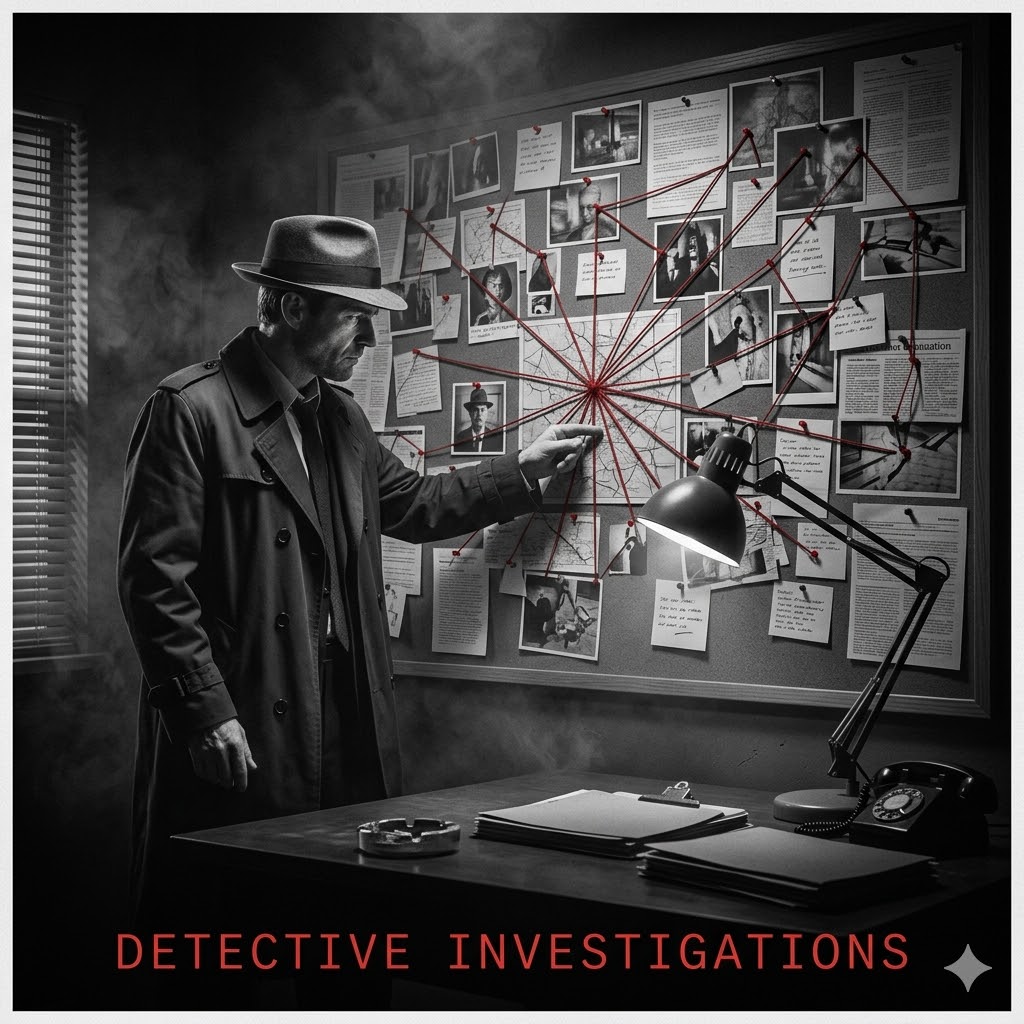
10 Detective Investigations Noir Films:
The Maltese Falcon
San Francisco private detective Sam Spade takes a case involving a mysterious woman and a jeweled statuette that attracts a gallery of memorable and deadly criminals. Humphrey Bogart’s laconic, self-sufficient performance established the definitive template for the hardboiled movie detective.
The Big Sleep
Philip Marlowe is hired by a rich general to handle his wayward daughter’s gambling debts and finds himself in a labyrinthine web of blackmail, pornography, and multiple murders that nobody — including the screenwriters — could completely untangle. Bogart and Bacall’s chemistry makes the film’s deliberate confusion irrelevant.
Murder, My Sweet
Philip Marlowe is hired by a massive ex-convict to find his missing girlfriend, and the search takes him into a conspiracy of wealth, murder, and a stolen jade necklace. Dick Powell’s transformation from musical comedian to laconic noir hero is one of the most successful reinventions in Hollywood history.
Laura
A police detective investigates the apparent murder of a beautiful advertising executive and falls under the spell of her portrait even before she reappears alive. The film is as much a study in obsession and the male gaze as it is a detective story.
Out of the Past
A former private eye’s past returns to destroy him when the gangster he once worked for forces him back into a case involving the lethal woman who betrayed him years earlier. Jacques Tourneur creates the most fatalistic, beautifully shot detective film in the noir canon.
In a Lonely Place
A Hollywood screenwriter becomes a suspect in a murder investigation while his neighbor, his alibi, develops a terrifying doubt about his innocence. Nicholas Ray inverts the detective formula so that the investigation becomes a vehicle for exploring the terror of not knowing the person you love.
Lady in the Lake
Philip Marlowe investigates the disappearance of a publisher’s wife in a film told entirely from the detective’s point of view through an unbroken first-person camera. Robert Montgomery’s formal experiment forces the audience to inhabit the detective’s perspective with unusual intimacy.
The Dark Corner
A private detective who has just left prison to start over finds himself framed for murder by an enemy whose identity he cannot uncover. Mark Stevens is solid, but it is the elegant villain played by Clifton Webb and the luminous Lucille Ball as the detective’s loyal secretary that make this film memorable.
The Brasher Doubloon
Philip Marlowe is hired to recover a valuable gold coin and finds himself in a world of forgery, blackmail, and murder in one of Chandler’s more complex narrative puzzles. George Montgomery makes a capable Marlowe in a film with unusually authentic period atmosphere.
Kiss Me Deadly
Brutal private eye Mike Hammer picks up a hitchhiker who is soon murdered, and his investigation of her death leads to a mysterious glowing box with apocalyptic implications. Robert Aldrich uses the detective form to create a nuclear-age nightmare that explodes the genre from within.
 CLASSIC NOIR