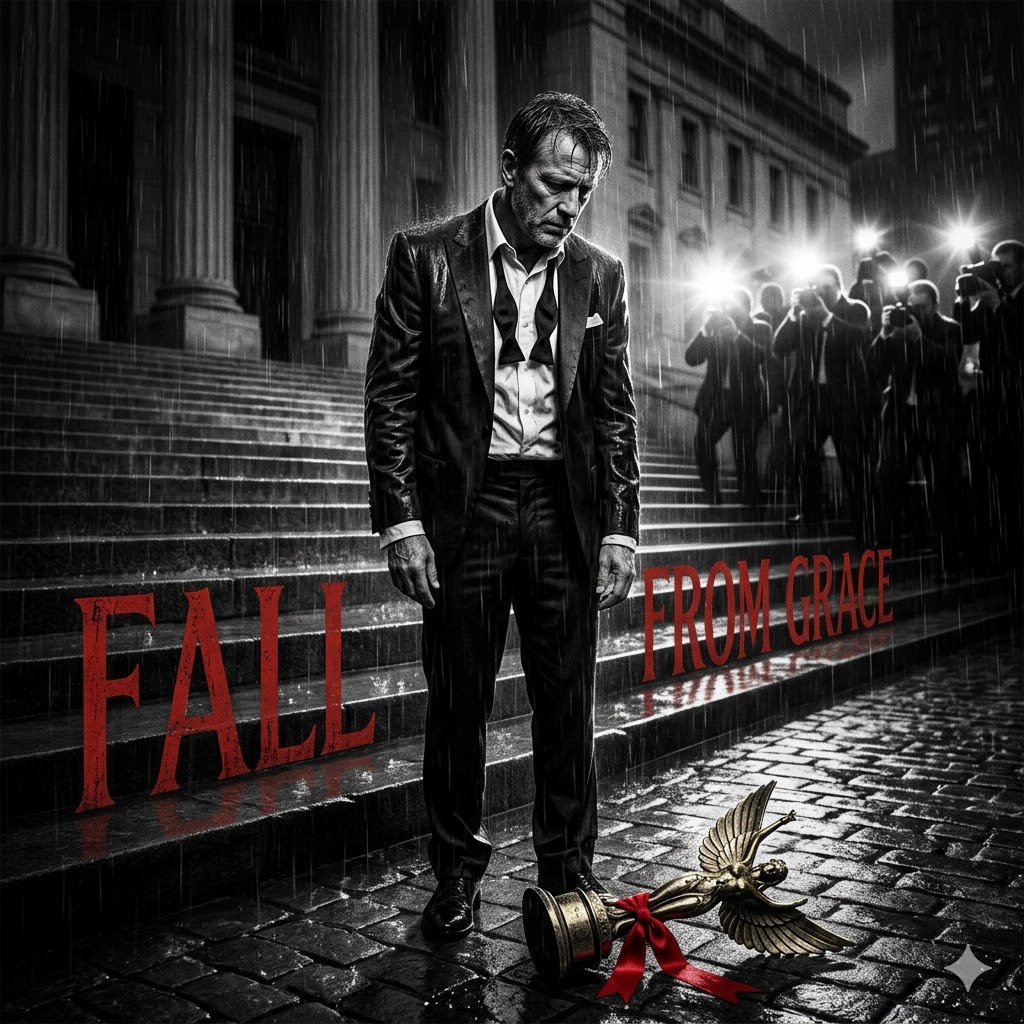
Fall from Grace
Film noir is fundamentally Protestant in its moral economy: the fall from grace is inevitable for those who have risen higher than their virtues can sustain. The ‘fallen’ figure in noir is often a man of genuine talent or distinction who, at the moment of his greatest vulnerability, makes the fatal choice that destroys everything he has built. Unlike tragedy, noir offers no catharsis — the fall is not ennobling but merely terminal, proof that the world is indifferent to individual worth. These films mark the distance between who a man intended to be and who the world’s pressures have made him.
10 Fall from Grace Noir Films:
Sunset Boulevard
A talented but desperate screenwriter trades his future for the illusory security of a faded star’s household, discovering too late that he has sold himself into a gilded captivity. William Holden makes Joe Gillis’s self-awareness about his own corruption one of the film’s most painful elements.
Ace in the Hole
A once-promising journalist fallen to the bottom of a small New Mexico newspaper exploits a man’s entombment to resurrect his own career, only to discover that his venality has a cost. Billy Wilder’s most savage film is a study in the complete abdication of professional ethics.
Nightmare Alley
An opportunist who has traded on the credulity of others in successively more elevated venues finally loses everything in a downward arc that returns him to the lowest rung of carnival life. The film’s final image is one of the most desolate in American cinema.
Sweet Smell of Success
A small-time press agent corrupts himself utterly in his desperate attempts to maintain his relationship with a powerful and sadistic newspaper columnist. Burt Lancaster and Tony Curtis define two species of moral failure — the man with power who uses it ruthlessly and the man without it who will do anything to get it.
The Harder They Fall
A sports journalist who knows boxing is fixed allows himself to be hired as a publicist for a fraud, telling himself he needs the money until he can no longer deny his complicity. Bogart’s final performance is perhaps his most morally honest, a portrait of a man who watched himself fall and did nothing.
The Big Knife
A Hollywood star who has achieved everything he dreamed of discovers that success has been purchased at the cost of his soul, held hostage by a studio system that owns him. Jack Palance gives a rawly exposed performance as a man who cannot find any exit from his golden cage.
In a Lonely Place
A screenwriter whose genuine talent has been corrupted by years of Hollywood compromise and violent temperament is offered one last chance at redemption by a woman’s love, which his own self-destructive behavior makes impossible to accept. Bogart is heartbreaking in the role.
Caught
A young woman who marries a millionaire for status discovers that wealth and cruelty are inseparable, and that her fall from dreams of glamour into a gilded nightmare is complete. Robert Ryan plays the megalomaniac husband as a study in the pathology of unchecked power.
All the King’s Men
A Louisiana farm boy with genuine convictions becomes a demagogic political boss whose rise to power corrupts everything he originally stood for. Broderick Crawford won an Oscar for this savage portrait of a man whose idealism is eaten alive by his appetite for power.
The Prowler
A corrupt policeman murders a woman’s husband and then marries her for her money, executing the perfect crime except for one thing he cannot control. Van Heflin’s methodical, cold-blooded murderer is a devastating portrait of American materialism taken to its murderous logical conclusion.
 CLASSIC NOIR