Foreign Film Noir
Film noir was never purely an American phenomenon — it was a sensibility that found resonance in European cinema from the moment French critics gave it a name. French poetic realism of the 1930s was one of noir’s most important ancestors, and postwar filmmakers in France, Britain, and Italy developed their own national variations on the genre’s essential themes of fatalism, moral compromise, and urban darkness. These foreign films share noir’s existential core while inflecting it with their own cultural anxieties, creating works that expand the genre’s reach far beyond Hollywood.
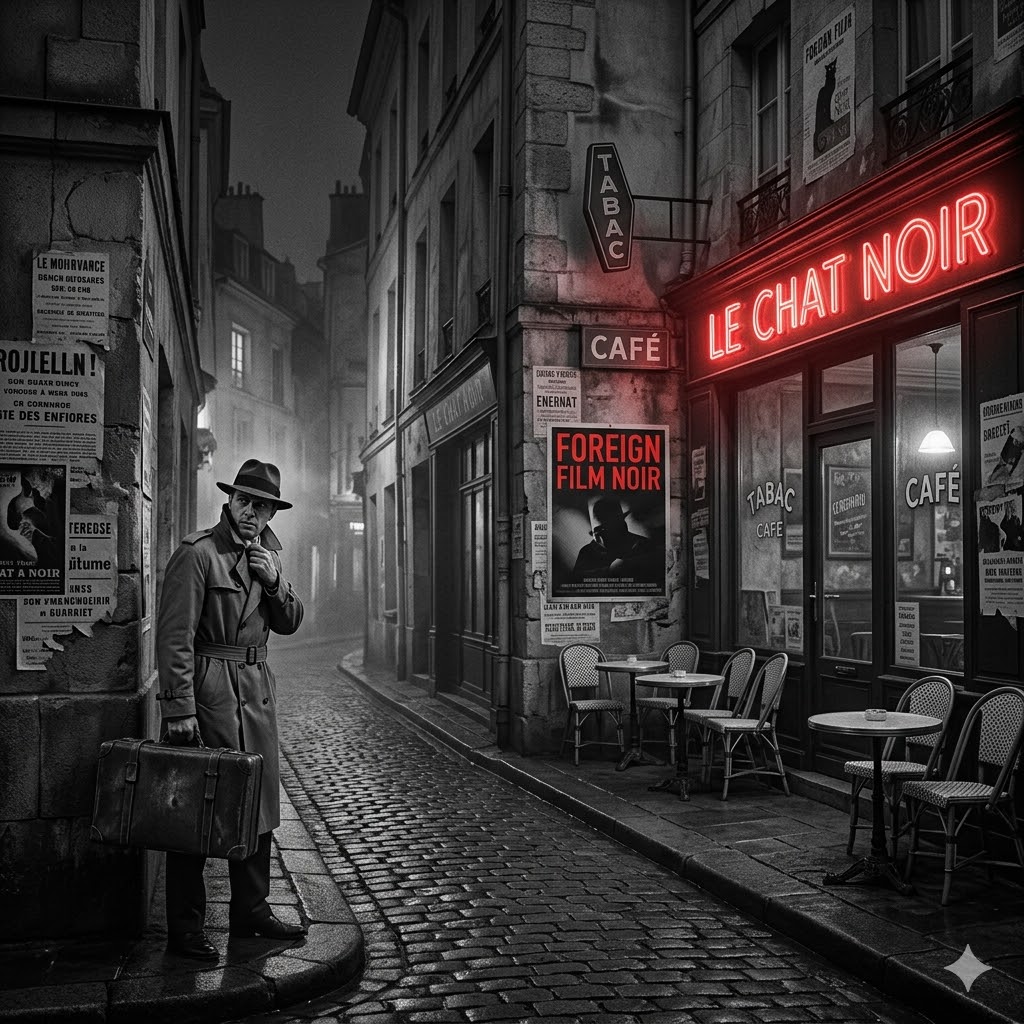
10 Foreign Film Noir Noir Films:
The Third Man
A pulp novelist arrives in postwar Vienna to join a friend and discovers the friend has been murdered, then becomes entangled in a black-market penicillin conspiracy. Carol Reed’s use of Vienna’s bombed ruins and Anton Karas’s zither score create the most distinctive atmosphere in all of noir.
Les Diaboliques
A sadistic schoolmaster’s wife and mistress conspire to murder him, only for the dead man’s apparent resurrection to drive one of them toward madness. Clouzot’s film is perhaps the most perfectly constructed thriller of the decade, and its final revelation remains one of cinema’s most shocking.
Rififi
Four men pull off an audacious Parisian jewel robbery in a nearly wordless 30-minute sequence that has never been surpassed as a study in sustained cinematic suspense. The American director Jules Dassin, working in exile during the McCarthy era, made the definitive European heist film.
Brighton Rock
A teenage gang leader in a seaside resort murders a journalist and then marries a naive waitress to prevent her from testifying, but his guilt is manifest in every frame. Richard Attenborough’s Pinkie is one of the most frightening criminal portraits in British cinema.
Odd Man Out
A wounded IRA commander staggers through the night streets of Belfast after a botched robbery, as the city closes in on him in this masterpiece of atmosphere and moral ambiguity. James Mason’s increasingly desperate and hallucinating fugitive is one of cinema’s most haunting performances.
Quai des Orfèvres
A music-hall singer, her jealous husband, and her manipulative manager become entangled in the murder of a wealthy lecher, investigated by a world-weary Paris detective. Clouzot’s prewar cynicism perfectly suits this dark comedy of human weakness.
The Blue Lamp
The shooting of a London beat policeman by a young thug triggers a citywide manhunt in which the criminal underworld cooperates with the police to bring the killer to justice. This foundational British crime film gave birth to the long-running television series Dixon of Dock Green.
Ascenseur pour l’échafaud
A man who has committed the perfect murder of his boss is trapped in an elevator through the night while his accomplice and victim’s wife are both simultaneously imprisoned and endangered by his mistake. Miles Davis’s improvised trumpet score creates one of cinema’s most memorably desolate soundscapes.
Night and the City
An American hustler in London stakes everything on a scheme to become a wrestling promoter, only to be crushed by the criminal power brokers he has attempted to circumvent. Richard Widmark’s performance as Harry Fabian is the most complete portrait of desperate ambition in all of noir.
Le Salaire de la Peur
Four desperate men stranded in a South American town accept a suicidal contract to drive trucks loaded with nitroglycerin over treacherous mountain roads for an American oil company. Clouzot turns the long, grinding journey into a sustained examination of the way that economic desperation reduces men to instruments.
 CLASSIC NOIR