Isolated Motels
The roadside motel is America’s most noir institution — a place specifically designed to conceal identity, facilitate anonymous encounters, and provide a geography for people whose purposes cannot withstand scrutiny. These establishments sit along the highways connecting one world to another, populated by travelers running from something or to something, and by proprietors who have seen too much to be surprised. The isolated motel in noir is both refuge and trap: a place that seems to offer safety from the world outside while actually concentrating the world’s darkest possibilities into a single strip of parking spaces.
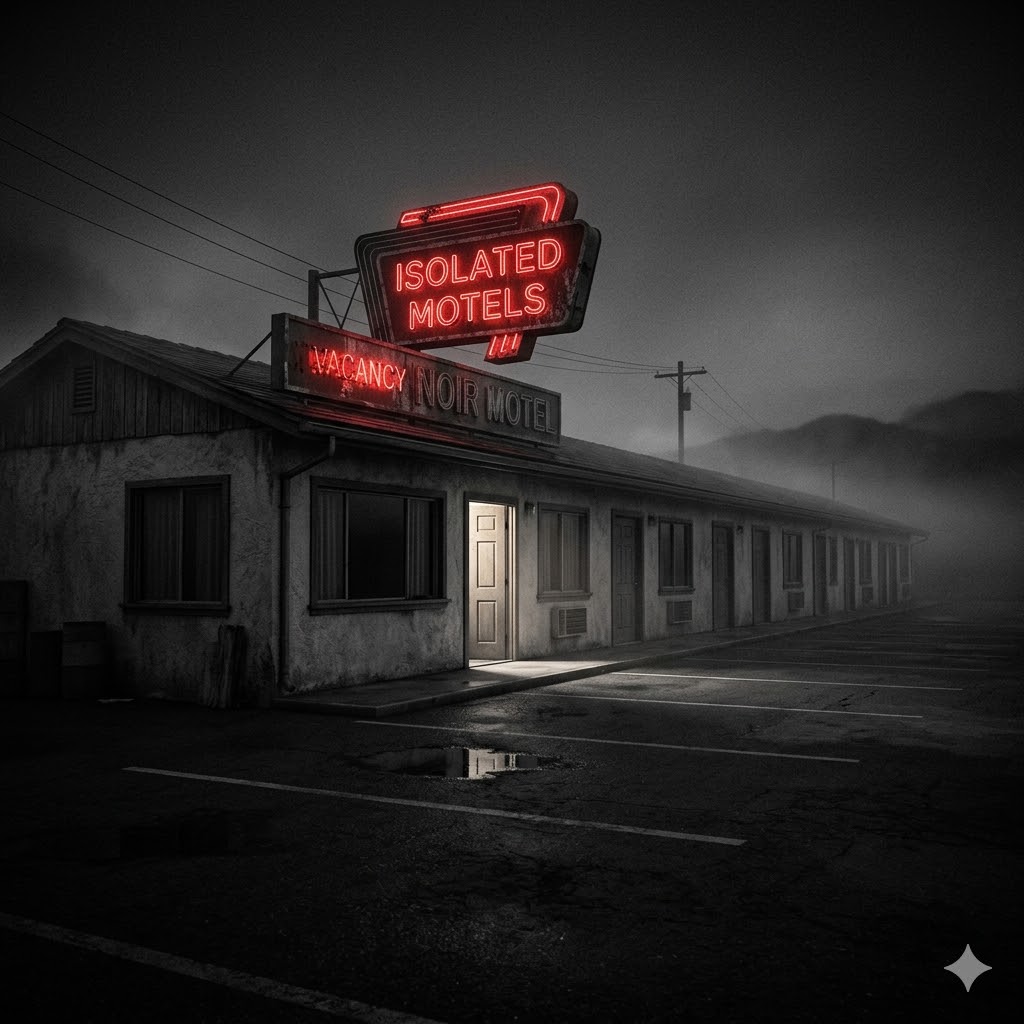
10 Isolated Motels Noir Films:
Touch of Evil
Much of Janet Leigh’s storyline unfolds in a nearly deserted roadside motel that quickly turns from refuge into trap. The motel’s empty corridors, absent staff, and encroaching gang members intensify her vulnerability, cutting her off from help despite being just off a busy border road. This setting crystallizes a core noir fear: that seemingly mundane American spaces can conceal predatory forces waiting just out of sight.
Detour
A hitchhiker’s highway journey is punctuated by fatally consequential stops at roadside establishments where his luck consistently turns for the worse. The film’s cheap motels and diners are given an expressionist atmosphere that makes every stopping point feel like another step toward doom.
The Hitch-Hiker
Two men on a fishing trip pick up a hitchhiker who holds them at gunpoint as his hostages on a cross-country journey through remote desert motels and gas stations. Lupino strips the thriller to pure survival mechanics, eliminating every comfort the genre usually offers.
The Postman Always Rings Twice
A drifter stops at a roadside café and is snared by the proprietor’s wife, setting the murder plot in motion in a landscape of dust, desire, and limited options. The café-as-motel is the perfect noir setting — a place that promises sustenance while extracting the highest possible price.
Road House
A rural roadhouse fifteen miles from Canada becomes the setting for a noir triangle of desire, jealousy, and escalating violence when its owner falls for the torch singer he has hired. The film’s isolated setting amplifies every conflict to breaking point.
Fear in the Night
A bank teller who dreams that he has committed a murder in a mirrored room gradually discovers that his dream may be a memory. The film’s treatment of hypnosis and the permeable border between sleep and guilt anticipates the psychological complexity of later noir.
The Phenix City Story
A documentary-style account of the corruption and violence that made Phenix City, Alabama the most lawless town in America, told with a newsreel prologue featuring real residents. The town’s roadside joints and motels are rendered as the geography of organized moral collapse.
Private Hell 36
Two detectives investigating a robbery accidentally recover some of the stolen loot, and one of them decides to keep it, beginning a spiral of corruption that involves a nightclub singer and a motel hideout. Ida Lupino co-wrote the screenplay and stars alongside Steve Cochran and Howard Duff.
Gun Crazy
A gun-obsessed young man and his sharpshooter girlfriend conduct a bank-robbing spree that moves from city to city, using cheap motels as their temporary bases between jobs. The film’s peripatetic landscape of American roadside transience is perfectly suited to its story of people who belong nowhere.
Thunder Road
A Korean War veteran runs moonshine through the mountains of Tennessee against both the federal government and a syndicate trying to take over the operation, in a film that mythologizes the outlaw against institutional power. Robert Mitchum produced, starred in, and co-wrote the story for this stripped-down noir.
 CLASSIC NOIR