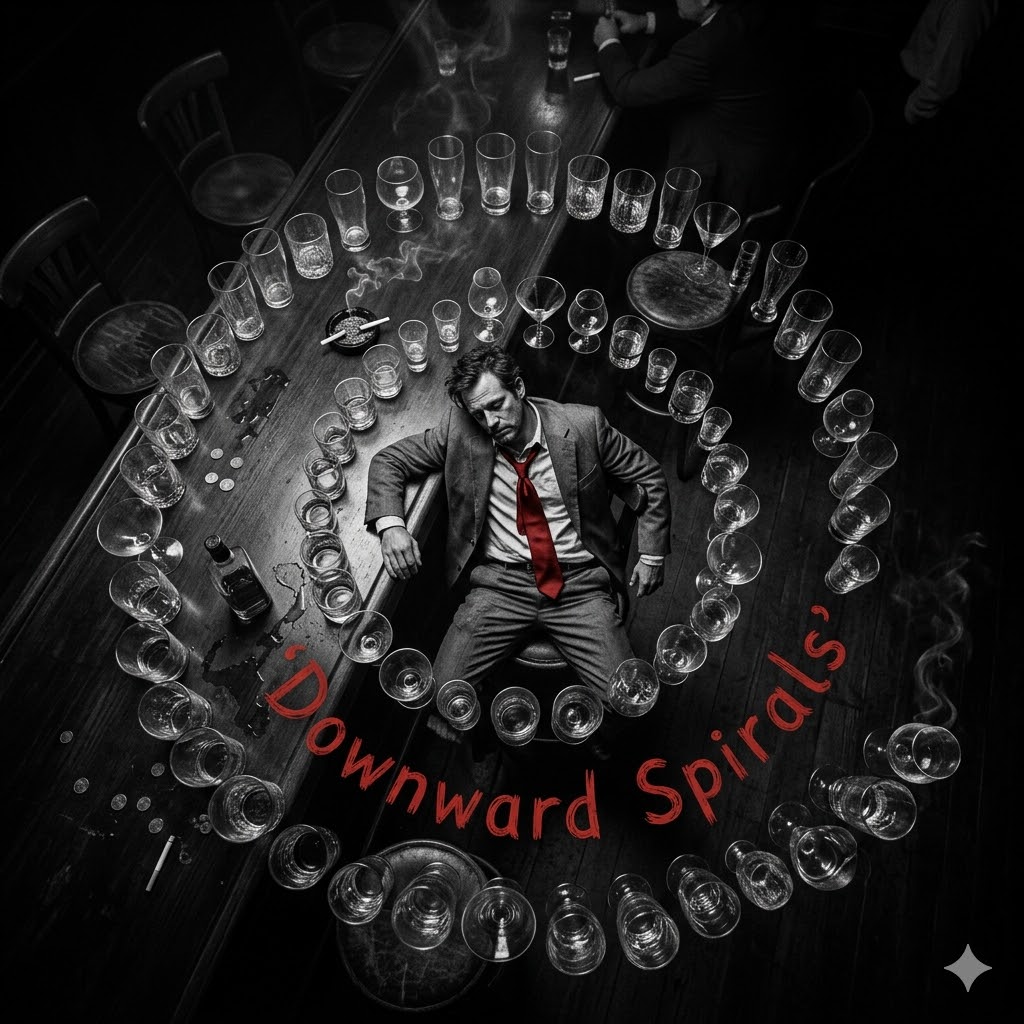
Downward Spirals
Descent is the defining motion of film noir — the inexorable drop from stability into chaos, from respectability into crime, from life into death. The downward spiral plot is the genre’s most honest structural metaphor: once a character makes the first compromise, each subsequent choice narrows the space for escape until none remains. These films are fascinated by the psychology of self-destruction and the way that ordinary people, given the right combination of pressure and temptation, will walk willingly toward their own ruin. The noir protagonist often seems to know he is falling but cannot or will not stop.
10 Downward Spirals Noir Films:
Detour
A pianist hitchhiking to California inadvertently causes a death and is then trapped by a ruthless woman who uses his guilt as a weapon, accelerating his fall through a series of increasingly desperate choices. Made for almost nothing, it achieves a compression and fatalism unique in American cinema.
Sunset Boulevard
A struggling screenwriter is seduced by the lavish household of a delusional former silent film star, trading his integrity for comfort until he cannot find his way back to his own life. Wilder’s portrait of Hollywood self-delusion is both savage and heartbreaking.
Ace in the Hole
A cynical, opportunistic reporter exploits a man trapped in a cave to revive his stalled career, turning a simple rescue into a media circus while his victim dies slowly underground. Kirk Douglas’s performance is one of the most uncompromising portraits of American moral bankruptcy ever filmed.
Nightmare Alley
An ambitious carnival barker rises from the freak show to the heights of phony spiritualism and society wealth before his compulsive deceptions lead him all the way back to the bottom. Tyrone Power’s arc from charming manipulator to broken geek is one of noir’s most complete and pitiless trajectories.
D.O.A.
A man reports his own murder to the police and then traces the steps that led to his poisoning in a 24-hour countdown to his own death. Edmond O’Brien’s frantic performance perfectly captures the panic of a man racing to solve his own murder before his body catches up with his knowledge.
Body and Soul
A tough kid from the Lower East Side rises to become boxing champion, then sells his title to gangsters before attempting a last-minute act of integrity. John Garfield gives one of the great athletic and moral performances of his career, and James Wong Howe’s camera work in the fight sequences is revolutionary.
The Lost Weekend
An alcoholic writer spends four days in a catastrophic binge while his patient girlfriend and loyal brother try to rescue him from himself. Ray Milland won an Oscar for this unflinching portrait of addiction that made Hollywood’s censors deeply uncomfortable.
Force of Evil
A mob lawyer working to consolidate the numbers racket under a single powerful boss discovers his older brother is one of the small operators being crushed by the scheme. Polonsky’s poetic, rhythmic dialogue and John Garfield’s tortured performance make this one of the most intellectually serious films in the cycle.
The Big Knife
A major Hollywood star finds himself trapped in a contract by a studio boss who holds evidence of a manslaughter cover-up over his head. Jack Palance’s physical and psychological breakdown is extraordinary, and Robert Aldrich keeps Clifford Odets’s stage-play origins from slowing the film’s accumulating dread.
Pitfall
A comfortable insurance man’s affair with a model draws him into the orbit of a psychotic private detective and a dangerous ex-convict. Dick Powell’s decent man making one wrong choice after another traces the classic noir arc of petit bourgeois destruction.
 CLASSIC NOIR