He understood that music does not accompany a scene, it completes it. What you see on screen is only half the film.
Bernard Herrmann is the great unacknowledged co-author of the films we call noir. His name appears at the end of the credits, after the picture has finished, and yet without what he contributed, the nervous strings, the theremin's unearthly moan, the brass that announces catastrophe before the image has time to, the films would be fundamentally different objects. He did not illustrate what was on screen. He completed it.
Herrmann came to film from radio and the concert hall, he had been the chief conductor of the CBS Symphony Orchestra and had written an opera before Orson Welles recruited him for Citizen Kane in 1941. The training showed. Where most Hollywood composers worked in the lush, sweeping tradition of the Romantic orchestral score, Herrmann thought in smaller, more precise units: a repeating two-note motif, a chord held just past the point of comfort, an instrumentation chosen for its psychological effect rather than its beauty.
His nine-film collaboration with Alfred Hitchcock produced the most celebrated music in thriller history, Psycho's shrieking strings, Vertigo's spiraling obsession, the cool menace of North by Northwest. But his noir work extended well beyond Hitchcock: The Ghost and Mrs. Muir, On Dangerous Ground, Taxi Driver. He understood the genre from the inside. The music he wrote for it does not describe noir, it enacts it.
He died on Christmas Eve, 1975, hours after completing the recording sessions for Taxi Driver, his last score, and one of his greatest. Martin Scorsese had asked him to write something that sounded like the city at 3am, and he had. He was sixty-four.
Herrmann's compositional vocabulary was specific and deliberate. He returned to the same techniques across decades not from laziness but because they worked, because they produced, with precision, the psychological states that noir demands. Understanding his toolkit is understanding how film music can be a moral instrument.
Herrmann habitually divided his string section into far more parts than convention allowed, 8 solo violins, 4 violas, 4 cellos, creating a dense, suffocating texture. The effect is of sound closing in from all sides. There is no space to breathe inside a Herrmann string passage.
Psycho · Vertigo · MarnieThe theremin, played without touch, its pitch controlled by proximity of the performer's hands to an antenna, produces a sound that the human ear registers as simultaneously human and inhuman. In Spellbound and other psychological noirs, it externalizes the sound of a mind coming apart.
Spellbound · The Day the Earth Stood StillThe saxophone is the instrument of the city at night, jazz-adjacent, slightly seedy, capable of extraordinary tenderness and equally extraordinary desolation. Herrmann deployed it for moments of urban solitude, when his protagonist is most isolated from the world around them.
Taxi Driver · On Dangerous GroundTrombones and tubas held at the very bottom of their range, sustained past the point where the sound begins to fray, this is Herrmann's signature announcement that something irrevocable is about to happen. Not a fanfare but a warning that arrives too late to be useful.
Citizen Kane · The Wrong ManHerrmann's scores are built from motifs that repeat with slight variation, a two-note figure, a harmonic progression, that accumulates psychological pressure the way a recurring thought does. The listener feels, before understanding why, that the music is going in circles that have no exit.
Vertigo · Psycho · Cape FearWestern music is built on the expectation of harmonic resolution, tension followed by release. Herrmann withholds resolution with surgical precision, leaving chords hanging in the air past the point of comfort. The listener's nervous system responds before the conscious mind catches up.
Vertigo · North by Northwest · MarnieThese are not the most famous moments in Herrmann's career, they are the most instructive ones. Each demonstrates a specific technique and shows how music can do something that image and dialogue cannot: externalize an interior state with complete precision.
The credit sequence begins with a woman's eye, then a spiraling geometric animation that suggests both a vortex and a dream. Herrmann's music enters simultaneously, a rising, obsessive string figure that spirals upward without resolution, mirroring the visual but also contradicting it: the image spirals in, the music spirals up. Together they produce vertigo itself. You feel dizzy before the film has begun.
Technique: Unresolved Ascending Motif
Hitchcock originally planned the shower scene without music, he wanted it to feel documentary, clinical. Herrmann recorded his strings cue and played it to Hitchcock. The director immediately changed his mind. The shrieking violins don't describe the stabbing, they are the stabbing, translated into pure sensation. The music makes the scene unwatchable in the best possible way.
Technique: Divided Strings – Extended Technique
Herrmann's final score, and perhaps his most personal. Scorsese asked for music that sounded like New York at its most abandoned hour. Herrmann wrote a theme that combines the urban saxophone with the obsessive string writing of his Hitchcock years, solitude and menace in equal measure. It was the last thing he recorded. He died that night. The score is a farewell from someone who understood darkness intimately.
Technique: Solo Saxophone over Sustained Strings
Nicholas Ray's film has two entirely different atmospheres, the brutal city, the redemptive countryside, and Herrmann wrote two entirely different scores for them, in contrasting orchestral colors. The city sequences use angular, violent brass and percussion that express Jim Wilson's self-loathing rage. The countryside sequences soften into strings. The music is the character's psychology, audible.
Technique: Dual Orchestral Palette| Year | Film | Director | Key Instrument | |
|---|---|---|---|---|
| 1941 | Citizen Kane | Orson Welles | Full orchestra – modernist | Essential |
| 1945 | Spellbound | Alfred Hitchcock | Theremin + strings | Essential |
| 1947 | The Ghost and Mrs. Muir | Joseph L. Mankiewicz | Strings – lush, romantic | Notable |
| 1951 | On Dangerous Ground | Nicholas Ray | Dual palette – brass / strings | Essential |
| 1956 | The Wrong Man | Alfred Hitchcock | Jazz – solo bass clarinet | Notable |
| 1958 | Vertigo | Alfred Hitchcock | Unresolved string motif | Essential |
| 1959 | North by Northwest | Alfred Hitchcock | Full orchestra – kinetic | Essential |
| 1960 | Psycho | Alfred Hitchcock | Strings only – divided | Essential |
| 1962 | Cape Fear | J. Lee Thompson | Low brass – sustained menace | Essential |
| 1976 | Taxi Driver | Martin Scorsese | Solo saxophone + strings | Essential |
Herrmann was the greatest composer to work in noir, but he was not the only one. The genre's sonic identity was built by several hands, each bringing a different sensibility to the same moral universe. Together they created a sound that audiences now hear in their heads when they think of a rain-slicked street and a hat pulled low.
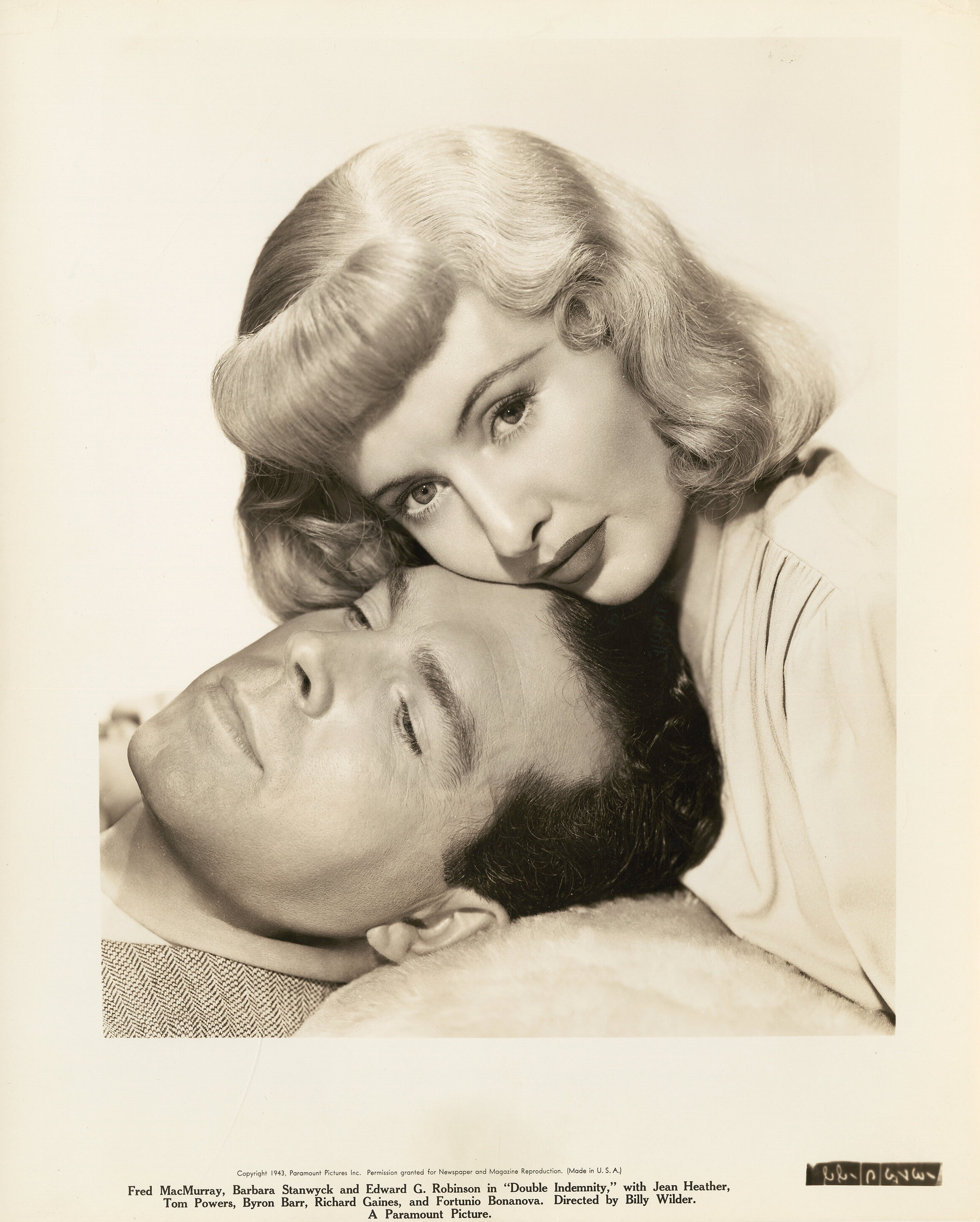
Hungarian-born Rózsa brought a late-Romantic European sensibility to Hollywood noir. His scores for Spellbound (before Herrmann), Double Indemnity, and The Killers established the theremin as noir's signature instrument. More lush than Herrmann, more overtly emotional, but equally precise about psychological states. His Spellbound theme is one of the most recognizable in film history.
Double Indemnity · Spellbound · The Killers · The Asphalt JungleGerman émigré whose score for Sunset Boulevard is arguably the finest in noir history, a decaying grandeur that mirrors Norma Desmond perfectly. Waxman worked at the emotional surface rather than the psychological depth, which made him the ideal composer for noir's operatic strain. His music never undercuts the drama; it doubles it.
Sunset Boulevard · Rear Window · Sorry, Wrong NumberRaksin wrote one theme, the Laura theme, that became so associated with a single film that it overshadowed a distinguished career. The melody is the musical equivalent of the portrait at the center of Preminger's film: beautiful, hypnotic, and slightly wrong. It sounds like love but functions like obsession. Nothing else he wrote touched it, and he knew it.
Laura · Force of Evil · The Bad and the BeautifulWilliams studied the Herrmann technique and translated it into the blockbuster era. The Jaws theme, two notes, repeating, tightening, is pure Herrmann. The obsessive motif structure of many Williams scores owes everything to what Herrmann demonstrated was possible.
Morricone arrived at similar conclusions from a different direction, the Italian tradition plus Spaghetti Western experimentation. His use of unusual timbres and obsessive repetition mirrors Herrmann's, though the two composers never directly influenced each other.
The Radiohead guitarist turned film composer is the most direct contemporary descendant of Herrmann's approach. There Will Be Blood, The Master, and Phantom Thread all use divided strings and harmonic suspension to create psychological pressure. Greenwood has cited Herrmann explicitly.
Shore's work for David Cronenberg, Videodrome, Naked Lunch, A History of Violence, draws directly on Herrmann's understanding that music can externalize psychological states that no image can fully represent. The instruments chosen, the sustained dissonance, all Herrmann.
Born June 29 in Manhattan to Russian Jewish immigrant parents. A precocious musical talent, wins a composition prize at thirteen, studies at New York University and Juilliard. The city's nervous energy will saturate everything he writes.
Joins CBS Radio as a conductor and composer. The radio years are crucial, he learns to create atmosphere and tension without visual support, a discipline that will define his film work. He meets Orson Welles through CBS.
Welles recruits him for his debut feature. Herrmann's score is unlike anything Hollywood has heard, modernist, psychologically precise, built from motifs rather than melodies. It establishes immediately that he will not do what is expected of him.
First collaboration with Alfred Hitchcock. The partnership will produce nine films over eleven years, the most celebrated composer-director relationship in cinema history. Hitchcock understood that Herrmann's music was doing something irreplaceable and gave him complete freedom.
The score that defines his career. The spiraling, unresolved string writing matches and amplifies the film's central obsession, a man falling in love with a woman who doesn't exist. The Academy passed it over for the Oscar. The Academy was wrong.
Hitchcock wanted silence. Herrmann recorded the strings-only cue and played it. Hitchcock changed his mind. The shrieking violins become the most famous 45 seconds in film music history. The score wins no Oscar. The Academy is, again, wrong.
Hitchcock fires Herrmann from Torn Curtain after hearing the score, the director wanted something more commercial, more contemporary. It is the bitterest professional blow of Herrmann's life. He moves to London and enters a period of diminished output.
Martin Scorsese recruits him for Taxi Driver. Herrmann writes what many consider his finest score, the saxophone theme for Travis Bickle's nocturnal New York. He completes the final recording session on December 23. Dies in his sleep Christmas Eve, hours after finishing the work.