When a young intern is found dead at Bellevue Hospital in New York City – an apparent suicide that does not quite add up – the police plant undercover detective Fred Rowan (Richard Conte) among the hospital staff to investigate. Posing as an intern, Rowan enters a closed world of exhausted residents, demanding surgeons, and the particular moral pressures that institutional life places on its inhabitants. His contact on the inside is 'Pop' Ware (Richard Taber), an aging elevator operator who feeds him information from the margins of the building's daily life.
Rowan's investigation draws him toward Dr. Steve Anderson (Alex Nicol), a gifted but compromised young physician whose gambling debts have made him vulnerable to a loan-sharking operation running through the hospital itself. Rowan also becomes entangled with two women: the compassionate nurse Kathy Hall (Peggy Dow) and Ann Sebastian (Coleen Gray), whose connection to the dead intern complicates the case in ways that test Rowan's professional detachment. Inspector Gordon (John Alexander) oversees the operation from a careful distance, aware that the deeper Rowan goes, the harder it becomes to extract him cleanly.
Sleeping City belongs to the semi-documentary noir cycle of the late 1940s and early 1950s, a mode that used authentic locations and procedural detail to lend institutional weight to stories about corruption and moral erosion from within. Shot largely on location at Bellevue, the film treats the hospital not as backdrop but as a system – one with its own hierarchies, dependencies, and points of failure – and uses that system to ask what ordinary desperation looks like when it is given a uniform and a professional obligation.
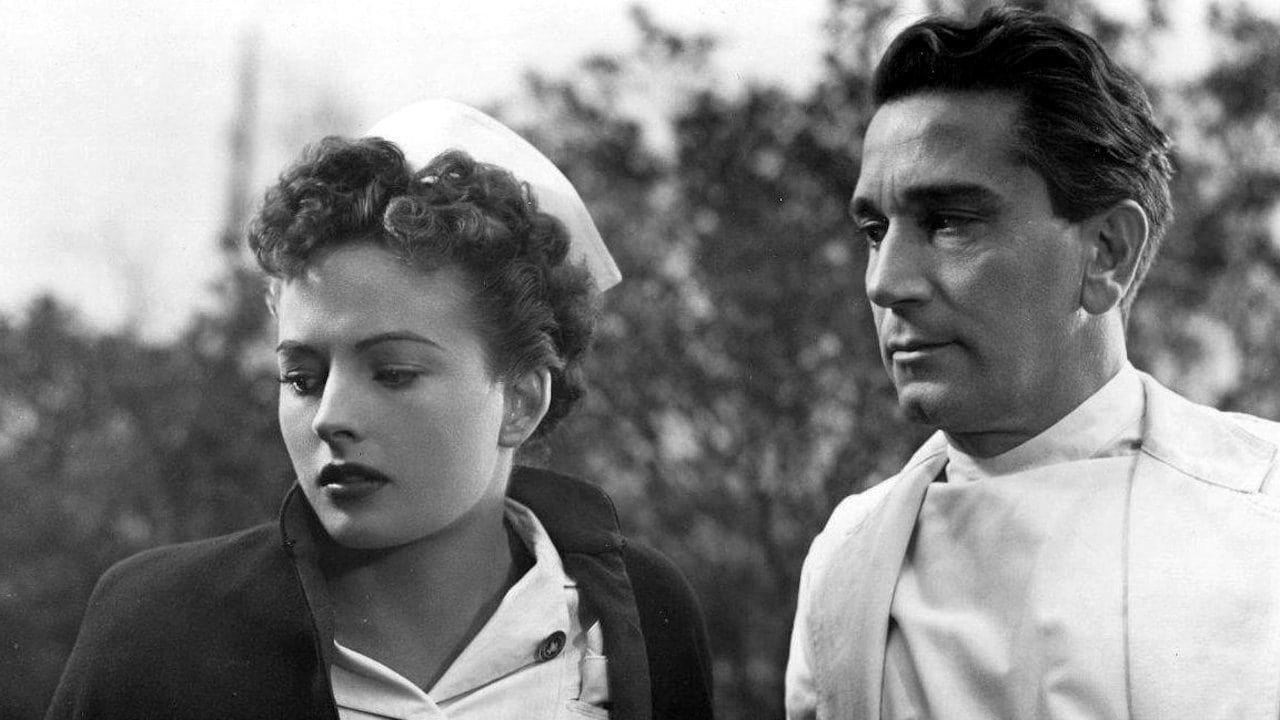
Sleeping City arrives at a precise moment in American noir when the semi-documentary form – pioneered by films like Call Northside 777 and Boomerang! – had become a viable mode for exploring institutional rot without the stylized fatalism of earlier noir. George Sherman, not a director associated with the genre's more expressionist tendencies, keeps the film grounded and procedural, which turns out to be exactly the right choice. The hospital setting does genuine conceptual work: Bellevue is a place where life and death are managed, where debt and duty coexist, and where the machinery of care can be turned toward exploitation. Richard Conte brings his characteristic quality of watchful tiredness to Rowan, a man whose undercover role requires him to be simultaneously present and absent. The film does not resolve its moral tensions so much as absorb them into the institution, and that refusal of clean catharsis is its most honest quality. As a document of postwar anxiety about the corruption of professional life, it rewards close attention.
– Classic Noir
William Miller frames the corridor in a long, slightly overhead shot that compresses the hallway's depth, making the fluorescent wash of the nurses' station appear as a single cold island in a surrounding darkness. The camera holds at a remove that refuses intimacy, and the light falls hard and institutional – there is no warmth in it, no shadow that suggests mystery so much as absence. As Rowan moves through the frame, Miller keeps him slightly off-center, the geometry of the corridor pulling the eye past him toward a door that remains closed.
The scene functions as a quiet argument about the nature of the undercover position: Rowan occupies the space without belonging to it, present in body but withheld in identity. The institutional light, which should render everything visible and accountable, instead exposes how much a man can hide in plain sight. It is the film's central moral image – surveillance and concealment occupying the same frame, neither resolving the other.
William Miller's cinematography on Sleeping City earns its authority through restraint rather than flourish. Shooting on location at Bellevue Hospital, Miller works with the building's existing geometry – long corridors, institutional overhead lighting, stairwells that compress perspective – and uses these architectural facts to make the film's moral argument visible. Where studio-bound noir of the period relied on constructed shadow and controlled chiaroscuro, Miller adapts to real spaces, using practical light sources and carefully placed fill to preserve the location's texture without sacrificing tonal contrast. His camera tends toward medium and wide shots that place characters within systems rather than isolating them in psychological close-up, a choice that reinforces the film's interest in institutional pressure over individual pathology. When he does move in close, the effect is measured – a face caught briefly in the light before the corridor swallows it again. The result is a visual language that treats the hospital as a noir environment on its own terms, without importing the genre's more theatrical conventions into a space that resists them.
Tubi has carried Sleeping City in a watchable transfer and remains the most accessible free option for most viewers in the United States.
Archive.orgFreeA public domain print is available through the Internet Archive, though transfer quality varies and should be verified before relying on it for critical viewing.
Amazon Prime VideoRentalA rental option is periodically available through Amazon's classic film partners and typically offers a cleaner transfer than public domain sources.