In the Upper Peninsula of Michigan, small-town lawyer Paul Biegler – a former district attorney more comfortable fishing than practicing – is pulled back into serious legal work when Army Lieutenant Frederick Manion is charged with murdering a local innkeeper. Manion claims the man raped his wife, Laura, and that he acted in a temporary state of irresistible impulse. Biegler, assisted by his alcoholic but sharp-minded colleague Parnell McCarthy and his unflappable secretary Maida Rutledge, agrees to take the case despite thin prospects and thinner pay.
As the trial unfolds, Biegler faces Claude Dancer, a formidably aggressive assistant attorney general brought in to shore up the prosecution. The case turns on contested evidence, manipulated testimony, and the shifting credibility of nearly every witness. Laura Manion's behavior before and after the alleged rape invites scrutiny the defense cannot fully suppress, and Manion himself is a cold, controlling presence who inspires little sympathy. Mary Pilant, the innkeeper's daughter, holds information that complicates both the prosecution's narrative and the jury's assumptions.
Anatomy of a Murder situates itself at the intersection of courtroom procedural and psychological noir, using the adversarial structure of a murder trial to excavate questions of guilt, complicity, and the uses of legal truth. The film offers no stable moral ground – every character's account is partial, every motive layered – placing it alongside the genre's most searching examinations of how institutions process violence without resolving it.
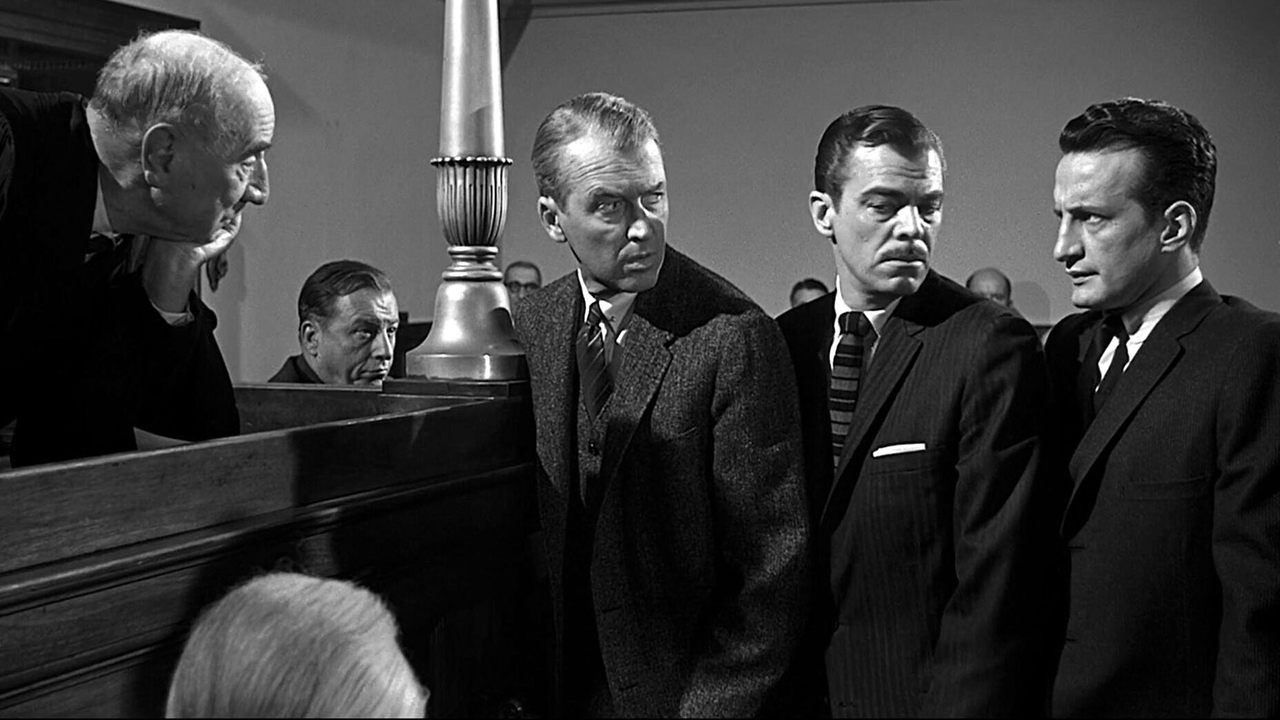
Anatomy of a Murder stands as one of the period's most rigorous courtroom films and one of the few to treat legal procedure not as dramatic scaffolding but as subject matter in itself. Preminger, working from Robert Traver's roman à clef, refuses to adjudicate between competing claims of innocence and predation; the film's achievement is that by the end, the verdict feels simultaneously correct and beside the point. James Stewart's Biegler is among the actor's most carefully calibrated performances – the folksy manner is real, but so is the professional cunning underneath it, and the film never sentimentalizes the distinction. George C. Scott's Dancer is a study in institutional aggression: righteous, sharp, and not wrong. What the film reveals about its era is a willingness – rare in Hollywood production – to hold the law and its practitioners in suspension, neither vindicated nor condemned, while the audience is left to manage the residue of ambiguity the trial was never designed to resolve.
– Classic Noir
Sam Leavitt's camera works in close registers during Dancer's cross-examination of Laura Manion, holding on faces longer than comfort allows. The courtroom is lit with a flat institutional brightness that drains shadow from the walls but pools it under eyes and along jawlines, so that every witness appears both fully exposed and somehow occluded. Leavitt does not move to close-up for emphasis alone; he arrives there as pressure accumulates, framing Laura in a medium shot that slowly tightens as Dancer's questions narrow, the frame itself enacting the logic of a trap closing.
The scene's argument is the film's argument: legal cross-examination is a form of controlled violence, and the woman at its center is simultaneously victim, suspect, and exhibit. Lee Remick holds Laura's composure with a surface that reads as calm only until the viewer begins to register what the camera is actually recording – calculation, or endurance, or something the film deliberately refuses to name. Whether Laura is truthful is a question the scene raises and declines to answer, which is precisely the point.
Sam Leavitt, shooting in black-and-white on location in Michigan's Upper Peninsula and in studio interiors, constructs a visual grammar built on institutional flatness punctuated by moments of compressed darkness. Leavitt resists the high-contrast expressionism associated with classic noir in favor of a more juridical light – even, unforgiving, difficult to hide within – that suits a film whose central arena is a public courtroom. His lens choices favor moderate focal lengths that preserve depth of field without distorting space, keeping multiple characters in sharp focus during exchanges where implication flows between faces. The rare low-key passages – Biegler's lakeside retreats, a late-night conversation with Parnell – function as relief from the courtroom's exposure rather than noir atmosphere for its own sake. Duke Ellington's score, recorded with the director's blessing as an on-screen presence rather than invisible underscore, gives the film an urban texture its rural setting would otherwise lack. Together, these choices produce a work that looks less like noir than it thinks like noir.
The Criterion Channel presents a clean transfer of the Columbia Pictures print; the most reliable streaming option for image quality and contextual programming.
TubiFreeTubi has carried the film in a serviceable public-domain-adjacent print; availability fluctuates and the transfer is inconsistent, but it is free and accessible.
Amazon Prime VideoRentalAvailable for digital rental in HD; a reasonable option when the Criterion Channel version is inaccessible.