Films People Pull a Fast One Night Beat Reading Room On TV Shop
In a Lonely Place 1950
1950 Santana Pictures Corporation
★★★★★ Essential
Film Noir · 93 minutes · Black & White

In a Lonely Place

Directed by Nicholas Ray
Year 1950
Runtime 93 min
Studio Santana Pictures Corporation
TMDB 7.6 / 10
"A man capable of murder lives next door – and she may already know it."

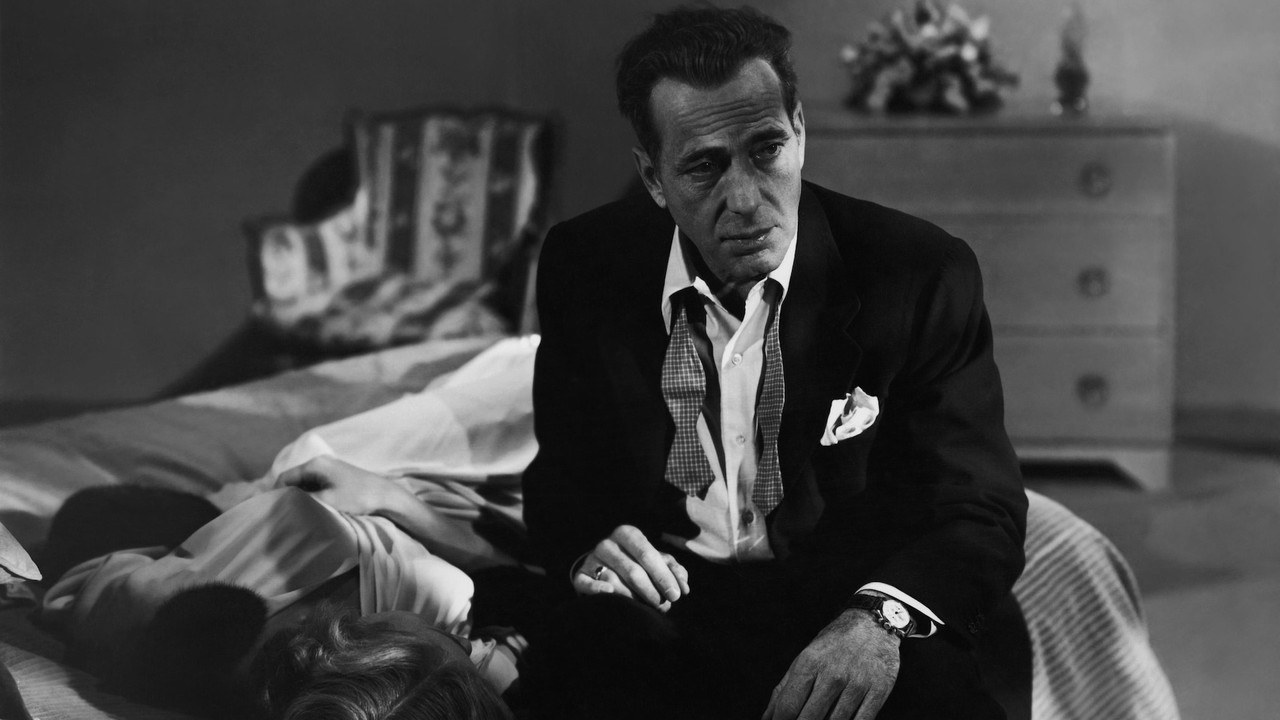
Dixon Steele (Humphrey Bogart) is a Hollywood screenwriter whose career has stalled and whose temper has become a matter of record. When a young hat-check girl, Mildred Atkinson (Martha Stewart), is found murdered the morning after Dix invited her to his apartment to recount a novel he was meant to adapt, he becomes the prime suspect. His neighbor, Laurel Gray (Gloria Grahame), provides an alibi – she saw him walk the girl to a cab – and in the weeks that follow, the two begin an affair shaped as much by proximity and loneliness as by attraction.

Detective Brub Nicolai (Frank Lovejoy), a wartime friend of Dix's, is assigned to the case and finds himself caught between loyalty and professional duty. As the investigation stalls, Laurel's initial certainty about Dix begins to erode. His rages are not theatrical; they are sudden and disproportionate, and they leave marks. Captain Lochner (Carl Benton Reid) applies steady pressure from outside while Dix's agent, Mel Lippman (Art Smith), watches from the margins with the tired concern of a man who has seen this before. The romance that seemed to offer Dix redemption quietly reorganizes itself into a trap – for both of them.

In a Lonely Place belongs to a strain of noir less interested in crime mechanics than in psychological corrosion. The murder is never far from the frame, but the film's real subject is the question of what someone is capable of, and whether love can survive that question being asked. Nicholas Ray uses the genre's conventions to examine male volatility and the cost extracted from those who live alongside it, producing a film that resists the comfort of resolution.
Classic Noir

In a Lonely Place occupies an unusual position in the noir canon: it subordinates its crime plot almost entirely to a character study, and in doing so it exposes something the genre rarely admits directly. Dixon Steele is not a man framed by circumstance or seduced into wrongdoing by a femme fatale; he is a man whose damage is internal, chronic, and recognizable. Bogart, working against his established screen identity, makes Dix sympathetic without making him safe – a distinction the film insists upon. Gloria Grahame's Laurel Gray is equally precise: not a victim, not a schemer, but a woman performing a rational calculation about survival. Ray, whose own marriage to Grahame was collapsing during production, brings to the material an autobiographical pressure that never becomes self-indulgent. What the film reveals about its era is the postwar male returned from violence and never fully returned from it – and the domestic spaces, bright and California-casual, that were expected to contain him.

– Classic Noir
5 ★★★★★ Essential
Credits

The Crew

DirectorNicholas Ray
ScreenplayAndrew Solt
CinematographyBurnett Guffey
MusicGeorge Antheil
EditingViola Lawrence
Art DirectionRobert Peterson
CostumesJean Louis
ProducerRobert Lord
Performances

The Cast

Close Reading

The Signature Scene

In a Lonely Place – scene
Dixon's Apartment, Interior Night Hands Around Her Throat

Ray and cinematographer Burnett Guffey frame the scene in tight, suffocating close-up. The light falls from a single practical source, casting one side of Bogart's face into deep shadow while leaving Grahame's expression fully exposed – a compositional choice that literalizes the asymmetry of power in the room. The camera does not cut away when Dix's hands close around Laurel's neck; it holds, refusing the audience the relief of ellipsis. The frame is composed to exclude the rest of the apartment, the rest of the world, so that for its duration the scene contains nothing but these two faces and what is happening between them.

The scene functions as the film's thesis made physical. Ray has spent the preceding hour building the case that Dix may or may not be a murderer, but in this moment the question becomes beside the point – what matters is what Laurel sees in his eyes and what the audience sees in hers. Dix stops, but the stopping is not exculpation. The scene argues that the potential for violence, held in suspension throughout a relationship, does the same work as violence itself; the threat is the act, and Laurel's subsequent decisions follow from that recognition with a cold, quiet logic.

Visual Language

The Cinematography

🎞️
Burnett Guffey – Director of Photography

Burnett Guffey's cinematography for In a Lonely Place works against the sun-bleached surfaces of early 1950s Los Angeles to find an interior darkness that has nothing to do with weather. Guffey favors medium shots and close-ups over the deep-focus wide frames common to period noir, a choice that keeps the film intimate and claustrophobic even in exteriors. The courtyard of the Patio Palms apartment complex – a studio construction designed with enough architectural specificity to feel observed rather than built – is lit to suggest warmth without providing it; the pools of light between units isolate characters rather than connect them. Shadow work in the interior scenes is restrained rather than expressionist, which proves more unsettling: the danger in this film does not announce itself through chiaroscuro but emerges from faces filmed in available-seeming light, close enough that evasion is impossible. The lens choices favor a slight compression that flattens personal space, placing characters uncomfortably near one another and near the camera, so that psychological pressure registers as something almost physical on screen.

In the Catalogue

Themes & Motifs

Availability

Where to Watch

Also in the Directory

See Also