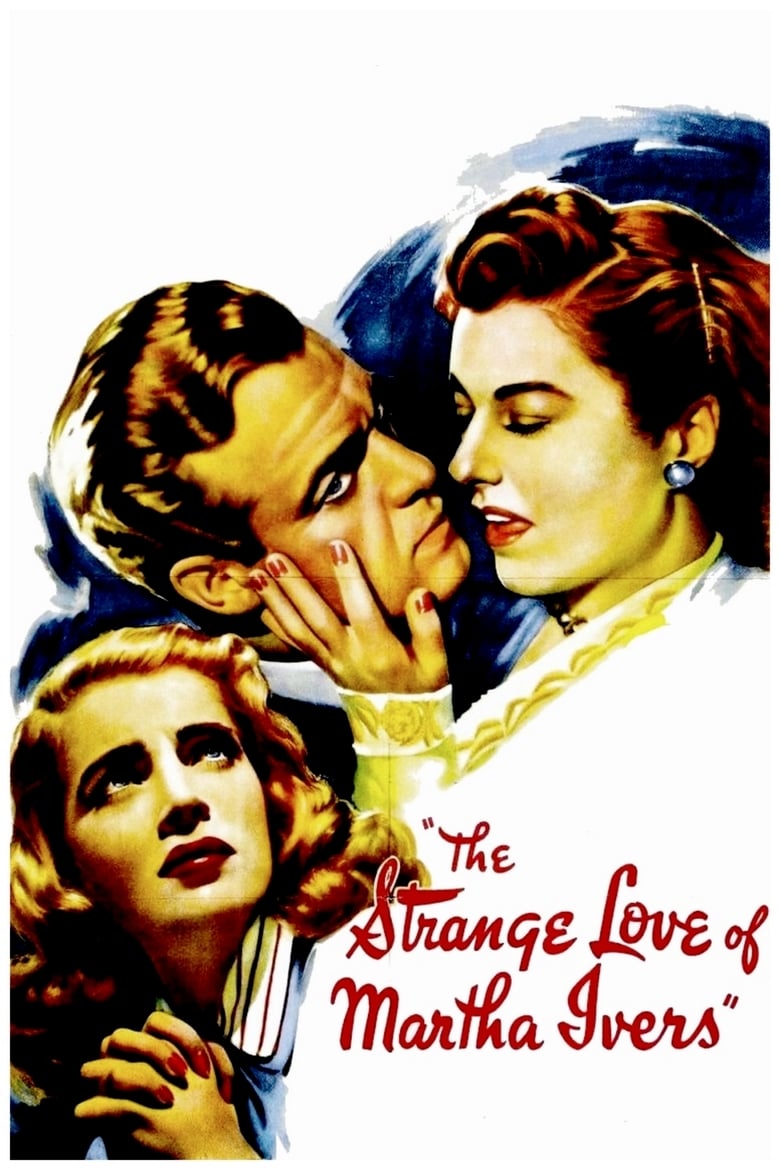
In the industrial Pennsylvania town of Iverstown, young Martha Ivers kills her domineering aunt during a failed escape attempt one stormy night in 1928. Her childhood companion Sam Masterson witnesses the act and vanishes before dawn, leaving Martha and the spineless Walter O'Neil – son of the local prosecutor – as the only survivors of that night's event. Walter's father, hungry for advancement, fabricates a story that an intruder committed the murder, and Martha, now heir to the Ivers fortune, becomes the town's most powerful figure. She marries Walter, elevating him to district attorney, though the marriage is built entirely on mutual blackmail and shared guilt.
Eighteen years later, Sam Masterson drifts back into Iverstown by accident, a rootless gambler with no apparent agenda. Martha, convinced that Sam has returned to expose her, draws him into a web of manipulation while Walter – now a weak and alcoholic district attorney entirely dependent on his wife – grows increasingly paranoid. Sam meanwhile falls into an uncomplicated attachment with Toni Marachek, a young parolee also passing through town. As Martha alternates between seduction and threat, and Walter oscillates between conspiring against Sam and pleading for absolution, the film's central question shifts from guilt to what any of these people might still want from their remaining years.
The Strange Love of Martha Ivers belongs to the postwar cycle of noir that locates corruption not in urban underworlds but in civic respectability itself – in the courthouses and drawing rooms of prosperous American towns. The film uses its three principals to examine what secrets cost over time: not a single dramatic reckoning but a slow moral erosion that renders each character both victim and perpetrator. It is a film about the weight of the past, and about how long a lie must be sustained before it becomes the only truth a person knows.
Released in the same year as The Postman Always Rings Twice and Gilda, The Strange Love of Martha Ivers is a more deliberately architectural film than either, less interested in erotic heat than in the structural damage wrought by concealed crime. Lewis Milestone directs with a measured hand that some critics have read as restraint and others as detachment; either way, the film's pacing allows its character dynamics to calcify visibly on screen. Barbara Stanwyck, already established as the genre's defining femme fatale from Double Indemnity two years prior, here plays a variation that is arguably more pitiable than predatory – a woman who committed violence as a child and has spent her adulthood building a prison around the memory. Kirk Douglas, in his debut, brings a hollowed-out desperation to Walter that becomes the film's most unsettling performance. What the film finally argues is that power purchased through complicity degrades both the powerful and their accomplices equally. It is a significant early entry in the postwar noir cycle, and a film that holds its moral seriousness without melodrama.
– Classic Noir
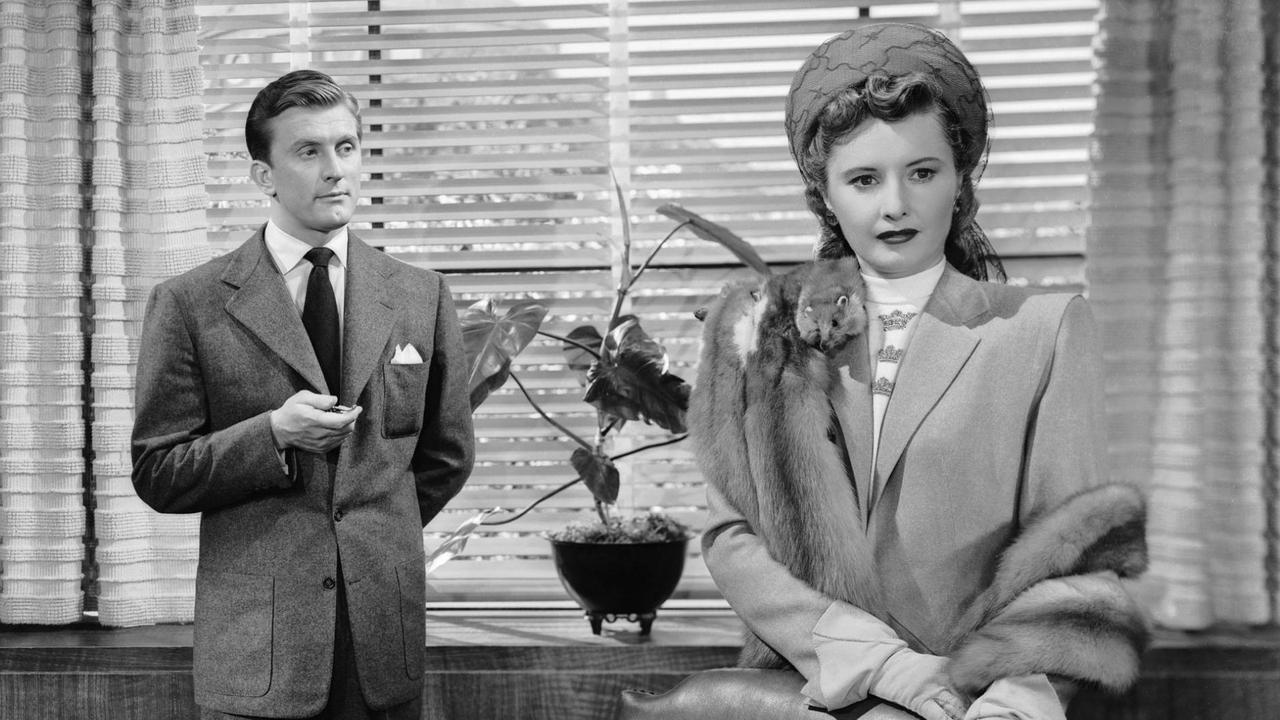
Milestone and cinematographer Victor Milner place Stanwyck at the center of a drawing room that is lit as if the surrounding darkness were actively pressing inward. The key light falls from a single source at screen left, carving one side of her face into deep shadow while the other remains composed and readable. The camera holds at a medium distance, neither crowding her nor conceding ground, and the effect is of a woman fully visible yet somehow unreachable. When Sam enters the frame, Milner allows his figure to occupy a slightly underlit position, restoring a visual equity between the two characters that the script has otherwise denied them.
The scene locates the film's central tension with precision: Martha has constructed everything around her – the house, the marriage, the career of the man she married – to contain a single night's event, and Sam's presence in the room makes the construction visible as construction. Stanwyck's stillness here is not confidence but control exercised under duress, and Milner's refusal to give her the dramatic chiaroscuro of a conventional villain reading suggests something more accurate – that Martha is not a creature of darkness so much as a person who chose, once, to remain in it.
Victor Milner's work on The Strange Love of Martha Ivers is calibrated to the film's moral argument: guilt here is not atmospheric or expressionist but structural, embedded in the architecture of domestic space and civic authority. Shooting on Paramount soundstages, Milner uses controlled studio lighting to impose a consistent but low-key illumination across interiors, avoiding the extreme contrast ratios associated with more stylized noir in favor of a grey-register palette that implicates everything in the same tonal range – mansion and courthouse, drawing room and jail cell. His lens choices favor middle focal lengths that neither flatten space nor distort it, keeping characters in accurate spatial relation to their environments. Shadow work is deliberate rather than theatrical: pools of darkness function as psychological annotations rather than decorative flourishes, appearing most densely around Walter O'Neil and most sparsely around Toni, whose relative moral simplicity Milner renders in something closer to available-light clarity. The cinematography serves a story in which no one is innocent and no setting is neutral.
The Criterion Channel periodically carries this title as part of its noir programming blocks, and its transfers of Paramount titles from this era are generally the most color-corrected and archivally sound available for streaming.
TCMSubscriptionTCM airs the film with some regularity in its classic noir rotation and offers access through the Max bundle; check the TCM schedule directly as availability shifts monthly.
TubiFreeTubi has carried this title as a free, ad-supported stream, though print quality varies and availability should be confirmed at time of viewing.