Jeff Warren (Glenn Ford) returns from service in Korea to resume his job as a locomotive engineer on a midwestern railroad. The world he comes back to is quiet, orderly, and faintly suffocating – a world of shift schedules, union halls, and small-town domesticity. Into this routine steps Vicki Buckley (Gloria Grahame), the wife of Carl Buckley (Broderick Crawford), a brutish railroad foreman whose temper has already cost him his job and very nearly his marriage. Jeff encounters Vicki aboard a night train and is drawn to her immediately, sensing something restless and wounded beneath her composure.
Carl, reinstated through the intervention of a man named Owens whose help carries a price, discovers that Vicki had an affair with Owens and forces her to lure him onto the train – where Carl murders him. Vicki, now complicit in the killing, turns to Jeff, offering herself as both refuge and reward if he will swear he saw nothing. Jeff is caught between honest witness and infatuation, between the uncomplicated affection of Ellen Simmons (Kathleen Case), the daughter of a colleague, and the toxic pull of a woman who needs him precisely because he can destroy her. The triangle tightens as Carl grows more volatile and Vicki more desperate.
Human Desire adapts Émile Zola's La Bête Humaine – previously filmed by Jean Renoir in 1938 – and transplants its deterministic fatalism into postwar American industrial life. Lang strips the novel of its naturalist excess and replaces it with the compressed moral geometry of classical noir: a good man edging toward ruin, a woman whose survival instincts are indistinguishable from manipulation, and a husband whose violence functions as a kind of gravitational field from which escape keeps proving impossible.
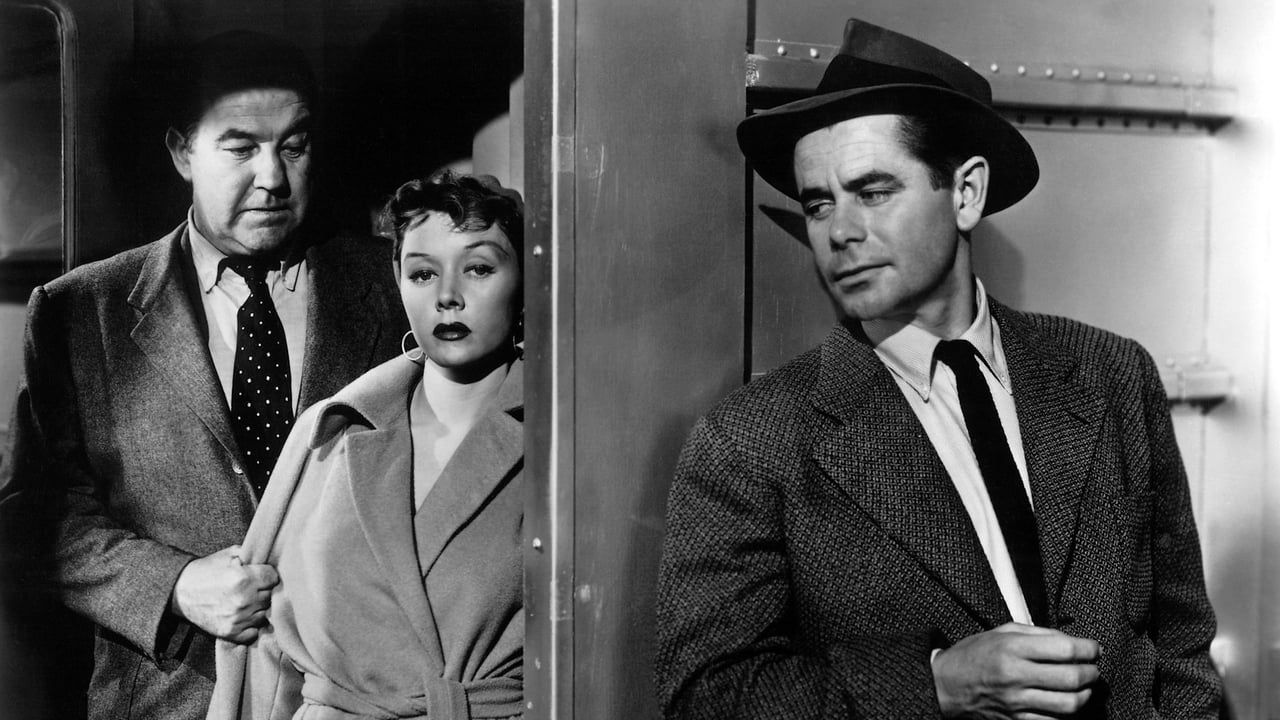
Human Desire arrives in the middle of Lang's second American period, after The Big Heat (1953) and before While the City Sleeps (1956), and it benefits from the same Columbia infrastructure and some of the same personnel. It is a lesser film than The Big Heat but an undervalued one, often dismissed because it softens Zola's biological determinism into something more conventionally psychological. That softening, however, is itself telling. The film cannot quite commit to condemning Jeff, which reflects a real tension in 1954 between the genre's inherited fatalism and the era's investment in male agency and rehabilitation. Gloria Grahame's Vicki is the film's most honest creation: a woman whose manipulation is also a survival strategy, whose guilt is real and whose options are narrower than the men around her acknowledge. Burnett Guffey's photography gives the railroad yards and sleeping cars a texture of industrial melancholy that the script occasionally fails to match. Taken as a document of mid-decade noir in transition – determinism softening, the femme fatale acquiring something like interiority – Human Desire repays serious attention.
– Classic Noir
Guffey frames Vicki in the narrow corridor of a moving passenger car, the overhead fixtures reduced to isolated pools of light that leave the spaces between berths in near-total darkness. The camera holds at a slight low angle, which elongates the corridor ahead of her and compresses the space at her back, making retreat feel geometrically impossible. The train's motion registers in the subtle sway of the frame rather than any cutting, and the sound design – wheels on rail, the hollow percussion of coupling joints – replaces music almost entirely. When Jeff appears at the far end of the corridor, Guffey keeps both figures small within the frame before tightening only gradually, as though the camera itself is reluctant to close the distance.
The scene argues in visual terms what the script argues obliquely: that the attraction between Jeff and Vicki is less a choice than a gravitational event, conducted in a space designed for transit, for passage between one state and another. The train is not incidental atmosphere but the film's central moral metaphor – everyone aboard is moving, and no one, Lang implies, is moving freely. Vicki's stillness within that motion is what makes her dangerous and, in its way, pitiable.
Burnett Guffey had already shot In a Lonely Place (1950) and would later photograph Bonnie and Clyde (1967), and on Human Desire he brings to the railroad milieu the same interest in industrial space as moral environment that distinguishes his best noir work. Working largely on Columbia studio sets augmented by location footage at actual rail yards, Guffey uses deep-focus compositions to keep both foreground figures and receding tracks simultaneously sharp, emphasizing the way characters are embedded in a system larger than themselves. His lighting favors single hard sources – a bare bulb in a dispatcher's office, the beam of an oncoming locomotive – that cast long diagonal shadows across figures rather than illuminating them conventionally. The effect is less expressionist than functional: shadow here marks proximity to a decision rather than interior psychology. In the sleeping-car sequences, Guffey narrows the palette further, pulling ambient fill until only the practicals survive, and the result is a visual vocabulary that equates intimacy with danger and exposure with mortality.
The most reliable source for a properly transferred print, often programmed alongside other Lang and Grahame titles in curated collections.
TCMSubscriptionTCM broadcasts the film periodically as part of noir retrospectives; the network's archive-quality transfers are generally dependable, though scheduling is irregular.
TubiFreeAvailability on Tubi fluctuates; if present, it offers free access though print quality may vary from the Criterion Channel version.