James Vanning, an illustrator living under a false name in Los Angeles, is under surveillance by insurance investigator Ben Fraser, who suspects him of involvement in a doctor's murder and the theft of a large sum of cash. Vanning, haunted and evasive, crosses paths with Marie Gardner, a model he meets by apparent chance, and the two form a cautious, tentative connection set against the city's anonymous sprawl.
Through a series of flashbacks, the full shape of Vanning's predicament emerges: he and a friend stumbled onto a robbery gone wrong in the Wyoming wilderness, witnessed the killers, and barely escaped with their lives – and inadvertently with the stolen money. Now two of those killers, the cold John and the volatile Red, are tracking Vanning across the country, convinced he is holding out on them. Fraser, meanwhile, is building a case that treats Vanning as a suspect rather than a victim, and Marie's loyalty is tested as the danger around her grows concrete and immediate.
Nightfall occupies a distinct position within the cycle of 1950s noir in its treatment of innocence under siege. Unlike the guilt-ridden protagonists who populate much of the genre, Vanning is genuinely wronged rather than compromised, which shifts the film's moral weight toward the machinery of pursuit itself – the systems, both criminal and institutional, that grind a man down regardless of culpability. Adapted from David Goodis's novel, the film uses the American landscape, from city interiors to open snowfields, as an extension of its protagonist's psychological exposure.
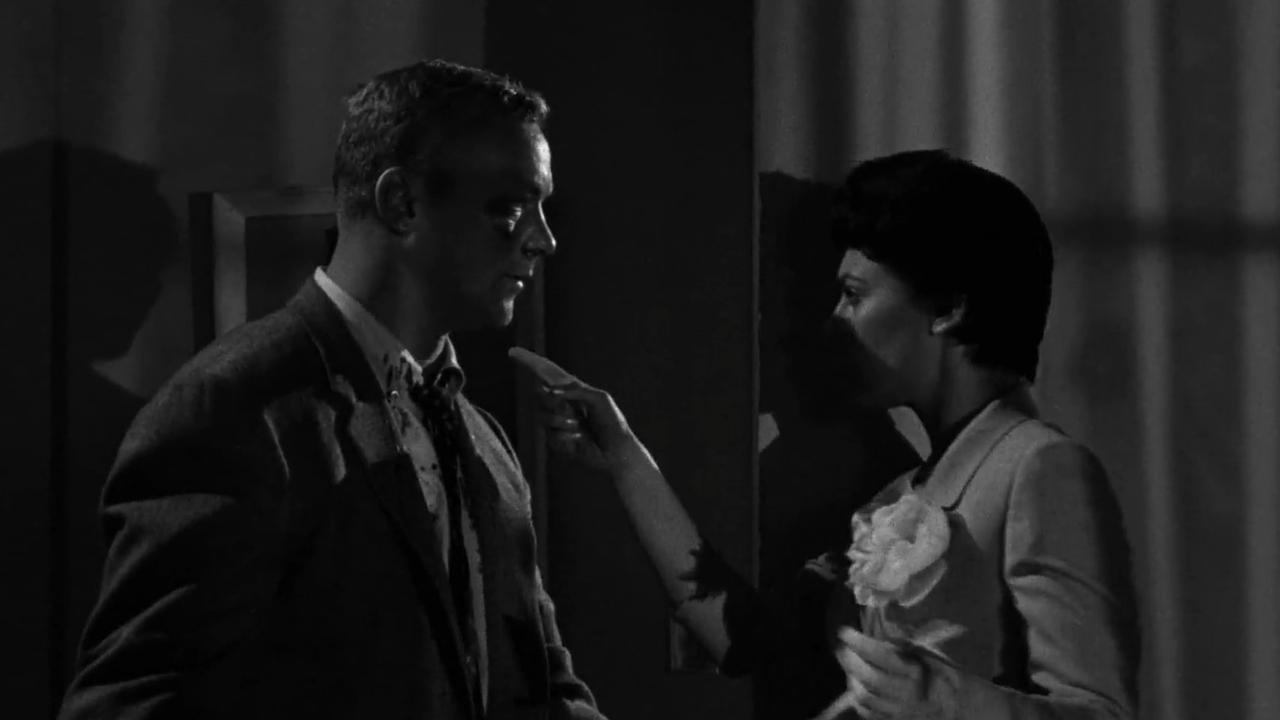
Nightfall is among the more precisely constructed films Jacques Tourneur made in the 1950s, a period when his career was scattered across genres but never entirely without distinction. Working from a David Goodis source novel and a screenplay by Stirling Silliphant, Tourneur keeps the film tight and undemonstrative, refusing the expressionist excess that lesser noir directors leaned on as a substitute for conviction. The casting of Aldo Ray is quietly counterintuitive: his physical density and blunt affect read as working-class stoicism rather than heroic composure, making Vanning's victimhood feel sociologically specific. Brian Keith's John is particularly well-calibrated – menacing through restraint rather than display. The film's most significant formal achievement is its integration of Wyoming exteriors, which introduces a spatial openness rarely associated with noir and allows Tourneur to make the landscape itself feel threatening rather than merely picturesque. At 79 minutes, nothing outstays its purpose.
– Classic Noir
Burnett Guffey shoots the climactic sequence against a broad, flat expanse of snow-covered terrain that offers no concealment and no shadow. The frame is unusually open by noir standards – a wide composition in which the figures of Vanning and his pursuers are reduced to silhouettes against an undifferentiated white ground. Light comes from everywhere and therefore protects no one. There is no darkness to retreat into, no architectural geometry to fragment the image into zones of safety and danger. The visual grammar that noir conventionally uses to encode threat is stripped away, leaving only exposure.
The scene makes a precise argument about the film's central condition. Vanning has spent the entire picture trying to disappear into urban texture, to become anonymous within the crowd and the city's layered geometry. The snowfield denies him that strategy absolutely. His vulnerability, which the city merely implied, becomes here a spatial fact. The sequence suggests that the wrong man cannot ultimately hide – not from the criminals who want their money back, not from the investigator who has misread his guilt, and not from a landscape that refuses to keep his secret.
Burnett Guffey, one of the most technically accomplished cinematographers working in Hollywood through the 1940s and 1950s, brings a considered pragmatism to Nightfall that suits the material precisely. His Los Angeles interiors are lit with a low-key discipline that avoids the exaggerated chiaroscuro of the cycle's peak years, favouring instead a middle-register darkness in which detail remains legible and faces are not obliterated by shadow. This restraint is a structural choice: Vanning is not a morally ambiguous figure to be obscured, and the lighting refuses to implicate him visually where the narrative will not. The location work – both in Los Angeles and in the Wyoming exteriors – is integrated without ostentation, and Guffey's handling of the outdoor sequences demonstrates his capacity to modulate the film's visual temperature sharply. The flatness of the snowfield is not accidental; it is a deliberate departure from studio-controlled shadow work that reorients the film's spatial logic at exactly the moment it is most needed.
The most reliably curated source for mid-century noir of this calibre; check current availability as catalogue rotates.
TubiFreeHas carried the film in an ad-supported stream; transfer quality varies, but it is a legitimate free option for first-time viewers.
Archive.orgFreePublic domain prints have circulated here; quality is inconsistent and this should be treated as a last resort.