Films People Pull a Fast One Night Beat Reading Room On TV Shop
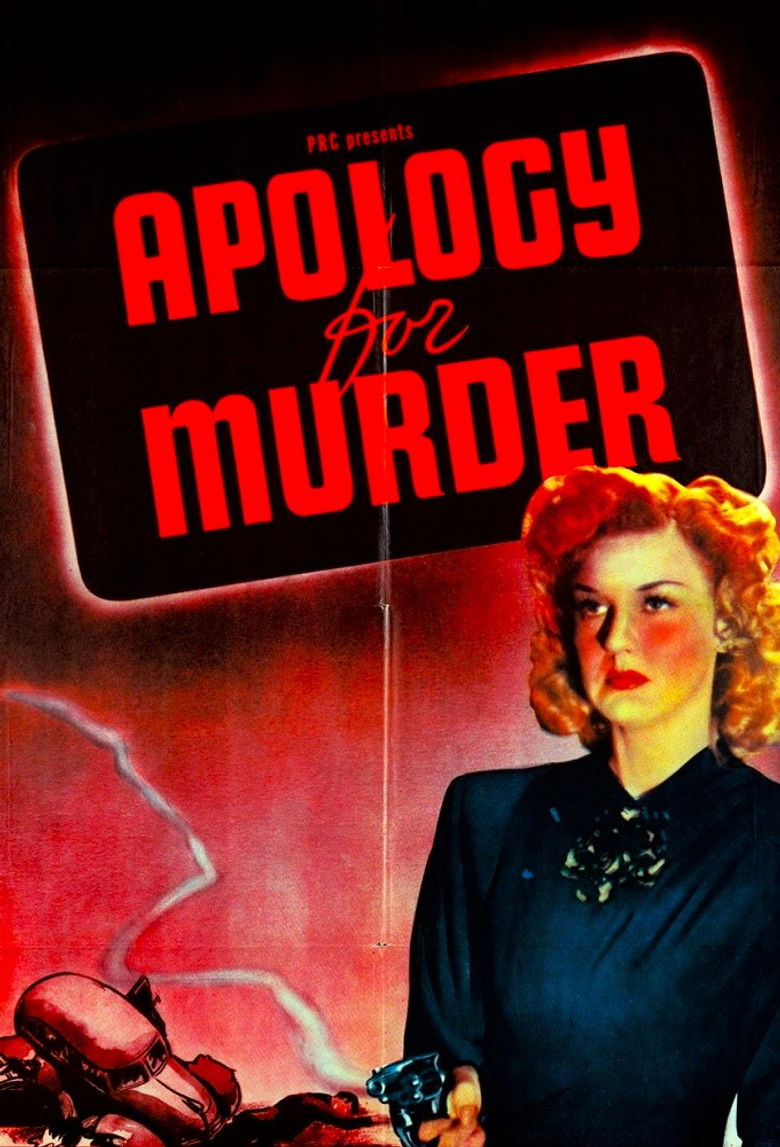
Apology for Murder 1945
1945 Sigmund Neufeld Productions
★★★☆☆ Notable
Film Noir · 67 minutes · Black & White

Apology for Murder

Directed by Sam Newfield
Year 1945
Runtime 67 min
Studio Sigmund Neufeld Productions
TMDB 4.9 / 10
"A reporter and a married woman agree on murder, then wait for the consequences to arrive."

Kenny Blake is a small-time newspaper reporter going nowhere fast when he crosses paths with Toni Kirkland, the cold and calculating wife of wealthy industrialist Harvey Kirkland. Their attraction is immediate and transactional: Toni wants her husband dead, and Kenny, susceptible to both her looks and the promise of money, does not refuse. When Harvey is found shot, the police investigation falls to editor Ward McGee and insurance man Craig Jordan, who begin probing the convenient circumstances of the death.

The alibi Kenny and Toni construct holds initially, but the arrangement between them was never built on trust. Toni is as willing to maneuver against her accomplice as she was against her husband, and Kenny begins to understand that he has exchanged one kind of trap for another. Jordan's scrutiny tightens, a secondary witness named Allen Webb emerges as a complicating variable, and the moral arithmetic of the scheme quietly collapses inward.

Produced by Sigmund Neufeld Productions on a budget that left no room for waste, Apology for Murder belongs to the cycle of poverty-row noirs that drew freely on the Double Indemnity template and transplanted its logic into stripped-down, low-overhead conditions. The film is less interested in suspense than in the predictable gravity that pulls two people who deserve each other steadily downward, a structure that the genre had already codified and that this film executes without embellishment.

Classic Noir

Apology for Murder is a frank piece of exploitation filmmaking, produced quickly and cheaply in the wake of Double Indemnity to capitalize on the appetite for femme fatale narratives. What it lacks in budget or ambition it partly compensates for with the casting of Ann Savage, whose work in Edgar G. Ulmer's Detour the same year demonstrated a capacity for cold menace that few actresses of the period matched. Here she functions as the engine of the film's moral argument: Toni Kirkland is not a woman driven by desperation or psychological complexity but by appetite, and Savage plays that flatness without apology. Hugh Beaumont's Kenny makes a credible study in ordinary male weakness, the man who understands the danger and enters it anyway. The film's brevity – sixty-seven minutes – is both its limitation and its discipline. It cannot afford subplots or ambiguity, and so it delivers its verdict on both characters with an efficiency that more elaborate noirs sometimes sacrifice. As a document of how the genre's conventions circulated through the lower tiers of American production, the film is genuinely instructive.

– Classic Noir
3 ★★★☆☆ Notable
Credits

The Crew

DirectorSam Newfield
ScreenplayFred Myton
CinematographyJack Greenhalgh
MusicWilliam A. Wilmarth
EditingHolbrook N. Todd
Art DirectionEdward C. Jewell
ProducerSigmund Neufeld
Performances

The Cast

Close Reading

The Signature Scene

Apology for Murder – scene
The First Seduction Toni Leans Into Shadow

The scene is composed with available studio economy: a single practical lamp throws Toni's face into high-contrast relief while Kenny occupies the softer edge of the frame. Greenhalgh holds the camera at a slight low angle on Savage, which adds a quiet authority to her figure without overstating the effect. The background is dark enough to be indeterminate, collapsing the space around the two characters into something close to an abstract negotiation rather than a domestic interior.

What the scene establishes is not desire exactly but calculation presented in the register of desire, and the visual arrangement makes that distinction legible. Toni is in the light because she chooses to be seen; Kenny is half-shadowed because he has already begun to recede from his own agency. The film's central argument – that the man who thinks he is taking something is in fact being taken – is already visible in how the frame distributes illumination between them.

Visual Language

The Cinematography

🎞️
Jack Greenhalgh – Director of Photography

Jack Greenhalgh was a reliable craftsman in the poverty-row system, and Apology for Murder shows what a competent low-budget cinematographer could accomplish within severe material constraints. Working entirely on studio interiors, Greenhalgh relies on high-contrast key lighting with minimal fill, a setup that serves the story's moral logic by keeping faces legible while allowing backgrounds to dissolve into shadow. There is no location work and no depth-of-field experimentation; the visual language is essentially theatrical, built around placement and light rather than camera movement. The lens choices are conservative – standard focal lengths that keep the image from distorting or aestheticizing the material beyond what the budget could support. What Greenhalgh achieves is a consistent tonal atmosphere, a sense that the world of the film exists only as far as the light reaches, and that everything beyond the frame is already foreclosed. For a film with nothing to spare, that is a coherent and defensible approach.

In the Catalogue

Themes & Motifs

Availability

Where to Watch

Also in the Directory

See Also