Films People Pull a Fast One Night Beat Reading Room On TV Shop
Strange Fascination 1952
1952 Hugo Haas Productions
★★★☆☆ Notable
Film Noir · 80 minutes · Black & White

Strange Fascination

Directed by Hugo Haas
Year 1952
Runtime 80 min
Studio Hugo Haas Productions
TMDB 5.5 / 10
"A man of discipline trades everything he has built for a woman who was never his to keep."

Paul Marvan is a concert pianist of modest European refinement, working steadily in American nightclubs and ballrooms while age quietly closes in on his career. When Margo, a young and calculating dancer, enters his orbit, Paul allows himself the delusion that passion can be separated from consequence. He installs her in his life with the care of a man who mistakes possession for love, and Margo accepts his attention with the patience of someone who has already begun to look elsewhere.

As Paul's professional standing erodes and his devotion to Margo deepens into dependency, the film traces the slow dismantling of a man who once prided himself on self-control. Carlo, younger and unencumbered, draws Margo's eye, and Paul is left to negotiate between pride and desperation. The supporting world – Diana Fowler's genteel social milieu, Mary's quiet loyalty – functions as a measure of what Paul is discarding, a moral ledger he refuses to consult.

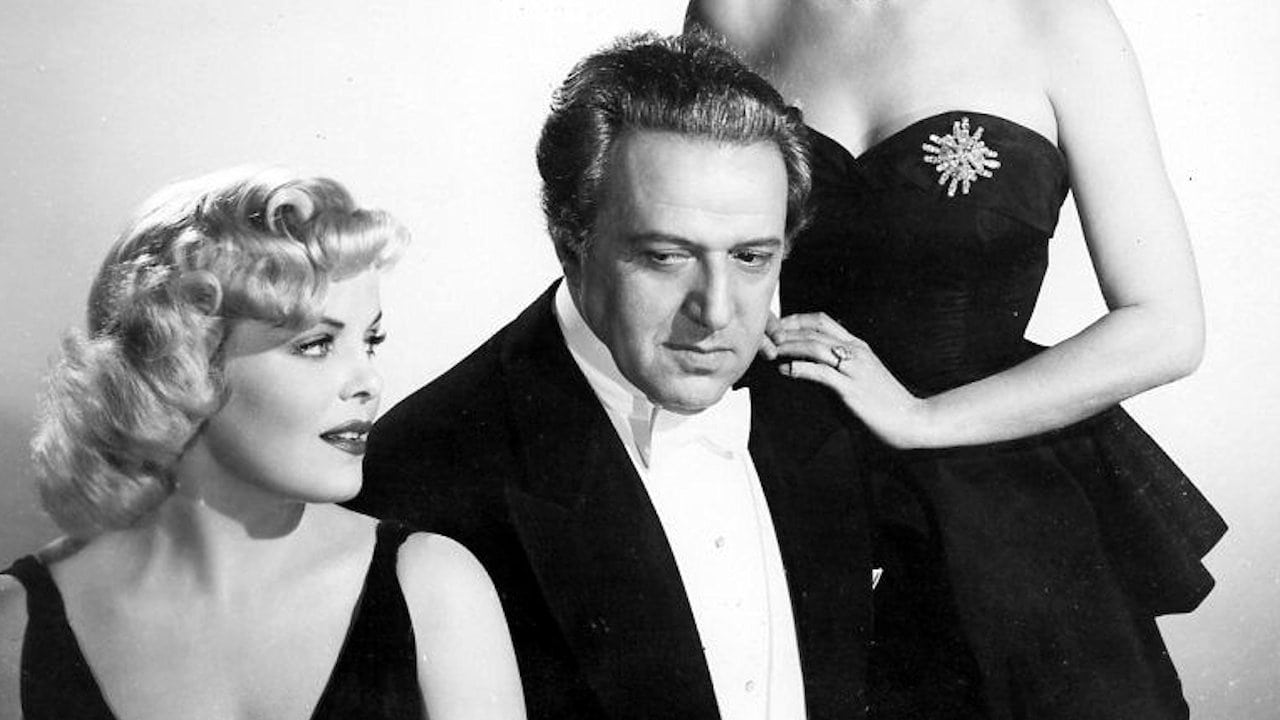
Strange Fascination belongs to the cycle of low-budget American noir that director Hugo Haas made almost entirely as a personal venture, casting himself as the aging, romantically doomed protagonist in a series of films that return obsessively to the same humiliation. The film is less interested in crime as event than in the psychology that makes crime feel inevitable to a man who has already lost everything that made caution worthwhile.
Classic Noir

Hugo Haas occupies a peculiar position in the noir catalogue – a Czech émigré filmmaker working at the absolute margins of the American industry, producing, directing, and starring in a run of films during the early 1950s that constitute something close to a sustained artistic argument. Strange Fascination, made in 1952 through his own production unit, rehearses the Haas obsession with blunt clarity: a cultivated older man destroyed by sexual fixation on a woman who is indifferent to his ruin. What makes this more than a poverty-row melodrama is the degree of self-awareness Haas brings to his own performance. He is not a tragic hero rendered pathetic by circumstance; he is a man whose vanity participates actively in his destruction. Cleo Moore, whose deadpan physicality Haas used repeatedly across this period, withholds the warmth that would make Margo seductive in any conventional sense, which is precisely the point. The film's cold assessment of erotic delusion aligns it with the bleaker strain of postwar noir, where desire functions as a form of self-erasure rather than appetite.

– Classic Noir
3 ★★★☆☆ Notable
Credits

The Crew

DirectorHugo Haas
ScreenplayHugo Haas
CinematographyPaul Ivano
MusicJakob Gimpel
EditingMerrill G. White
Art DirectionRudi Feld
ProducerHugo Haas
Performances

The Cast

Close Reading

The Signature Scene

Strange Fascination – scene
The Practice Room, Late Evening Hands Still on Keys

Paul sits at the piano in a room that Paul Ivano lights from a single practical lamp positioned low and stage left, leaving the upper register of the frame in an unresolved grey. The camera holds in a medium shot that refuses to close in for consolation, watching Paul's hands rest motionless on the keys after a passage he cannot finish. The shadow cast by the lamp doubles his silhouette against the wall behind him, slightly distorted, as though the room itself is offering a second, less flattering version of the man.

The stillness of the scene carries the film's central argument more precisely than any of its dialogue: Paul is a performer who has lost his audience, a man of craft who has traded the discipline that gave him identity for an attachment that returns nothing. The unplayed music is not merely a symbol of blocked emotion but an index of concrete loss – a career interrupted, a competence quietly abandoned. The frame does not moralize; it simply waits with him in the silence.

Visual Language

The Cinematography

🎞️
Paul Ivano – Director of Photography

Paul Ivano, a cinematographer whose career stretched back to the silent era, brings to Strange Fascination the economy of a craftsman working under genuine budget pressure with enough experience to make constraint serve the material. Shooting largely on studio-built interiors of deliberate shabbiness, Ivano relies on hard single-source lighting that carves faces rather than flatters them, producing a visual texture closer to documentary realism than the expressionist excess associated with higher-budget noir. The lens work is conservative – mid-range focal lengths that keep actors in spatial relation to their environments rather than isolating them in close-up rhetoric. Shadow is deployed not as atmosphere but as moral notation: the degree to which a character is submerged in darkness tracks reliably with their proximity to self-destruction. The cinematography serves Haas's thematic purposes by refusing pictorial beauty, insisting instead on a kind of affectless observation that makes the film's emotional deterioration feel systemic rather than dramatic.

In the Catalogue

Themes & Motifs

Availability

Where to Watch

Also in the Directory

See Also