Films People Pull a Fast One Night Beat Reading Room On TV Shop
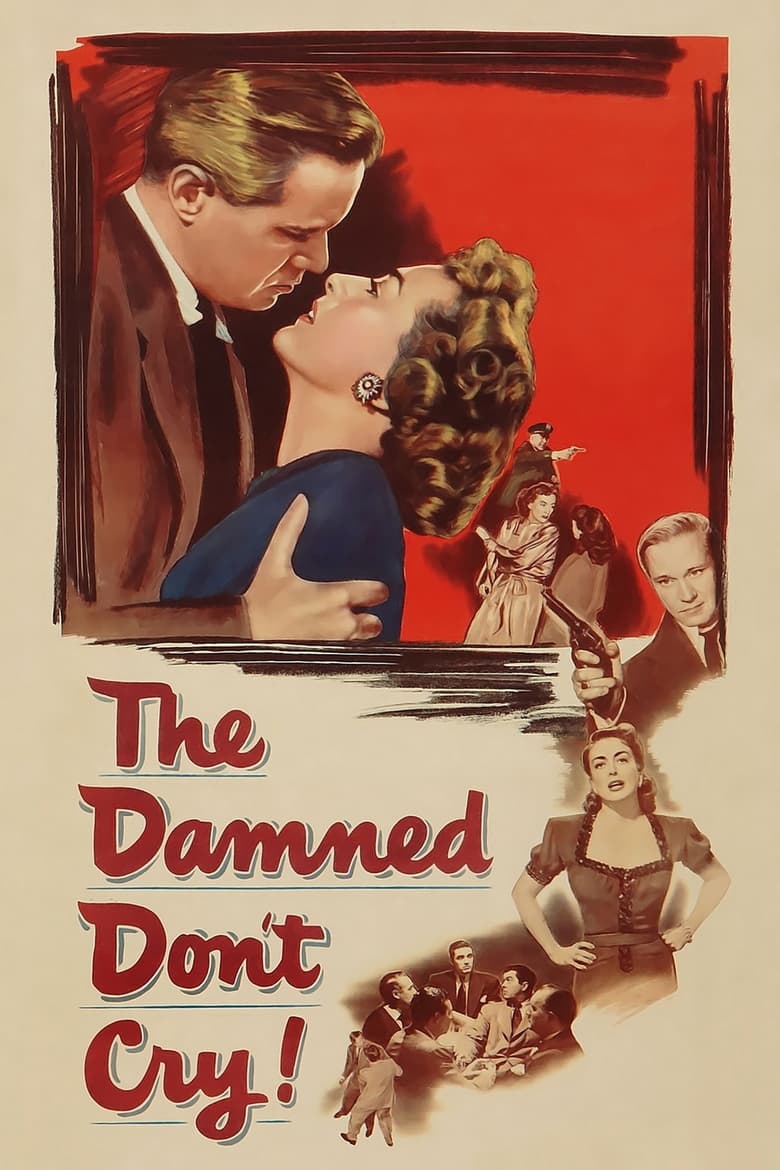
Damned Don't Cry 1950
1950 Warner Bros. Pictures
★★★☆☆ Notable
Film Noir · 103 minutes · Black & White

Damned Don't Cry

Directed by Vincent Sherman
Year 1950
Runtime 103 min
Studio Warner Bros. Pictures
TMDB 7.0 / 10
"A woman reinvents herself on borrowed time, in borrowed money, in a world that collects its debts."

Ethel Whitehead (Joan Crawford) is a Texas housewife ground down by poverty and a husband who sees no further than the next oil field shift. When a family tragedy strips away what little she has, Ethel walks out on her life and begins the slow, deliberate construction of a new one – trading her real name for Lorna Hansen Forbes and her mill-town past for the look and manner of money. She attaches herself to tax accountant Martin Blackford (Kent Smith), whose connections to organized crime open a door she has no intention of closing.

Martin introduces Ethel to George Castleman (David Brian), a composed and powerful crime boss who recognizes in her both an asset and a liability. Castleman uses her to infiltrate the operation of Nick Prenta (Steve Cochran), a volatile syndicate lieutenant operating out of the Southwest. What begins as a calculated arrangement becomes something more dangerous when Prenta develops a possessive fixation on Ethel, and the competing interests of the men around her close into a tightening circle. Her loyalty to none of them and her appetite for security make her simultaneously the most resourceful and the most exposed figure in the film.

The film belongs to a cycle of Warner Bros. productions that placed women at the center of criminal worlds not as victims but as navigators – calculating, adaptive, and ultimately subject to a system that tolerates female ambition only up to the point where it becomes inconvenient. Crawford's performance holds the film's moral ambiguity in tension, and director Vincent Sherman keeps the melodrama taut enough that the genre machinery rarely overwhelms the character study at its core.
Classic Noir

The Damned Don't Cry occupies a precise intersection in postwar American noir: the woman's picture and the syndicate film, two genres Warner Bros. had cultivated separately through the 1940s, here collapsed into a single vehicle calibrated around Crawford's particular screen authority. The film is not especially inventive in its plotting, and Sherman works within the genre's established grammar rather than against it. What distinguishes it is the degree to which it refuses to sentimentalize Ethel's rise or render her ambition as pathology requiring punishment. The critique of class – the contempt of the poor, the performance demanded of those who cross social lines – runs beneath the surface with enough consistency to feel considered rather than incidental. David Brian's Castleman is one of the more credibly cold crime bosses the studio produced in this period, and Cochran's volatility provides a counterweight that keeps the triangle from resolving too neatly. The film's limitations are structural: the framing device softens what could have been a harder conclusion. Nevertheless, as a document of the era's anxieties about mobility, desire, and the cost of reinvention, it repays attention.

– Classic Noir
3 ★★★☆☆ Notable
Credits

The Crew

DirectorVincent Sherman
ScreenplayJerome Weidman
CinematographyTed D. McCord
MusicDaniele Amfitheatrof
EditingRudi Fehr
Art DirectionRobert M. Haas
ProducerJerry Wald
Performances

The Cast

Close Reading

The Signature Scene

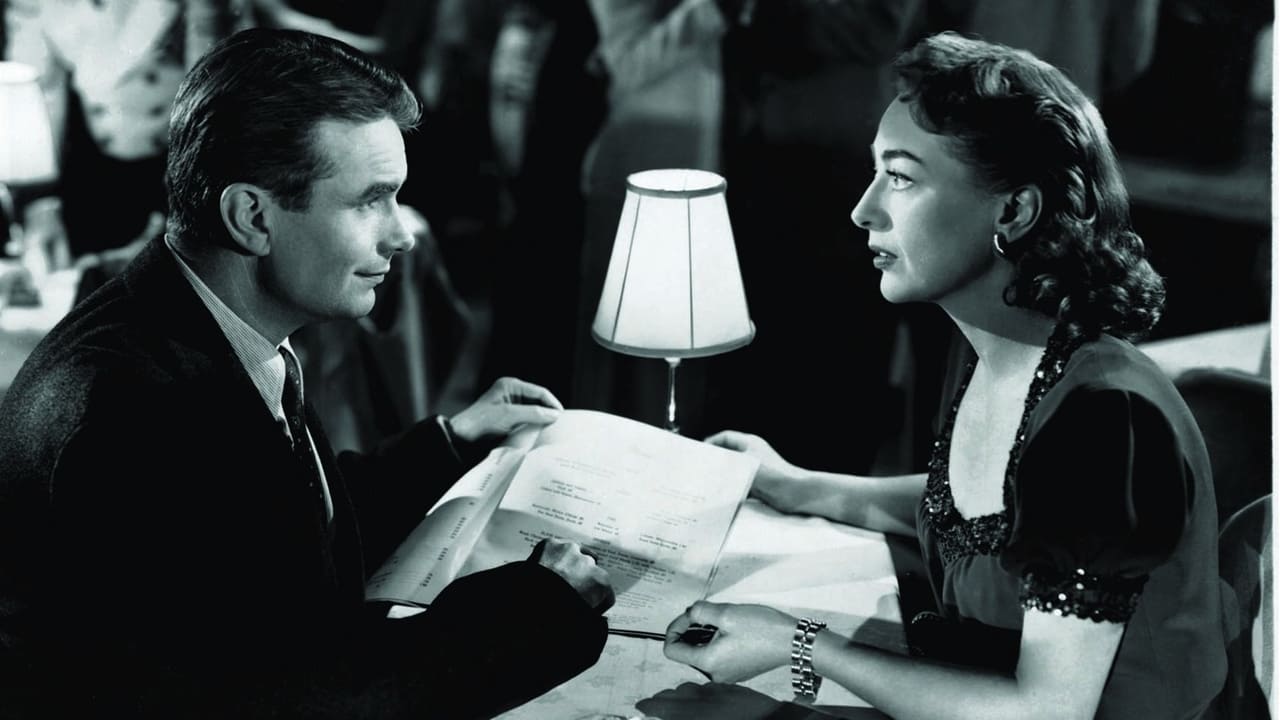
Damned Don't Cry – scene
Castleman's Study The Price of New Names

Ted D. McCord lights the scene with a strong lateral source – likely a practical lamp just off frame left – that cuts Castleman's face into two planes, one readable, one withheld. Crawford is positioned slightly below eye level with Brian, the composition engineered to suggest a power differential that her posture quietly refuses to confirm. The camera holds in a medium two-shot long enough to register the stillness between them before cutting to close-ups that isolate each face in its own calculation. Shadow falls across the bookshelves and the desk's surface in geometric blocks, the studio set dressed to suggest wealth as architecture rather than comfort.

The scene is where the film's central argument becomes explicit without being stated: Ethel has acquired the fluency of another class but not its protection, and Castleman knows it. His willingness to use her is inseparable from his assessment that she has nowhere credible to retreat. Her composure in the exchange is not confidence but a performance of confidence, and McCord's close-up on Crawford at the scene's close – eyes level, expression controlled – leaves the question of whether she believes her own act deliberately unresolved.

Visual Language

The Cinematography

🎞️
Ted D. McCord – Director of Photography

Ted D. McCord's work on The Damned Don't Cry operates within the conventions of late-studio noir while deploying them with enough precision to serve the film's specific moral logic. Shooting primarily on Warner Bros. soundstages, McCord constructs interiors that use depth of field conservatively – keeping backgrounds soft enough to foreground the social performance Crawford's character is always enacting. His lighting setups favor hard-edged sources that cast shadows with clean borders rather than diffuse atmospherics, which suits a film about surfaces and what lies just beneath them. The Southwest exteriors, when they appear, are handled with flatter light that deliberately strips away glamour, reinforcing the film's argument that the world Ethel came from offers no romantic alternative to the dangerous one she has chosen. McCord avoids the extreme low-angle expressionism of harder noir, keeping his framing largely at eye level – a choice that locates menace in social situation rather than visual distortion, and that keeps Crawford's face, rather than the geometry around it, as the film's primary instrument of meaning.

In the Catalogue

Themes & Motifs

Availability

Where to Watch

Also in the Directory

See Also