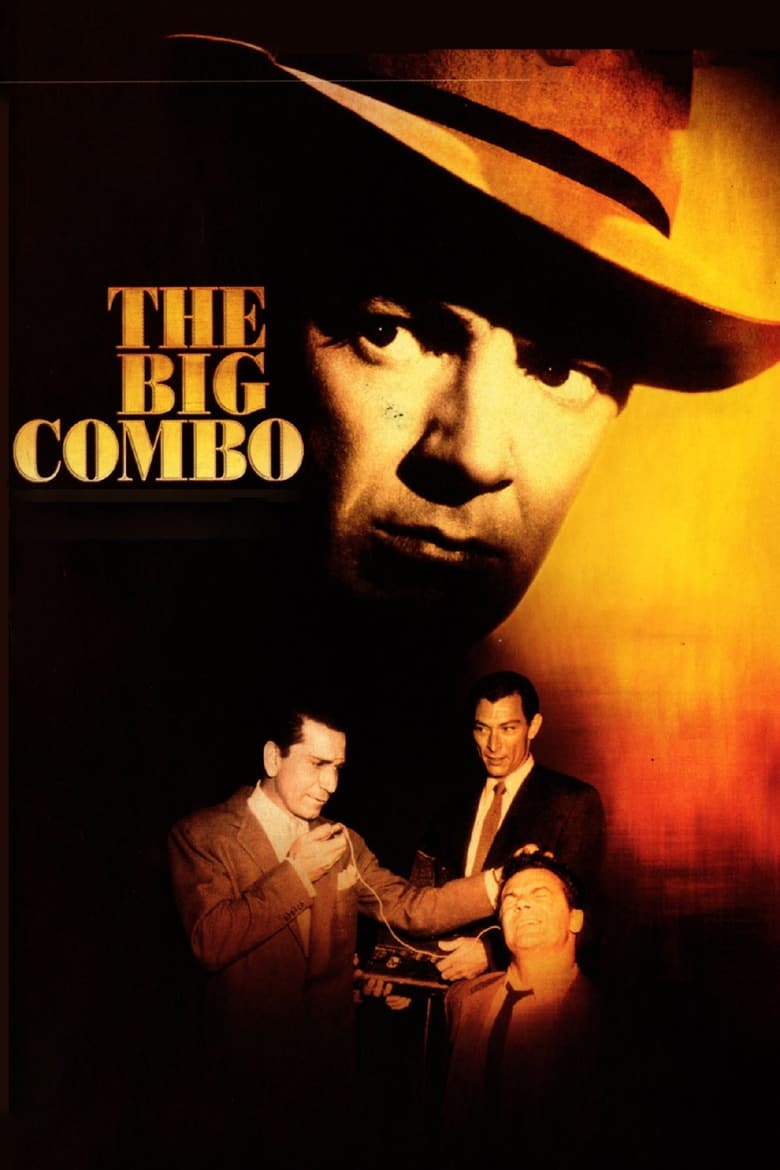
Lieutenant Leonard Diamond is a police detective running out of patience and department goodwill. He has spent months – and most of his budget – trying to build a case against Mr. Brown, the cold and methodical head of a crime syndicate known only as the Combo. Diamond's fixation has a personal dimension: Susan Lowell, Brown's companion, is a woman of evident intelligence trapped in a relationship that has corroded her from within. She is not quite a witness, not quite a victim, and Diamond is not quite certain whether his interest in her serves the investigation or the other way around.
Brown operates through a rigid hierarchy enforced by two killers, Fante and Mingo, whose partnership carries an unspoken intimacy that the film regards without comment. His former lieutenant, McClure, has been stripped of authority and left to drink himself into irrelevance, kept alive only because Brown finds humiliation more useful than murder. Alicia Brown, the wife Brown has buried under an assumed death, surfaces as a thread Diamond pulls – carefully, because pulling too hard means dying. Allegiances inside the syndicate are not shifting so much as they are corroding under the pressure Brown applies to everyone around him.
The Big Combo is a film about institutional failure as much as criminal enterprise. The police are underfunded, politically constrained, and outmaneuvered at every turn, while the syndicate operates with the efficiency of a corporation. Joseph H. Lewis frames this imbalance not as cynicism but as structural fact, and it is within that structure – where the law is slower, poorer, and more accountable than the organization it opposes – that Diamond must find whatever leverage he can.
The Big Combo arrives late in the classical noir cycle and knows it. Joseph H. Lewis and cinematographer John Alton construct a world so visually severe that the film's occasional narrative weaknesses – a romance that never fully earns its weight, a resolution that concedes more to convention than the preceding eighty minutes warrant – recede behind the sheer authority of the imagery. The film's real subject is power and its maintenance: Brown does not merely commit crimes, he administers them, and Richard Conte plays him with a bureaucratic precision that is more disturbing than any outburst of violence. The syndicate functions as a mirror held up to postwar corporate America, organized, hierarchical, and indifferent to individuals. What distinguishes the film within the genre is its willingness to present the detective not as the moral center restoring order but as a man whose obsession is itself a form of disorder, institutionally sanctioned but personally ungovernable. That ambiguity keeps the film alive.
– Classic Noir
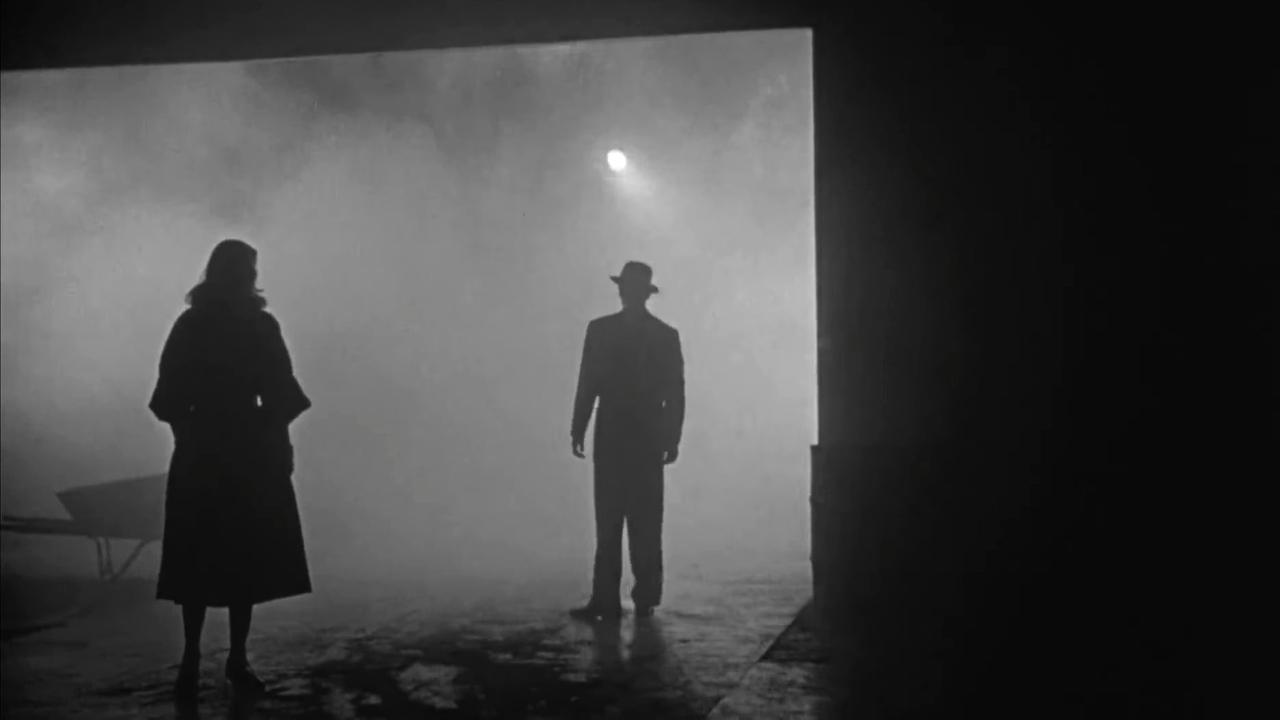
Alton fills the frame with a dense, practical fog that reduces the hangar and airfield to a field of grey gradations. Two figures – Diamond and Susan – stand at the edge of legible space, light falling on them from a source low and slightly behind, so that their faces are partially turned toward shadow. The geometry is stripped to almost nothing: no architectural detail, no horizon line, only the soft dissolution of form into atmosphere. The camera holds at a distance that keeps them small within the frame, isolated rather than intimate, the surrounding void doing the work that dialogue cannot.
The scene functions as the film's thesis statement delivered in visual terms. These two people have survived something – the law technically prevailing – but Alton's fog refuses to grant them clarity or release. They are not framed as victors. The image insists that what surrounds them is not safety but simply the absence of immediate threat, which in this film has never been the same thing as freedom. It is the most honest frame Lewis and Alton find for a story that has never promised resolution, only continuation.
John Alton's work on The Big Combo represents the most concentrated expression of his approach to noir lighting: a method that treats darkness not as absence but as substance. Working on studio sets with controlled environments, Alton uses single-source and hard-edge lighting to carve figures out of darkness rather than illuminate them against it. Faces register as partial facts, half-consumed by shadow, and the effect is not decorative but moral – these are people who cannot be fully known, including by themselves. His lens choices favor a flatter depth in the frame's darker registers, which compresses space and removes any sense of safe distance between characters and threat. The famous torture sequence, in which Brown uses a hearing aid as an instrument of disorientation, is shot almost entirely in close and mid close-up with lateral light that makes flesh look like something being examined rather than observed. Throughout the film, Alton's shadow work serves Lewis's argument that the syndicate and the institutions opposing it share the same darkness, differentiated only by which side of the law they operate on.
Criterion's presentation draws from a restored print and represents the most carefully contextualized viewing option, with supplementary material on Alton and the film's production history.
TubiFreeAvailable at no cost with ads; the print quality is variable but the film is in the public domain and this is a reliable free option for first-time viewers.
Archive.orgFreeMultiple transfers are hosted here in the public domain; quality varies between uploads, so checking user ratings on individual files is advisable.