Films People Pull a Fast One Night Beat Reading Room On TV Shop
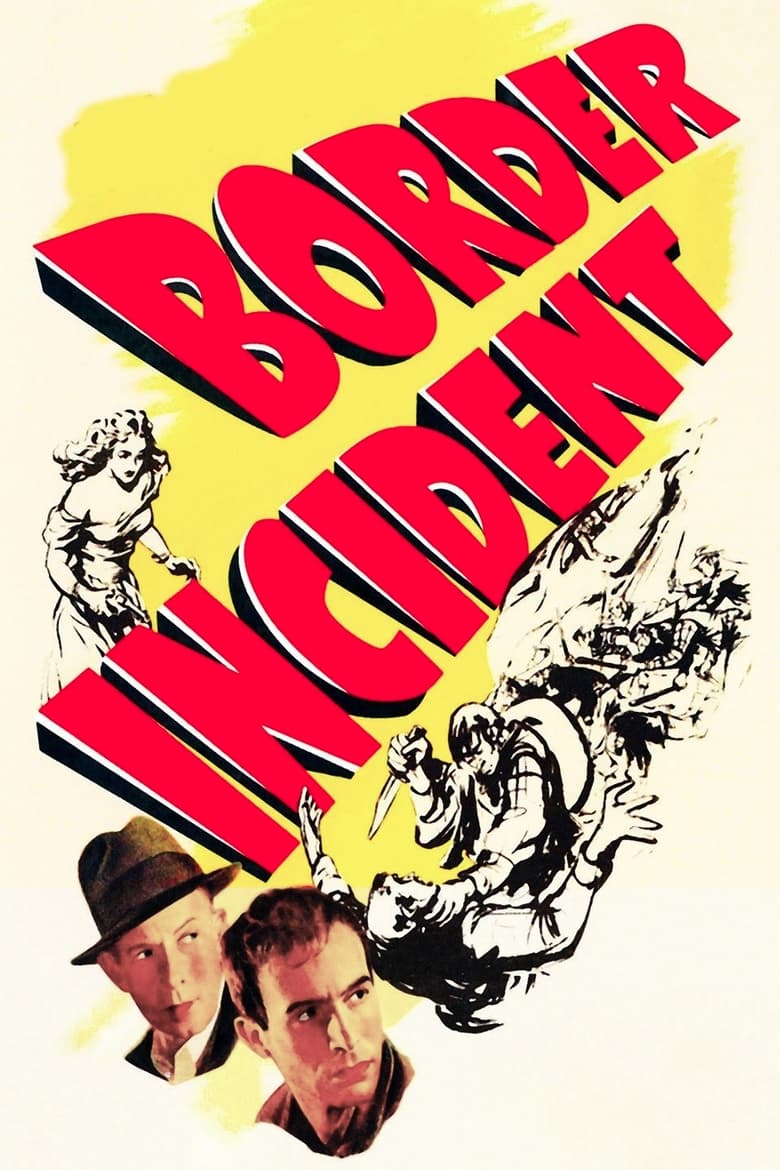
Border Incident 1949
1949 Metro-Goldwyn-Mayer
★★★★☆ Recommended
Film Noir · 94 minutes · Black & White

Border Incident

Directed by Anthony Mann
Year 1949
Runtime 94 min
Studio Metro-Goldwyn-Mayer
TMDB 7.0 / 10
"Two agents cross into the killing ground where the law ends and the desert begins."

In the years following World War II, the United States Immigration Service launches a covert operation to dismantle a smuggling network that ferries undocumented Mexican bracero workers across the California border, strips them of their earnings, and murders them to prevent identification. Pablo Rodriguez (Ricardo Montalban), a Mexican federal agent, infiltrates the operation from the south while American operative Jack Bearnes (George Murphy) works the same network from the north, neither man fully aware of the other's role until the trap is nearly closed.

The criminal enterprise is controlled by Owen Parkson (Howard Da Silva), a rancher who operates with the cold efficiency of a man who has long since stopped distinguishing between livestock and human cargo, and enforced by the sadistic Zopilote (Arnold Moss) and knife-man Cuchillo (Alfonso Bedoya). As Pablo moves deeper into the organization, the two investigations begin to intersect at dangerous angles, and the line separating undercover identity from genuine peril grows indistinct. Bearnes's cover is blown, and the consequences are swift and without mercy.

Border Incident belongs to that postwar cycle of semi-documentary noirs in which institutional procedure and individual vulnerability exist in direct tension. Shot on location in the Imperial Valley and the Mexicali region, it uses the border landscape – flat, nocturnal, indifferent – as both physical setting and moral argument. The film refuses the reassurance of a clean outcome, and its treatment of labor exploitation and state violence against migrant workers carries an unease that exceeds the conventions of the crime genre.
Classic Noir

Border Incident occupies a precise and underexamined position within the noir canon. Directed by Anthony Mann at the height of his partnership with John Alton and released the same year as their T-Men, the film shares that picture's semi-documentary architecture but pushes further into moral discomfort. Where T-Men centers on federal agents and a relatively abstract criminal target, Border Incident implicates an entire economy – the legal bracero program, American agricultural dependency on cheap labor, the systematic robbery and killing of workers who have no recourse to law. Ricardo Montalban's Pablo Rodriguez is not simply an undercover operative; he is a Mexican national whose competence and authority the film treats with a seriousness unusual for the period, complicating the standard American-hero framework. Howard Da Silva's Parkson is villainous not through flamboyance but through the bureaucratic normality of his greed. The film's violence, when it arrives, is abrupt and without catharsis. Mann and Alton do not use the border as exotic backdrop; they use it as evidence.

– Classic Noir
4 ★★★★☆ Recommended
Credits

The Crew

DirectorAnthony Mann
ScreenplayJohn C. Higgins
CinematographyJohn Alton
MusicAndré Previn
EditingConrad A. Nervig
Art DirectionCedric Gibbons
ProducerNicholas Nayfack
Performances

The Cast

Close Reading

The Signature Scene

Border Incident – scene
The Irrigation Field The Tractor in the Dark

Alton shoots the scene almost entirely in darkness. The irrigation furrows of the Imperial Valley provide faint horizontal geometry, and a single source of mechanical light – the tractor's headlamp – moves through the frame from background to foreground with the deliberate pace of something that cannot be stopped. The camera holds at a low angle, nearly at ground level, so the machine occupies the upper register of the frame while the figure in the furrow is reduced to a shape against dark earth. There is no shadow play here in the expressionist sense; instead, Alton uses the near-total absence of light as a compositional argument, the tractor's beam illuminating just enough to confirm what is happening without offering the viewer any way to distance themselves from it.

The scene functions as the film's moral center of gravity. Bearnes's death is not presented as a thriller setpiece but as an industrial act – a man disposed of by the same machinery that works the land that depends on the labor of men like Pablo. The violence is economic before it is personal, and Mann's refusal to cut away or to score the moment with dramatic emphasis transforms it from a plot point into an indictment. What the scene reveals is that Border Incident is not finally about espionage; it is about what a border permits those on one side to do to those crossing from the other.

Visual Language

The Cinematography

🎞️
John Alton – Director of Photography

John Alton's work on Border Incident is among the most disciplined location cinematography in the American noir cycle. Where his studio collaborations with Mann rely on controlled shadow geometry and constructed pools of light, here Alton adapts to the flat, expansive terrain of the Imperial Valley and the Mexicali region without sacrificing the visual severity his work demands. He uses deep-focus compositions in exterior night sequences to establish scale and isolation simultaneously – figures small against vast dark sky, the horizon line functioning as a kind of threshold. In the interior scenes, particularly those in Parkson's operation, he constructs lighting setups that suggest institutional fluorescence while retaining hard shadow edges. The contrast between the near-featureless daylight landscapes and the compressed, shadow-dense interiors articulates the film's central logic: the open border is where vulnerability is manufactured; the enclosed spaces are where it is exploited. Alton never aestheticizes the violence; the camera remains observational, which is precisely what makes it severe.

In the Catalogue

Themes & Motifs

Availability

Where to Watch

Also in the Directory

See Also