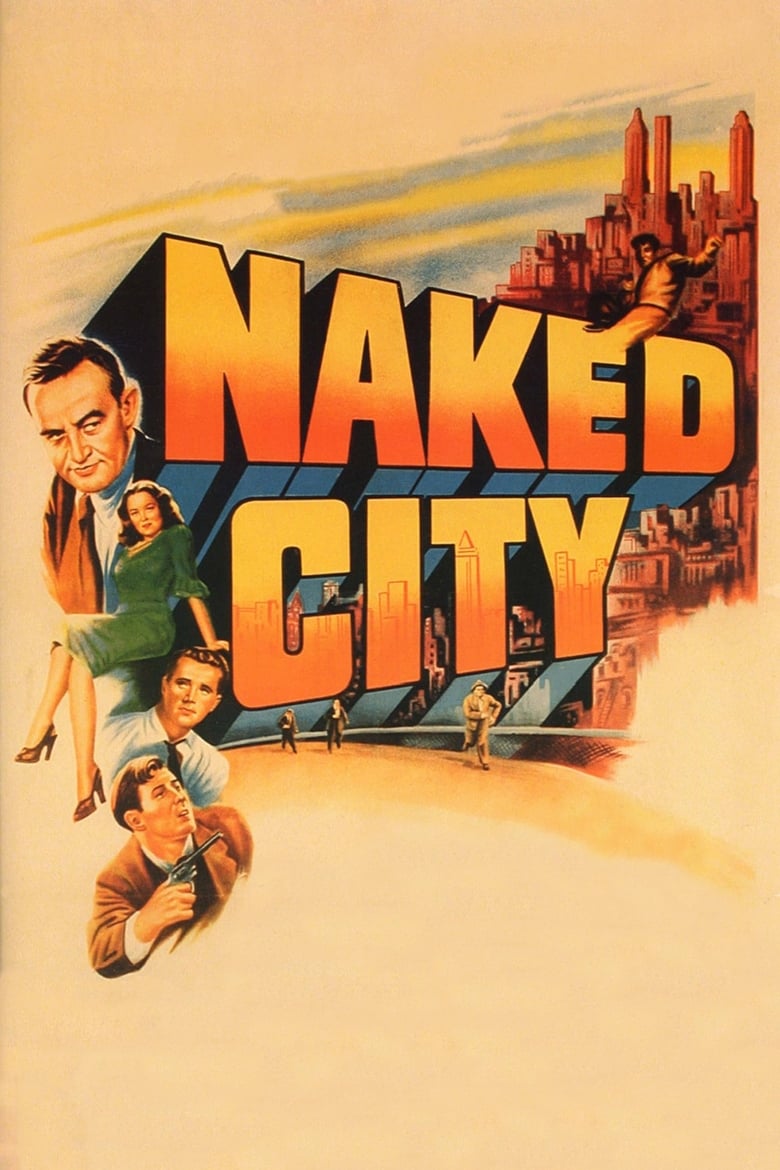
In the pre-dawn hours of a New York summer, a young model named Jean Dexter is found drowned in her apartment bathtub. The case falls to Lieutenant Dan Muldoon, a weathered, sardonic homicide detective, and his junior partner Jimmy Halloran, a family man still finding his footing on the force. Working out of a real Manhattan precinct against a backdrop of actual city streets, the investigation begins with the slow, unglamorous accumulation of facts: interviews with neighbors, cross-checks with vice records, and the gradual construction of a portrait of a woman whose life was more complicated than her death first suggests.
The inquiry draws in Frank Niles, a slick and evasive man with connections to the victim and a talent for partial truths, and eventually points toward a network of petty criminals and muscle-for-hire operating at the fringes of legitimate society. As Muldoon and Halloran close the distance, the film shifts its weight from procedural routine to something more pressurized. Willy Garzah, the most dangerous figure in the chain, becomes the target of a chase that the city itself seems to absorb and complicate at every turn. The film refuses to romanticize either the detective's instincts or the criminal's desperation.
Naked City belongs to a specific postwar impulse in American crime cinema: the desire to strip the genre of studio artifice and set it down on pavement that actually exists, among faces that were never meant for the movies. Produced with extensive location photography across Manhattan, it turns the city into both setting and subject, a place whose density and indifference are as much a part of the moral equation as any individual act. The film's famous closing declaration – that there are eight million stories in the naked city – frames the murder as one data point in an enormous, ongoing human ledger.
Naked City arrived in 1948 as one of the more deliberate formal experiments in postwar American noir, its ambitions declared openly by producer Mark Hellinger's narration, which frames the film as documentary record rather than genre entertainment. Jules Dassin, working in the year before his blacklisting effectively ended his American career, channels the neorealist impulse then reshaping European cinema into a recognizably Hollywood procedural. The result sits in productive tension with itself: a studio film that distrusts studio space, a genre exercise that keeps interrupting its own conventions to inventory a street corner or a tenement stairwell. Barry Fitzgerald's Muldoon is shrewdly cast against type – his Irish theatricality functioning as a kind of deliberate mask over the film's colder procedural logic. What Naked City ultimately argues, with more rigor than its documentary surface might suggest, is that crime in a modern city is less a matter of individual moral failure than of social density and economic friction – a thesis that places it closer to the reformist journalism of its era than to the fatalism that defines classical noir.
– Classic Noir
Cinematographer William H. Daniels shoots the Williamsburg Bridge sequence in flat, unsparing daylight – a deliberate refusal of the expressionist shadow vocabulary most noir reserves for its climactic moments. The camera works at a distance for the establishing geography, then closes with handheld urgency as Willy Garzah ascends the bridge's steel lattice. The vertical axis dominates: the fugitive climbing, the city receding below, the frame organizing itself around the irony of a man seeking escape by moving upward into a structure that goes nowhere useful. Light reflects off the bridge's metalwork without drama, rendering the setting precisely as it is rather than as fear might distort it.
The choice of open daylight is the sequence's critical argument. Garzah has no darkness to shelter in, no shadows that might suggest a world complicit in his flight. The city continues below – traffic, the river, the ordinary commerce of a Tuesday – indifferent to the fact of a man dying above it. The sequence positions the criminal not as a figure of noir's romantic fatalism but as a problem the city's infrastructure will eventually solve, with or without the intervention of the detectives climbing behind him. His fall is less tragedy than administrative conclusion.
William H. Daniels, whose career stretched from the silent era through his collaborations with Greta Garbo and his later work on Brute Force, brings to Naked City a disciplined refusal of the atmospheric excess that defined much studio-bound noir. Shooting on location across Manhattan with stripped-down equipment adapted for street conditions, Daniels calibrates his exposure for the specific quality of available New York light – the harsh mid-morning glare of a commercial district, the softer fill that comes off the Hudson in the late afternoon. Interior sequences, still necessarily controlled, are lit to match rather than contradict what the exteriors establish, maintaining a tonal consistency that reinforces the film's documentary argument. Where a conventional noir cinematographer might reach for low angles and oppressive shadow to signal menace, Daniels tends toward the observational – the camera positioned as though it simply arrived somewhere and found what was already there. The moral logic served by this approach is specific: guilt in this film is not an atmosphere but a fact, and the city's light is indifferent enough to illuminate it without judgment.
The Criterion Channel presents a clean transfer that respects Daniels's location photography; the best available streaming option for the film's visual detail.
TubiFree (Ad-Supported)Tubi has carried the film in a public domain print; image quality varies, but it is a no-cost option for first-time viewers.
Archive.orgFreeA public domain transfer is available for streaming or download, though viewers should verify the specific print quality before committing to a feature-length watch.