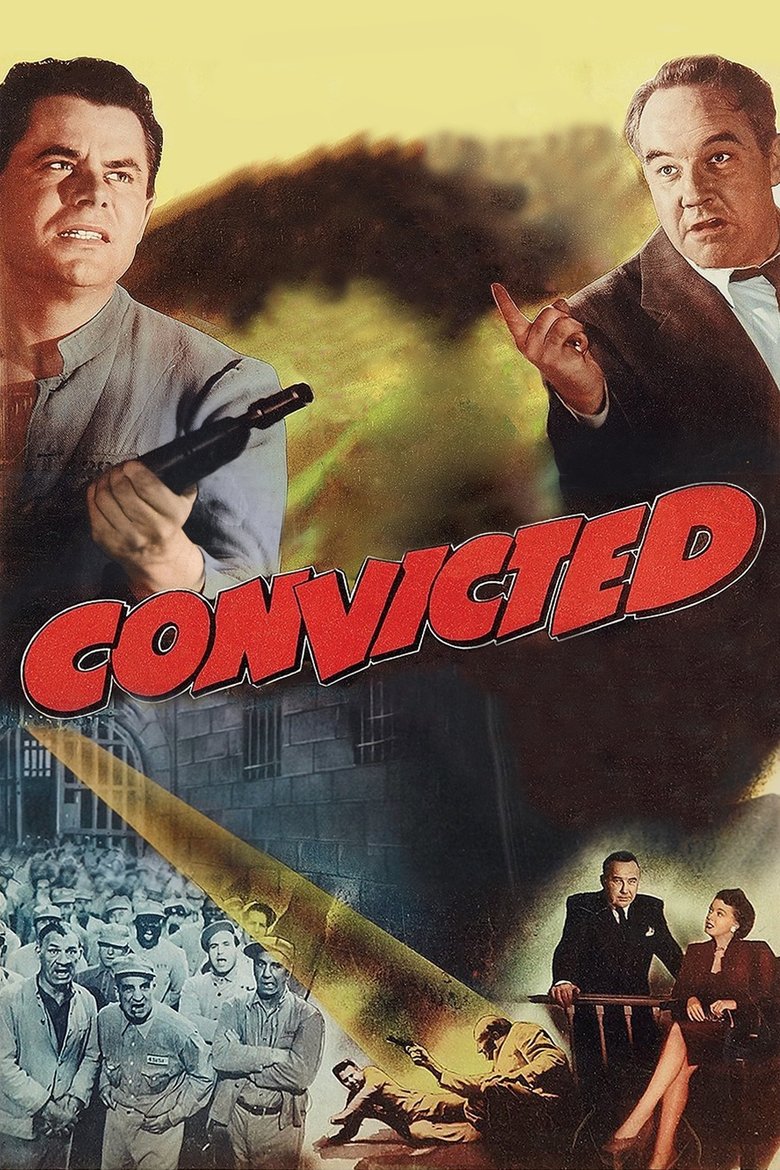
Joe Hufford (Glenn Ford) is convicted of manslaughter after a barroom killing he did not intend, sent to a state penitentiary for a crime that sits somewhere between accident and misfortune. The district attorney who prosecuted him, George Knowland (Broderick Crawford), is appointed warden of the very prison where Hufford serves his sentence – a coincidence loaded with moral weight. Knowland's daughter Kay (Dorothy Malone) had been present at the fatal incident and carries her own complicated version of events.
Inside the prison, Hufford navigates a population stratified by violence and self-interest. Convicts Ponti (Frank Faylen) and Mapes (Will Geer) represent the institution's predatory underside, while the cynical veteran Malloby (Millard Mitchell) offers a more ambiguous form of solidarity. Knowland, facing the man his prosecution sent away, must reckon with the distance between legal conviction and moral certainty. Kay's presence – and what she knows – becomes a pressure point that neither her father nor Hufford can ignore.
Convicted operates within the prison-noir tradition, using the penitentiary as a closed system in which the machinery of justice and the machinery of power are shown to be imperfectly aligned. The film is less interested in escape than in the question of what a man owes to a system that has wronged him, and what that system owes in return.
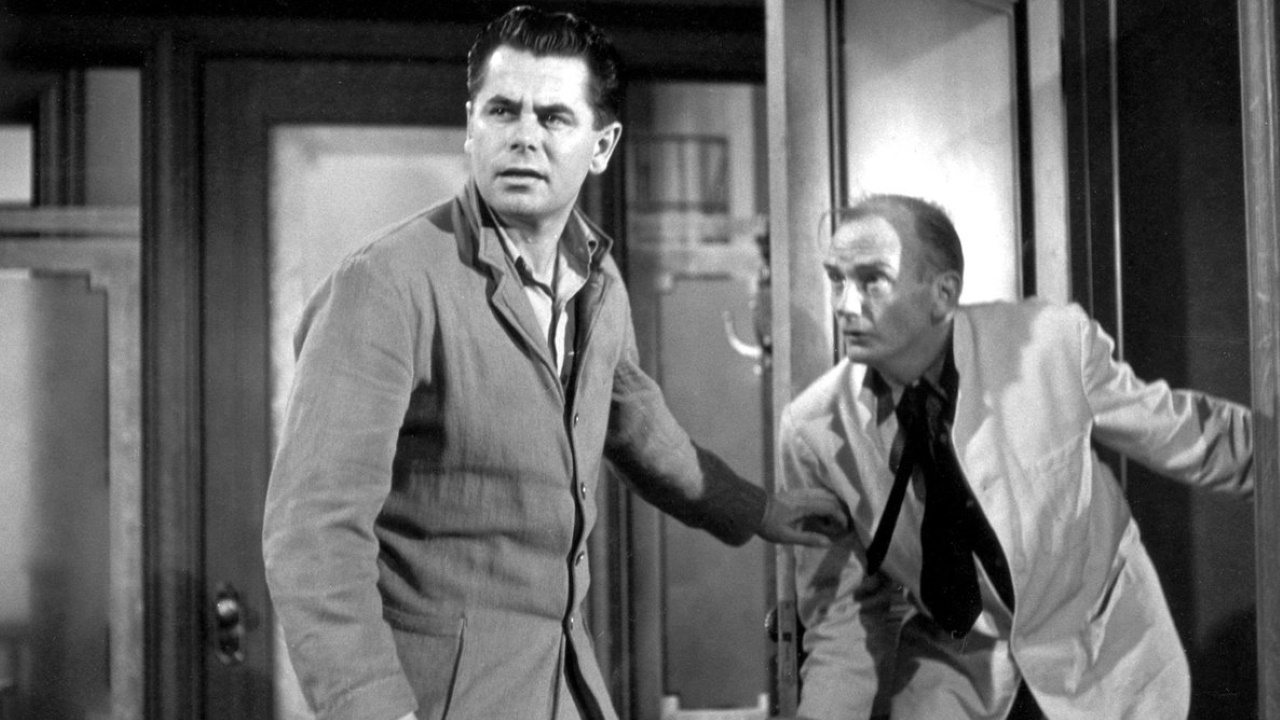
Convicted arrives in 1950 as part of a cycle of prison pictures that Columbia was quietly developing as vehicles for examining institutional authority in the postwar decade. Henry Levin directs with efficiency rather than ambition, but the film earns its place in the noir catalogue through the tension between its two leads. Glenn Ford plays Hufford with the contained frustration he had already refined in Gilda and The Undercover Man – a man whose virtue is legible but not sentimental. Broderick Crawford, fresh from his Academy Award for All the King's Men, brings to Knowland the particular exhaustion of a man who has confused procedural correctness with justice. The film's central argument – that the legal apparatus can be technically right and humanly wrong – connects it to a broader noir preoccupation with institutions as moral hazards. Dorothy Malone's Kay functions as the story's conscience, the one figure who holds knowledge that could correct the record. Convicted is not a film that reinvents its form, but it executes that form with enough integrity to warrant attention.
– Classic Noir
Burnett Guffey frames the confrontation between Knowland and Hufford across a wide desk that functions as both barrier and exhibit. The warden's side is lit by a practical lamp that catches Crawford's face in three-quarter light, emphasizing the institutional authority he now carries. Hufford stands in a slightly cooler, flatter zone – the light of the administered rather than the administrator. The camera holds on a medium two-shot longer than convention demands, refusing to cut away from the discomfort that fills the space between them.
The scene makes visible what the film is fundamentally about: the same facts, read by two men with different investments in them, produce two irreconcilable positions. Knowland cannot admit error without dismantling his own legitimacy. Hufford cannot accept silence without surrendering his. The desk between them is the law itself – present, unmoved, insufficient.
Burnett Guffey, who would later shoot From Here to Eternity and Bonnie and Clyde, brings to Convicted the disciplined low-key style he was developing at Columbia in the late 1940s. Working almost entirely on studio-constructed sets that replicate cell blocks, administrative corridors, and yards with persuasive compression, Guffey uses pools of hard light against dark mid-ground space to reinforce the sense of confinement without resorting to expressionist distortion. The prison is not gothic here – it is procedural, which makes it more oppressive. Guffey's lens choices favor a moderate focal length that keeps faces in honest proportion to their surroundings, denying characters the heroic distortion of wide-angle close-ups. Shadow work is deployed most precisely in the transitional spaces – doorways, staircases, corridors – where characters move between the relative clarity of authority and the moral ambiguity that lives just beyond its reach. The cinematography serves Levin's thematic argument by making the institution look exactly as credible and exactly as cold as it needs to.
Tubi has carried Columbia noir titles from this period and is the most likely free streaming source, though availability should be confirmed before visiting.
TCMSubscriptionTCM licenses Columbia catalog noir regularly and presents films in uncut broadcast versions; check the schedule for upcoming air dates.
Archive.orgFreePublic domain prints of Columbia titles from this era occasionally appear on Archive.org, though transfer quality varies considerably.