Films People Pull a Fast One Night Beat Reading Room On TV Shop
Jigsaw 1949
1949 Tower Pictures Inc.
★★★☆☆ Notable
Film Noir · 70 minutes · Black & White

Jigsaw

Directed by Fletcher Markle
Year 1949
Runtime 70 min
Studio Tower Pictures Inc.
TMDB 5.0 / 10
"A city's silence can be as damning as its noise."

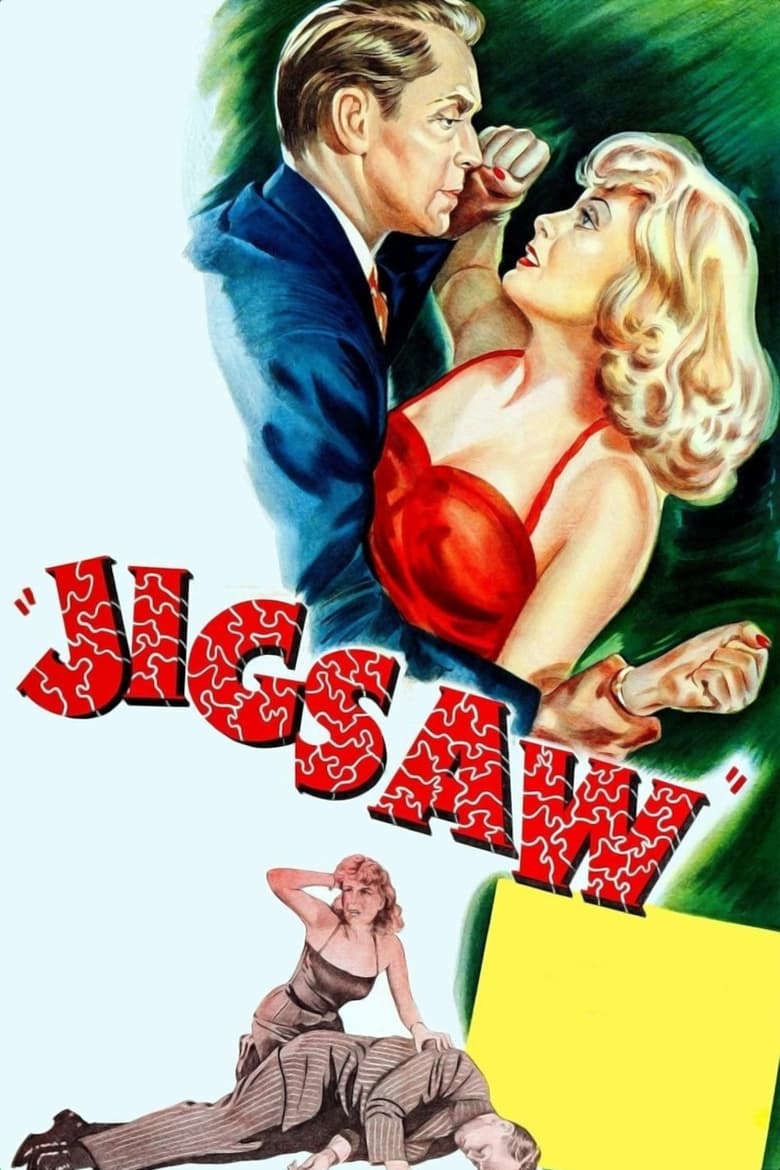
Howard Malloy is an assistant district attorney in New York City with a reputation for pursuing cases others prefer to leave alone. When a woman is murdered after passing him a piece of hate literature linked to a shadowy fascist organization, Malloy finds himself drawn into an investigation that reaches far deeper into the city's civic and criminal fabric than a single homicide would suggest. His initial inquiry is straightforward; the resistance he encounters is not.

As Malloy presses further, the case entangles him with Barbara Whitfield, a woman whose connection to the dead victim raises questions about loyalty and exposure, and with Charles Riggs, a figure whose affiliations prove difficult to fix with certainty. The organization behind the propaganda operates through intermediaries and enforcers, among them the blunt and menacing Angelo Agostini, and its reach into positions of influence gives Malloy reason to distrust the very institutional machinery he represents.

Jigsaw uses the procedural framework of a murder investigation to examine how organized hate sustains itself through respectable cover and civic indifference. The film belongs to that postwar cycle of American noir concerned less with individual corruption than with systemic rot, placing its protagonist not in the role of a lone detective but of a public servant whose effectiveness depends on institutions that may already be compromised.

Classic Noir

Jigsaw occupies a specific and underexamined corner of late-1940s noir, one in which the genre's fatalism is directed not toward erotic obsession or criminal ambition but toward political vigilance. Produced independently by Tower Pictures, it reflects a moment when American cinema was willing, however briefly, to name organized bigotry as a structural threat rather than an aberration. Fletcher Markle directs with economy rather than flair, and the film benefits from that restraint; the absence of visual showmanship keeps the procedural mechanics credible. Franchot Tone brings a quality of controlled weariness to Malloy that suits the material better than conventional heroics would. The film's cameo appearances from figures including Marlene Dietrich and Henry Fonda, uncredited, have attracted curiosity over the decades, but Jigsaw earns its place in the genre catalogue on substantive grounds: it demonstrates that noir's moral seriousness could be turned toward civic argument, and that the threat of the unseen organization was as potent a source of dread as any single antagonist.

– Classic Noir
3 ★★★☆☆ Notable
Credits

The Crew

DirectorFletcher Markle
ScreenplayJohn Roeburt
CinematographyDon Malkames
MusicRobert W. Stringer
EditingRobert Matthews
ProducerHarry Lee Danziger
Performances

The Cast

Close Reading

The Signature Scene

Jigsaw – scene
The Printshop Discovery Light Through Stacked Type

Don Malkames frames the interior of the printshop in deep shadow, allowing the industrial geometry of presses and stacked type trays to dominate the background while Malloy moves through a narrow channel of available light. The camera holds at a low angle, making the machinery loom with an authority that dwarfs the human figure. A single overhead source casts hard shadows across the propaganda sheets lying on the compositing table, the text partially legible, partially swallowed by darkness.

The composition does precise work: the materials of persuasion are present but not fully visible, which is the film's argument made spatial. Malloy can see enough to understand the threat but not enough to act decisively, and the frame acknowledges this condition rather than resolving it. The scene establishes that the enemy in Jigsaw is not a man with a gun but a process, reproducible and anonymous, and that understanding it requires entering spaces where the normal guarantees of illumination do not apply.

Visual Language

The Cinematography

🎞️
Don Malkames – Director of Photography

Cinematographer Don Malkames, working within the constraints of an independent production with a limited budget and a predominantly location-based New York shoot, turns necessity into a coherent visual argument. His use of available light and practical sources in exteriors gives the film a documentary texture that reinforces its civic subject matter; these are real streets carrying real social weight. In interiors, Malkames favors tight framing and lateral shadow that isolates characters within the frame rather than connecting them, a compositional logic that mirrors the film's thematic concern with concealment and incomplete information. He avoids the expressionist excess common to studio noir of the period, working instead with a flatter, grainier image that suits the procedural register. The effect is a city that looks neither glamorous nor entirely menacing but simply occupied, full of people conducting ordinary business while something dangerous runs beneath the surface. That visual restraint is not a limitation; it is the film's most disciplined formal choice.

In the Catalogue

Themes & Motifs

Availability

Where to Watch

Also in the Directory

See Also