Frank McCloud, a disillusioned ex-Army officer, travels to a run-down hotel on Key Largo to pay his respects to the father and widow of a former comrade killed in the war. James Temple owns the hotel; Nora Temple, his daughter-in-law, has kept it running out of loyalty and grief. When Frank arrives, he finds the place locked down against an approaching hurricane – and occupied by men he was not expecting.
The uninvited guests are Johnny Rocco, a deported mob boss making a covert return to Florida, and his small crew of enforcers and hangers-on. Rocco holds the Temples and Frank at gunpoint, waiting for a transaction to conclude before the storm passes. Frank, hollowed out by the war and by a corrosive cynicism about causes worth dying for, refuses to play the hero – a stance that puts him in direct moral collision with Nora, who believes her husband's sacrifice meant something, and with Rocco, who reads passivity as cowardice he can exploit.
Key Largo operates as a chamber noir, confining most of its action to a single building under siege, using the hurricane as both physical pressure and moral amplifier. The film asks whether a man who has survived one kind of violence can find sufficient reason to resist another, and whether the ordered world the returning soldier was promised ever existed at all. It belongs to a postwar cycle of American crime pictures that locate evil not in shadowy urban margins but in the daylight institutions – hotels, law, civic order – that criminals learn to use as cover.
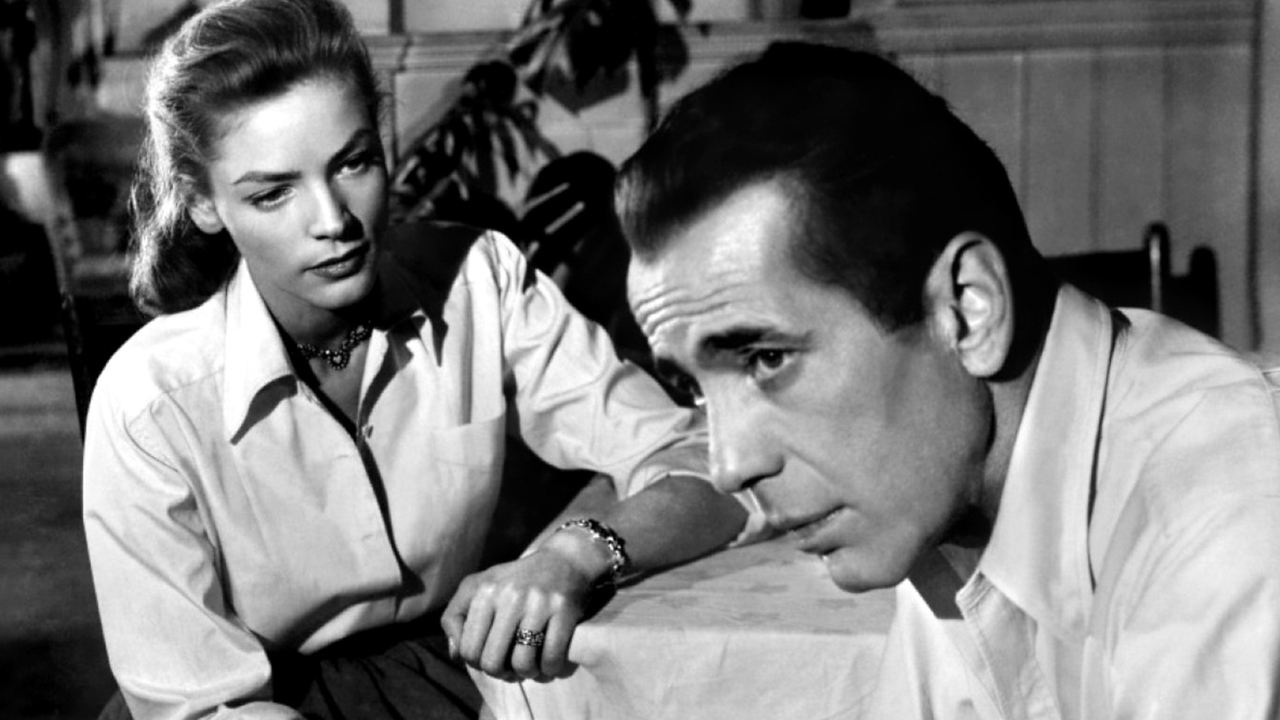
Key Largo occupies a transitional position in the noir canon: it is more theatrical than cinematic in its origins – Maxwell Anderson's 1939 stage play provides the armature – yet John Huston and Richard Brooks's adaptation sheds the allegory's wartime specificity in favor of something colder and more durable. Edward G. Robinson's Rocco is one of the genre's defining portraits of organised crime, not because the character is subtle but because Robinson refuses sentimentality in either direction, making Rocco's vanity and cowardice feel structurally related to his cruelty. Bogart's Frank McCloud is the more complex figure: a man whose cynicism is a wound, not a pose. What the film reveals about 1948 is the difficulty American culture had in converting wartime sacrifice into peacetime meaning. The hurricane serves this argument honestly – it is not a metaphor tacked on but a condition that strips away the hotel's pretensions to safety and order, leaving the characters with nothing between them but what they are. Karl Freund's photography deepens this exposure without aestheticising it.
– Classic Noir
The camera holds on Gaye Dawn, Rocco's alcoholic companion, as she performs a degraded nightclub number for an audience of bored gunmen. Freund lights the scene from below and to one side, casting long shadows up the lobby walls that dwarf the human figures without dramatising them. The frame keeps Rocco at the edge, half in darkness, watching with the flat attention of a man who owns what he is watching. When the song ends and Gaye begs for the whiskey she was promised, Huston cuts to a series of tight two-shots that reduce the lobby's space to something like a cell.
The sequence crystallises the film's argument about power: Rocco's cruelty is not passionate but procedural, a habit of control exercised because no one in the room has yet decided to stop him. Frank watches from the background, and Freund keeps him in soft focus – present but not yet resolved. The scene does not ask for sympathy for Gaye so much as it forces a reckoning with the cost of waiting for the right moment to act. Passivity, the film suggests, is its own form of complicity.
Karl Freund, whose career stretched back to German Expressionism and whose work on Metropolis and Dracula had established the expressive range of studio-era shadow photography, brings to Key Largo a restraint that serves the material precisely. Working entirely on Warner Bros. studio sets, Freund constructs the hotel as a space of shrinking interiors: wide shots of the lobby gradually give way to tighter framings as Rocco's control tightens, a compression that is spatial before it is psychological. He uses low-key lighting not for atmosphere as an end in itself but to map moral clarity – the characters who are most certain of their position tend to inhabit the frame's lit zones, while Frank McCloud persists in ambiguity at the margins. During the hurricane sequences, practical light sources – lamps, flashlights – anchor the compositions in a physical reality that keeps the Gothic pressure of the storm from tipping into melodrama. The result is a visual language that is sober and functional, qualities that match the film's unwillingness to romanticise either its villain or its reluctant hero.
As a Warner Bros. production, Key Largo appears on Max and is the most straightforward subscription option for most viewers in the United States.
TCMSubscriptionTCM broadcasts Key Largo regularly and the TCM app offers on-demand access to it as part of a cable or streaming package; presentation quality is reliable and contextual programming is often provided.
TubiFree (Ad-Supported)Key Largo has appeared on Tubi at no cost, though availability on free platforms fluctuates and the transfer quality may vary from the versions on subscription services.