Films People Pull a Fast One Night Beat Reading Room On TV Shop
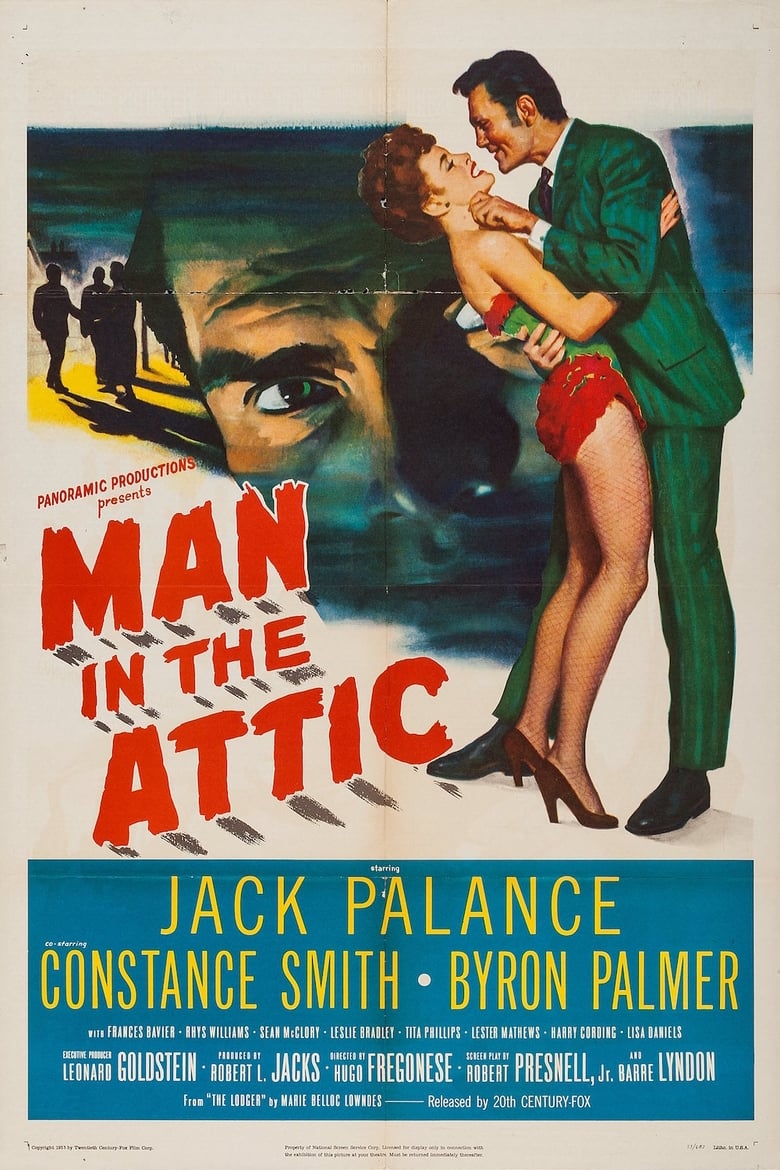
Man in the Attic 1953
1953 Panoramic Productions
★★★☆☆ Notable
Film Noir · 82 minutes · Black & White

Man in the Attic

Directed by Hugo Fregonese
Year 1953
Runtime 82 min
Studio Panoramic Productions
TMDB 5.5 / 10
"A quiet lodger in a fog-bound city, and the streets grow quieter still."

London, the autumn of 1888. A soft-spoken pathology student named Slade takes a room in the Harley household, arriving with a black bag and an air of deliberate reserve. His landlords, William and Helen Harley, are unremarkable people living in a city gripped by fear: the Whitechapel murders are ongoing, and the police have no suspect. Slade is precise, self-contained, and oddly contemptuous of women, a quality that Helen's niece Lily Bonner – a music-hall performer who also lodges in the house – registers but cannot quite name.

Inspector Paul Warwick is assigned to the Ripper case and finds himself drawn to Lily, which places him in an increasingly charged proximity to Slade. The household becomes a closed geometry of suspicion: Warwick watching Slade, Slade watching Lily, Lily caught between attraction and unease. As the murders continue and Slade's nocturnal absences multiply, Helen begins to voice the fear that no one in the house has been willing to articulate aloud. The investigation tightens, but the evidence remains circumstantial, and Slade's composure does not break.

Man in the Attic works as a period noir transposed onto one of the genre's oldest anxieties – the monster who rents a room, who eats at your table and says good night on the landing. The Jack the Ripper scaffold allows the film to examine guilt as a quality of presence rather than proof, and to ask how much danger a woman must feel before her feeling counts as evidence. The film belongs to a cycle of 1950s noirs that locate evil not in crime syndicates or corrupt institutions but in the furnished rooms of ordinary domesticity.
Classic Noir

Man in the Attic is the second sound adaptation of Marie Belloc Lowndes's 1913 novel The Lodger, following John Brahm's more celebrated 1944 version with Laird Cregar, and it benefits from the comparison only partially. What Hugo Fregonese's film contributes is Jack Palance, whose angular physicality and coiled reticence make Slade something other than the trembling neurotic Cregar played – here the menace is cold rather than febrile, and the film is more disturbing for it. Fregonese, an Argentine director working fluently within the Hollywood studio framework, keeps the period setting from becoming picturesque: the gaslit streets function as a moral condition as much as a visual one. The film does not overexplain its protagonist, and that restraint is its primary strength. Where it falters is in the romantic subplot, which asks Byron Palmer to anchor scenes that pull against Palance's gravitational weight. At eighty-two minutes it is economical without being quite lean, and its central performance earns it a place in any serious survey of postwar American noir.

– Classic Noir
3 ★★★☆☆ Notable
Credits

The Crew

DirectorHugo Fregonese
ScreenplayRobert Presnell Jr.
CinematographyLeo Tover
MusicHugo Friedhofer
EditingMarjorie Fowler
Art DirectionLeland Fuller
CostumesTravilla
ProducerRobert L. Jacks
Performances

The Cast

Close Reading

The Signature Scene

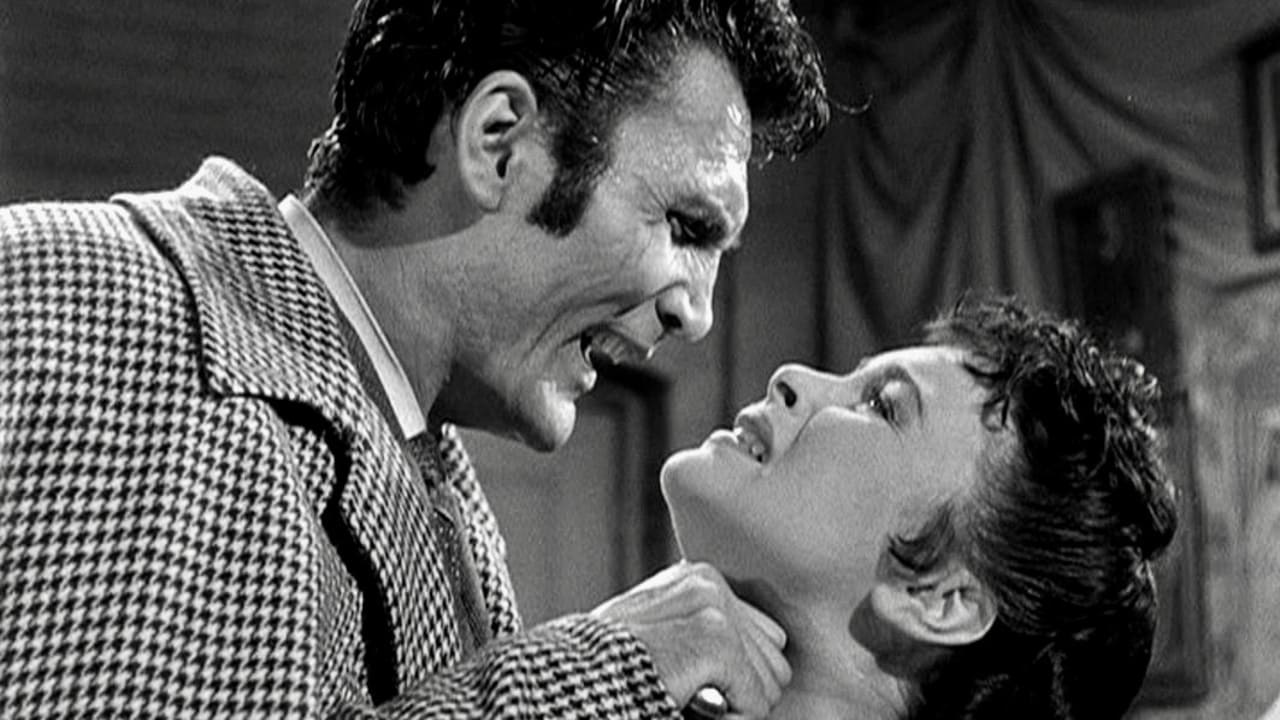
Man in the Attic – scene
The Attic, Late Evening Slade Alone with the Knife

Leo Tover frames Slade in the upper room with a single practical lamp throwing a hard cone of light downward, leaving the ceiling and the far walls in near-total darkness. The camera holds at a slight low angle, so that Palance's face catches the light unevenly – one side readable, one side consumed by shadow. The composition refuses symmetry: the black bag sits at the edge of the frame, in focus but peripheral, its contents implied rather than shown. The fog pressing against the dormer window flattens the background to a uniform grey, sealing the room off from the city below.

The scene does not confirm guilt; it constructs the texture of it. What Tover and Fregonese achieve here is the rendering of interiority as visual fact – the way a man sits in a room, the way he holds something with excessive care, becomes its own form of testimony. The film's central argument is that guilt can be atmospheric before it is evidentiary, and this scene is where that argument is made most precisely.

Visual Language

The Cinematography

🎞️
Leo Tover – Director of Photography

Leo Tover's work on Man in the Attic is studio-bound noir photography operating under the discipline of period constraint: Victorian London cannot carry the neon and wet asphalt of contemporary noir, so Tover builds his visual language from gas flame, fog diffusion, and the geometry of narrow interiors. He favors tight focal lengths in the Harley house, which compress the space and make proximity between characters feel like pressure. Shadow is deployed architecturally rather than expressionistically – it maps the house's vertical logic, with the lodger's attic existing in permanent half-dark while the parlor below retains a thin domestic warmth. The fog exteriors, almost certainly shot on studio backlots, are lit from low sources that eliminate mid-ground detail and push figures into silhouette. This is not decorative gloom; it serves the film's moral logic, in which the truth about Slade remains perpetually at the edge of visibility – present, suggested, never quite resolved into certainty.

In the Catalogue

Themes & Motifs

Availability

Where to Watch

Also in the Directory

See Also