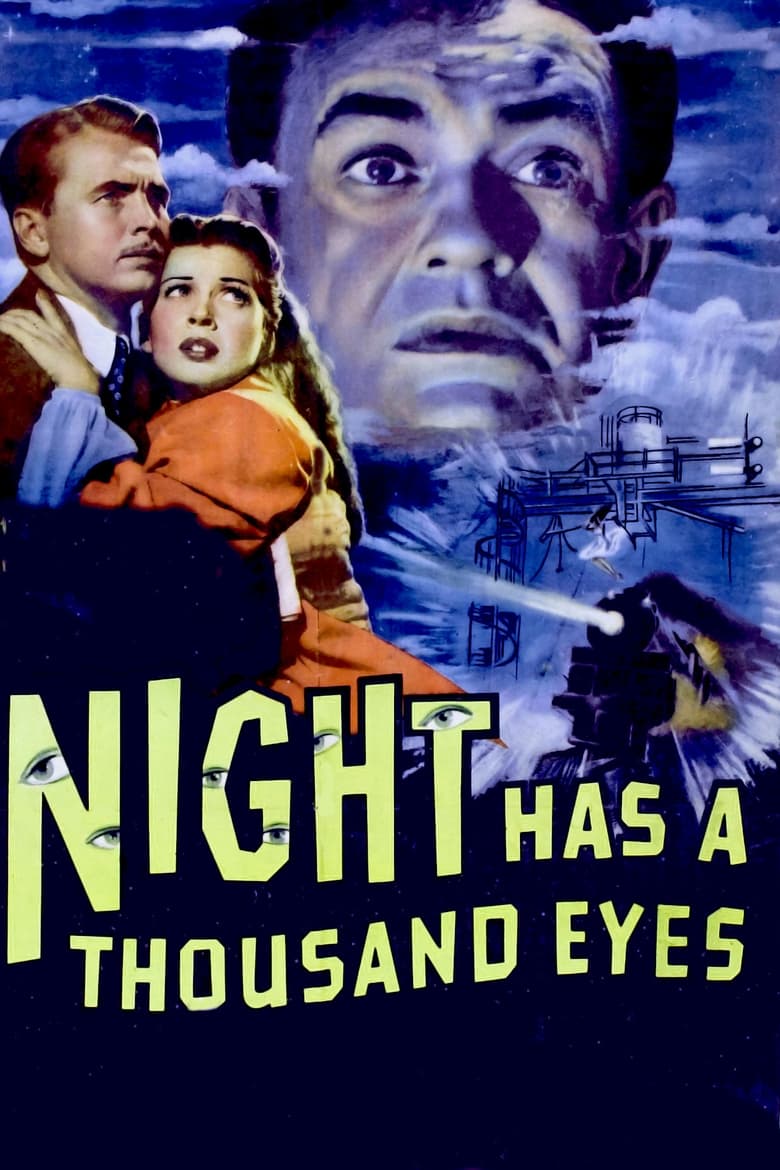
In late 1940s San Francisco, police lieutenant Shawn pulls Elliott Carson back from the edge of a bridge, where the young man has gone to end his life. Carson explains that his fiancée, Jean Courtland, is fated to die at midnight – a prophecy delivered by John Triton, a broken-down mentalist who claims to possess genuine second sight. What follows is a long, desperate account of how three lives came to intersect around a gift that no one, least of all Triton, wished was real.
Triton's story begins years earlier, when he worked as a fraudulent stage performer alongside Jean's father, Whitney Courtland, and a woman named Jenny. When Triton discovers that his visions are not fabrications but true predictions – including one that ends in tragedy for Jenny – he abandons the act and retreats into isolation, guilt, and poverty. Now, against his own will, he is drawn back into the Courtland family's orbit, bearing foreknowledge of Jean's death at the jaws of a lion before the night is through. Whitney Courtland dismisses him as a confidence man; Carson believes him absolutely; and Jean, fragile and resigned, seems almost to accept her fate.
Night Has a Thousand Eyes occupies a specific corridor of postwar noir where the supernatural and the psychological are held in deliberate, unresolved tension. The film does not ask the audience to choose between rational explanation and genuine clairvoyance so much as it asks what it costs a man to know things he cannot change. That question – of foreknowledge as burden rather than power – aligns it with the genre's deepest fatalist current, even as John Farrow keeps the mechanics of the thriller intact and the clock visibly running.
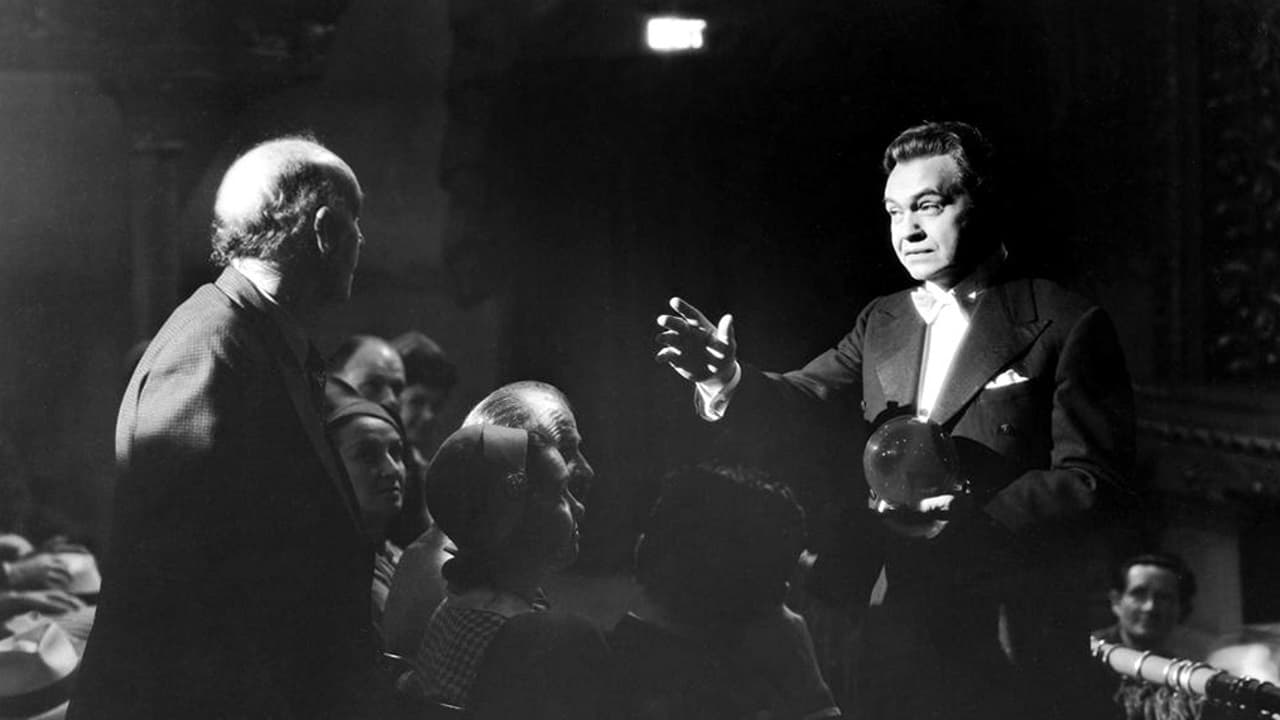
Night Has a Thousand Eyes is one of the more unusual films to emerge from Paramount's postwar noir cycle, and its peculiarity is precisely what gives it staying power. John Farrow, working from Cornell Woolrich's novel by way of a screenplay by Barré Lyndon and Jonathan Latimer, refuses to fully rationalize Triton's gift, which places the film at an oblique angle to genre convention. Edward G. Robinson's performance is the axis on which everything turns: he plays Triton not as a mystic or a showman but as a man ground down by certainty, a figure whose suffering is proportional to his accuracy. The casting carries its own irony – Robinson, so long associated with the exercise of will and force, here embodies helplessness. John F. Seitz's photography keeps the film visually honest, resisting any temptation toward expressionist excess in favor of a bleaker, more intimate darkness. The film does not entirely resolve the tension between its thriller mechanics and its metaphysical premise, but that irreducibility is part of its interest. It belongs to a subset of noir concerned less with crime than with fate, and in that company it holds its own.
– Classic Noir
Seitz frames the exterior night in compressed, sourceless shadow, with the observatory dome rising behind the action as a pale geometric mass against a black sky. The lion's enclosure is lit from a low angle that catches the animal's movement without fully exposing the surrounding space, producing a frame in which solid ground feels provisional. Carson and Shawn converge from separate directions, the camera tracking each in tight, urgent cuts rather than a single establishing shot, so that spatial orientation remains slightly uncertain until the last possible moment. The light falls on Jean in the manner of an object already at rest.
The scene is the film's argument made physical: Triton has seen this moment with absolute clarity, and the machinery of rescue arrives not to disprove fate but to enact it by other means. Whether the prophecy is fulfilled or deflected is almost beside the point – what the sequence insists upon is that the night has already happened, somewhere, in Triton's mind, and that everyone present is moving through a script they did not write. The tension is not between danger and safety but between knowing and being unable to act soon enough.
John F. Seitz, who shot Double Indemnity and Sunset Blvd. for Billy Wilder, brings to Night Has a Thousand Eyes a more subdued and inward visual strategy than those films required. Working largely on Paramount studio sets with controlled artificial light, Seitz avoids the theatrical shadow geometry that defines the most celebrated noir cinematography in favor of a flatter, colder darkness – the kind that suggests not moral corruption so much as simple absence of warmth. He uses medium-focal-length lenses that keep faces readable without flattering them, and his lighting setups for Triton frequently place Robinson in partial silhouette or against neutral, textureless backgrounds, visually isolating the character from the world he can see but not alter. The nighttime exterior sequences, including the bridge opening and the observatory climax, are shot with a minimum of fill light, allowing the frame's edges to dissolve into black rather than resolving into recognizable space. This restraint serves the film's moral logic: a man burdened by vision should inhabit a world that looks exactly this unilluminated.
The most reliable streaming home for Paramount noir of this period; check current availability as titles rotate seasonally.
TCMSubscriptionTCM broadcasts the film periodically as part of its noir and Edward G. Robinson programming blocks; scheduling varies.
Archive.orgFreeA public domain print may be available, though video and audio quality cannot be guaranteed to match licensed transfers.