Films People Pull a Fast One Night Beat Reading Room On TV Shop
Street of Chance 1942
1942 Paramount Pictures
★★★☆☆ Notable
Film Noir · 74 minutes · Black & White

Street of Chance

Directed by Jack Hively
Year 1942
Runtime 74 min
Studio Paramount Pictures
TMDB 5.4 / 10
"A man without a past finds one he cannot escape."

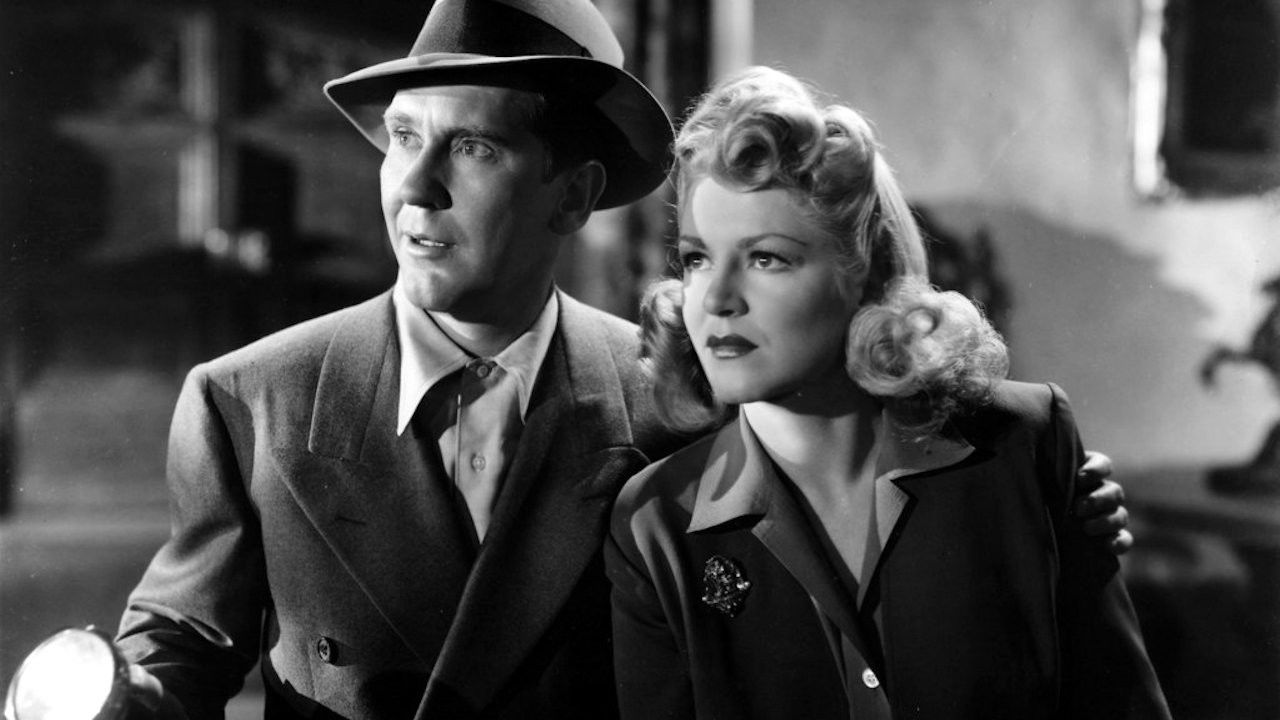
Frank Thompson (Burgess Meredith) steps off a curb in New York City and wakes up with no memory of the preceding year. The suit he is wearing is not his own, the city block around him is unfamiliar, and the woman who finds him – Ruth Dillon (Claire Trevor) – knows him by a different name. Slowly, and with her reluctant help, Frank begins to reconstruct a missing life he is not certain he wants to reclaim.

The trail leads to a suburban household presided over by the cold, watchful Alma Diedrich (Frieda Inescort) and her husband Bill (Jerome Cowan), and to the discovery that the man Frank apparently was during his lost year stands accused, in everything but formal law, of murder. Back in the city, his loyal wife Virginia (Louise Platt) waits in ignorance while Frank's inquiries draw the attention of Joe Marruci (Sheldon Leonard), a syndicate operative with reasons of his own to control what the amnesiac remembers.

Adapted from Cornell Woolrich's novel 'Black Alibi' – here transposed from Woolrich's usual nocturnal dread to a more procedural register – the film uses the amnesia premise not as a gimmick but as a sustained metaphor for guilt, identity, and the uneasy relationship between who a man believes himself to be and what the record shows. The resolution hinges less on action than on the credibility of memory itself, placing it in the company of noir's most psychologically attentive work.
Classic Noir

Street of Chance occupies an instructive position in early American noir: released the same year as This Gun for Hire and just ahead of the cycle's first sustained wave, it demonstrates how Woolrich's source fiction translated to screen before genre conventions had fully calcified. Jack Hively's direction is workmanlike rather than distinctive, but the film's intelligence resides in its central proposition – that amnesia is not merely a plot device but a moral condition. Burgess Meredith brings an unshowy credibility to a man who must simultaneously solve a crime and judge himself, and Claire Trevor, already a specialist in women whose loyalty is purchased at considerable personal cost, adds texture the screenplay alone does not quite earn. The film's compressed runtime keeps the procedural elements moving without allowing the psychological undertow to surface as fully as Woolrich's source material warrants. As an early Paramount entry in what would become a dominant studio mode, it rewards attention as a document of the genre finding its footing.

– Classic Noir
3 ★★★☆☆ Notable
Credits

The Crew

DirectorJack Hively
ScreenplayGarrett Fort
CinematographyTheodor Sparkuhl
MusicDavid Buttolph
EditingArthur P. Schmidt
Art DirectionHans Dreier
Performances

The Cast

Close Reading

The Signature Scene

Street of Chance – scene
The Diedrich Parlor Strangers Pretending to Know Him

Theodor Sparkuhl frames Frank's first sustained scene inside the Diedrich house with a deliberate spatial unease: the camera holds at a slight remove, keeping the room's furniture between Frank and the family as if the architecture itself registers his trespass. The key light falls on Alma Diedrich rather than on Frank, so that her face is legible while his remains partially shadowed – the man who cannot remember rendered visually incomplete even in medium shot. The parlor's period furnishings, meticulously dressed, feel less like comfort than confinement.

What the scene argues, without stating it, is that the Diedrich household has its own investment in Frank's amnesia – that his forgetting is not simply his misfortune but their convenience. Alma's controlled hospitality, her careful sentence construction, the way her eyes check his face for recognition rather than offering any of her own: these details establish that the people Frank encounters in this missing year have narratives prepared, and that the truth, if it exists, will have to be forced into the open rather than volunteered.

Visual Language

The Cinematography

🎞️
Theodor Sparkuhl – Director of Photography

Theodor Sparkuhl, a German-trained cinematographer who had worked in the UFA system before emigrating, brings to Street of Chance a continental preference for deep shadow and compressed interiors that suits Woolrich's moral atmosphere even when Hively's direction does not fully press its advantage. Sparkuhl avoids the expressionist excess that sometimes overwhelmed lesser noir work of the period, instead deploying graduated shadow gradients across faces and walls to suggest psychological states rather than announce them. His work on the interior sequences – lit as though the rooms themselves are withholding information – contrasts effectively with the film's outdoor New York passages, which carry a documentary flatness that makes the protagonist's disorientation register as physical fact. The use of slightly constricted focal lengths in two-person exchanges creates a subtle claustrophobia, placing characters uncomfortably close within the frame as though they cannot escape the implications of what is being said. The overall visual grammar reinforces the film's central argument: in this world, light is not revelation but exposure.

In the Catalogue

Themes & Motifs

Availability

Where to Watch

Also in the Directory

See Also