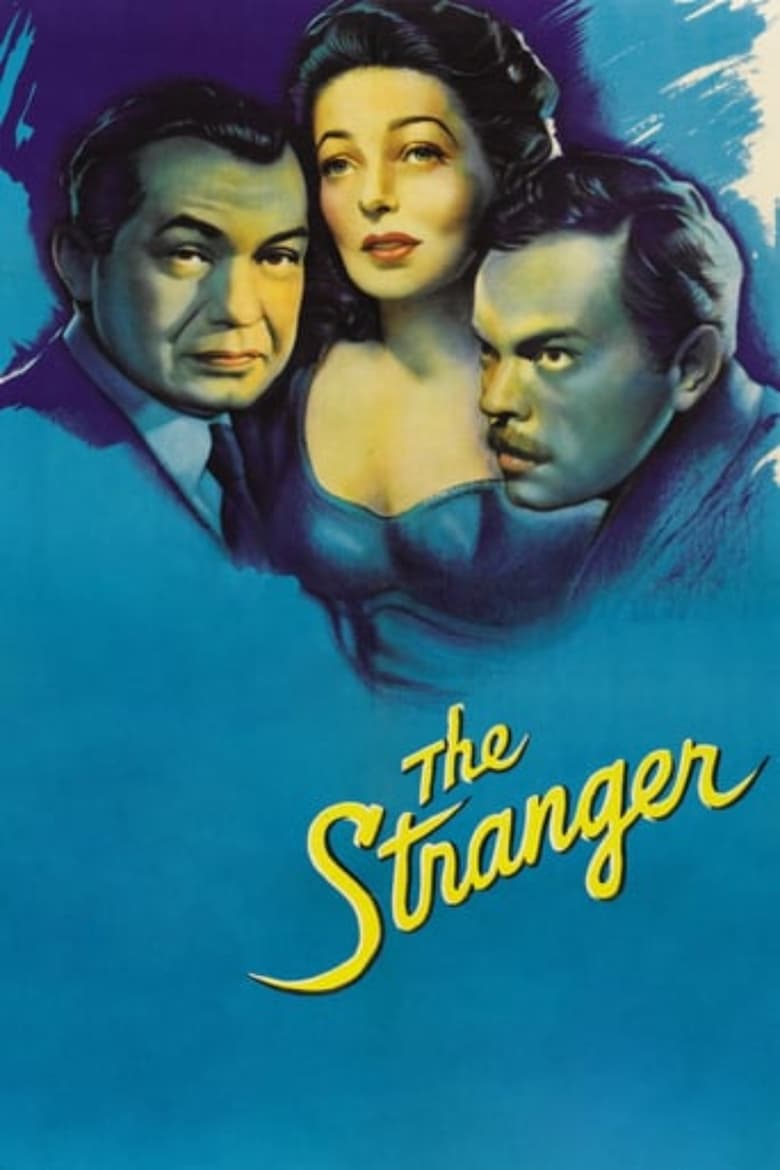
In the quiet Connecticut town of Harper, Federal agent Wilson tracks a fugitive Nazi war criminal named Franz Kindler, who has assumed the identity of Charles Rankin, a well-regarded prep school instructor on the eve of his marriage to Mary Longstreet, daughter of a sitting Supreme Court justice. Wilson follows Kindler's former associate Meinike to Harper, hoping the contact will expose Rankin before the wedding proceeds. When Meinike is murdered in the woods – his body hidden beneath the town's landmark clock tower – Wilson finds himself without the one witness who could confirm his suspicions.
Wilson inserts himself into Harper society, befriending the Longstreet family while gathering circumstantial evidence against a man who is careful, intelligent, and deeply embedded in American respectability. Mary, loyal to her husband and resistant to Wilson's suggestions, becomes the film's central moral problem: she is not ignorant so much as unwilling, and Rankin exploits that willingness with patience and calculation. As the evidence accumulates, the household itself becomes a site of quiet menace, with Rankin's charm functioning as a form of ongoing violence.
The Stranger works as both a procedural thriller and a parable about the concealment of fascist ideology within ordinary American life. Where much noir fixates on the criminal underworld, Welles locates danger in domesticity – in the church, the dinner table, the town square. The film's tension derives not from whether Rankin is guilty but from how long the truth can be suppressed, and what it costs those who suppress it.
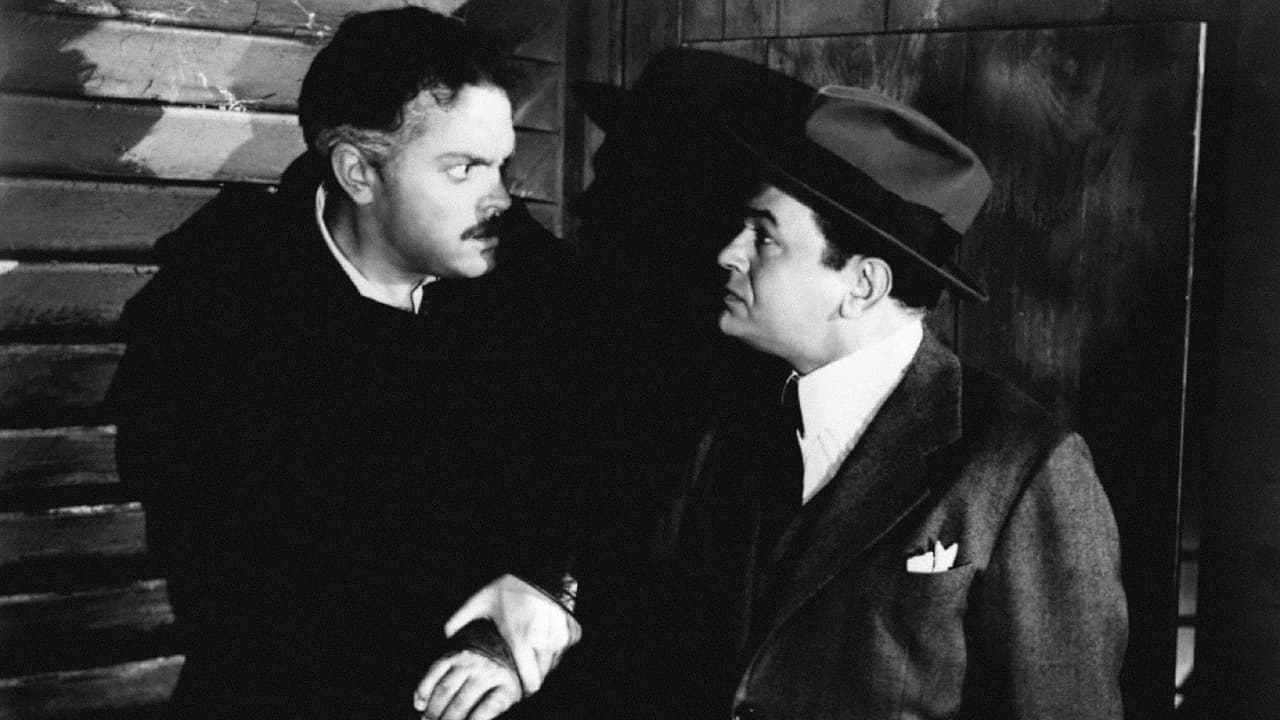
The Stranger occupies a peculiar position in both Welles's filmography and the noir canon. It was, by his own account, his most commercially conventional work – a concession made to secure creative financing – and that tension between commercial craft and larger ambition is legible in every sequence. What the film achieves, and what is too often undervalued, is a precise anatomy of postwar denial: the idea that fascism could be absorbed into American civic life not through conspiracy but through social acceptance. Edward G. Robinson's Wilson is a methodical, morally certain figure who functions less as a noir detective than as a reckoning the narrative keeps postponing. Loretta Young's performance is more complex than it first appears; her resistance to the truth is not stupidity but a portrait of how complicity actually works. Russell Metty's cinematography – all low angles and shadow-cut interiors – ensures that Harper never reads as safe, whatever its surface suggests. The film belongs to a postwar moment when American cinema was beginning to examine what the war had revealed about the country itself.
– Classic Noir
Welles frames the tower's interior as a maze of interlocking gears and counterweights, the camera tilting between tight close-ups of machinery and longer shots that diminish the human figure within the mechanism. Metty uses hard side-lighting that carves the wooden scaffold into sharp planes of black and white, with Rankin's face alternately lit and obscured as he climbs. The Gothic clock face, visible through the tower's apertures, provides a recurring compositional anchor – time rendered as a physical structure that is indifferent to the man trapped inside it.
The scene externalises the film's central argument: Rankin has spent the narrative controlling his environment through language and social manipulation, and here the environment asserts its own logic. The mechanical figures that strike the clock's bells become instruments of an impersonal justice that Wilson's procedural patience could not quite achieve. It is the film's acknowledgment that some reckonings do not require a human agent – that the structures men build to mark time can, under the right pressure, become the means of their destruction.
Russell Metty's work on The Stranger operates under considerable formal constraint – a studio picture shot largely on location in Woodstock, Connecticut, with limited opportunity for the expressionist excess Welles favored in his independent productions. Within those limits, Metty constructs a consistent visual argument. Exterior scenes use deep-focus compositions that make Harper's clapboard architecture feel subtly oppressive rather than picturesque, with the clock tower recurring in the background as an environmental accusation. Interior scenes rely on low-key three-point lighting that introduces shadow into spaces – a family dining room, a judge's study – where shadow has no social permission to exist. Metty favors slightly low camera placements that lend Welles's Rankin an unearned authority in the frame, a visual irony that sharpens as the film progresses. The cinematography does not call attention to itself; it works by accumulation, ensuring that by the final act the audience has been trained to read ordinary domestic space as inherently dangerous.
The Criterion Channel streams a clean print with accurate contrast levels that preserve Metty's shadow work; the preferred option for serious viewing.
TubiFreeA free ad-supported stream is available, though print quality varies and is not recommended for critical study.
Archive.orgFreeThe film entered the public domain and is available on Archive.org; transfer quality is inconsistent across uploads, so source selection matters.