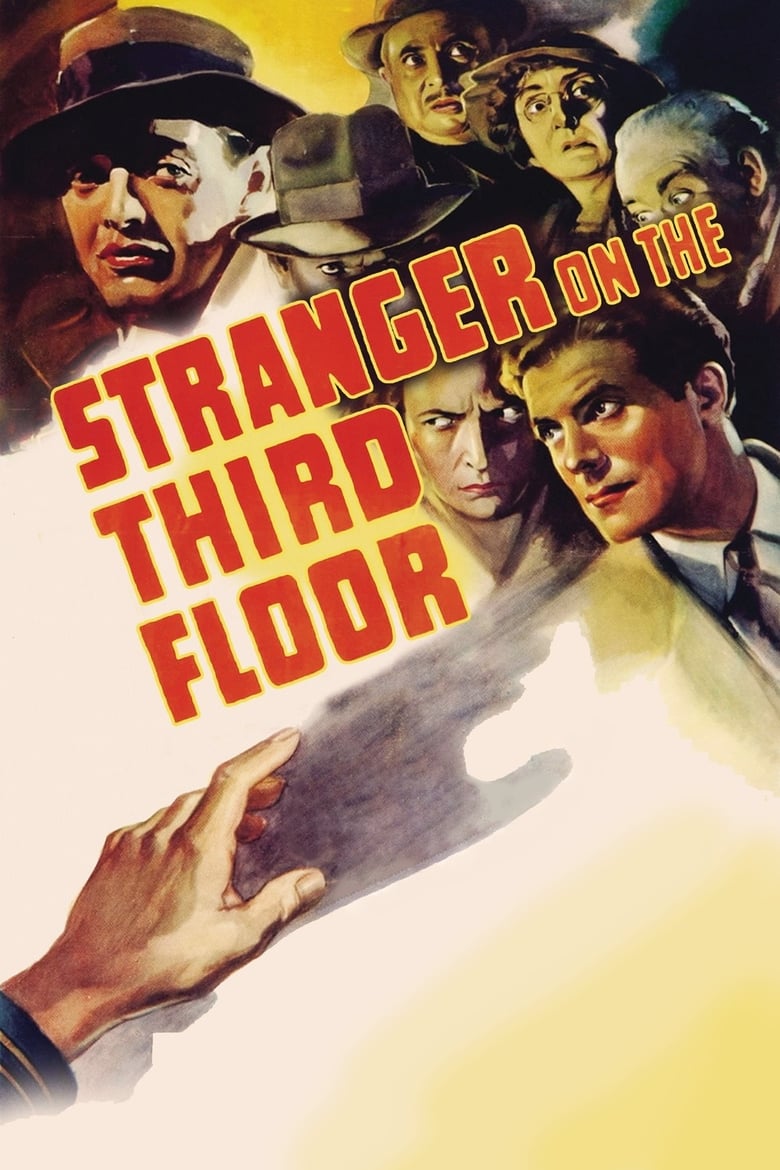
In New York City, reporter Michael Ward testifies against Joe Briggs, a young drifter accused of slashing a diner owner's throat. Ward's eyewitness account is the prosecution's cornerstone, and the jury convicts. Ward's girlfriend Jane has misgivings about the case – she finds Briggs too frightened to be guilty – but Ward, flush with the professional recognition the trial has brought him, dismisses her doubts.
Ward's confidence fractures when he discovers that his despised neighbor, the fastidious Albert Meng, has been found murdered in the same manner as the diner victim. A white-scarved stranger Ward glimpsed near the diner now surfaces in his memory. The circumstantial evidence against Ward himself begins to accumulate, and in a long dream sequence he imagines his own arrest, trial, and execution – the same machinery of justice he helped set in motion against Briggs now grinding toward him.
Stranger on the Third Floor compresses its noir argument into 64 minutes: the wrong-man premise, the fallibility of eyewitness testimony, and a legal system that rewards certainty over accuracy. Peter Lorre's strange, gliding presence – glimpsed more than seen – gives the film its atmosphere of dread, while the expressionist dream sequence anticipates the full noir visual vocabulary that would define the decade to follow.
Stranger on the Third Floor carries a reasonable claim to being the first fully realized American film noir, arriving three years before the cycle is conventionally dated. Boris Ingster works on a poverty-row budget and turns constraint into method: the film's cramped tenement corridors and pooled street lighting feel less like economy than argument. What the film understands – and what gives it lasting relevance – is that the noir nightmare is not visited upon its protagonist from outside. Michael Ward earns his terror. He gave false confidence to a conviction he was not certain of, and the logic of the story repays him in kind. The extended dream sequence, shot by Nicholas Musuraca with distorted angles and stark shadow geometry, is not an interruption of the narrative but its thesis made visible. Roy Webb's dissonant score reinforces the psychological unease without underlining it. The film's brevity is not a limitation; it is its form. Nothing in its 64 minutes is decorative.
– Classic Noir
Musuraca shoots Ward's imagined trial and execution in a register entirely distinct from the film's already grim realism. Courtroom walls loom and tilt at angles that no architect would sanction; the ceiling presses down; the jury box is stacked to an impossible height. Light arrives in hard shafts that illuminate faces from below or from extreme angles, reducing the District Attorney and judge to masks of institutional authority. The shadows cast by dock railings fall across Ward's face like bars before he has been sentenced. The camera moves slowly, with a deliberate, processional weight.
The sequence makes explicit what the main narrative keeps implicit: Ward is not simply afraid of being wrongly convicted – he is afraid because he recognizes the process. He has seen how testimony becomes fact, how momentum replaces scrutiny, how a confident witness can close a case. The dream does not distort justice; it clarifies it. The expressionist excess is the film's most honest register, the point at which style and moral argument become the same thing.
Nicholas Musuraca, who would go on to shoot Out of the Past and The Spiral Staircase, was already in command of a rigorous low-key visual grammar by 1940, and Stranger on the Third Floor is an early demonstration of what that grammar could accomplish with limited resources. Working almost entirely on RKO studio sets, Musuraca constructs space through shadow rather than through production design: walls recede into blackness, doorways frame figures in narrow wedges of light, and the street exteriors are built from wet pavement reflections and isolated lamp pools. The dream sequence shifts from this controlled chiaroscuro into outright German Expressionist distortion – canted sets, extreme low angles, light sources that defy spatial logic – but the transition does not feel disjunctive because Musuraca has already established a world where light is adversarial. The visual language consistently serves the film's moral argument: in this world, what you see clearly is precisely what will betray you.
The Criterion Channel has carried Stranger on the Third Floor as part of its noir programming and offers a clean transfer – confirm current availability on their site.
Archive.orgFreeThe film is in the public domain and is available for free streaming and download at Archive.org, though transfer quality varies by upload.
TubiFreeTubi has hosted this title among its classic noir offerings; availability may shift, but it is worth checking as a free ad-supported option.