Frank Keeler, an American ex-convict, arrives in postwar Italy with a singular purpose: to recover a cache of stolen money he hid before his prison term. The sum, buried somewhere in the rubble and memory of a country still reorganizing itself after the war, represents everything Keeler has left. He moves through Rome and its margins with the deliberate patience of a man who has rehearsed this moment for years, drawing as little attention as possible while quietly tracking down the coordinates of his cache.
His plan begins to unravel when he encounters Elena Ravezza, a local woman whose knowledge of the area and whose own survival instincts make her both useful and dangerous. Around them, a rotating cast of opportunists – Pietro, a thick-set local fixer; the slippery Convay; and the shadowy figures of Massina and the Greek – begin to sense that Keeler is searching for something worth finding. Allegiances shift on economic logic rather than loyalty, and Keeler discovers that trust in this environment is simply a liability with delayed consequences.
Three Steps North belongs to a recognizable postwar cycle in which American protagonists carry their criminal pasts into European settings only to find that the landscape has its own moral gravity. The film is less interested in action than in the slow erosion of a man's calculated confidence, and it uses Italy not as backdrop but as a social condition – a place where the war has redistributed power in ways that make an outsider's scheme perpetually vulnerable.
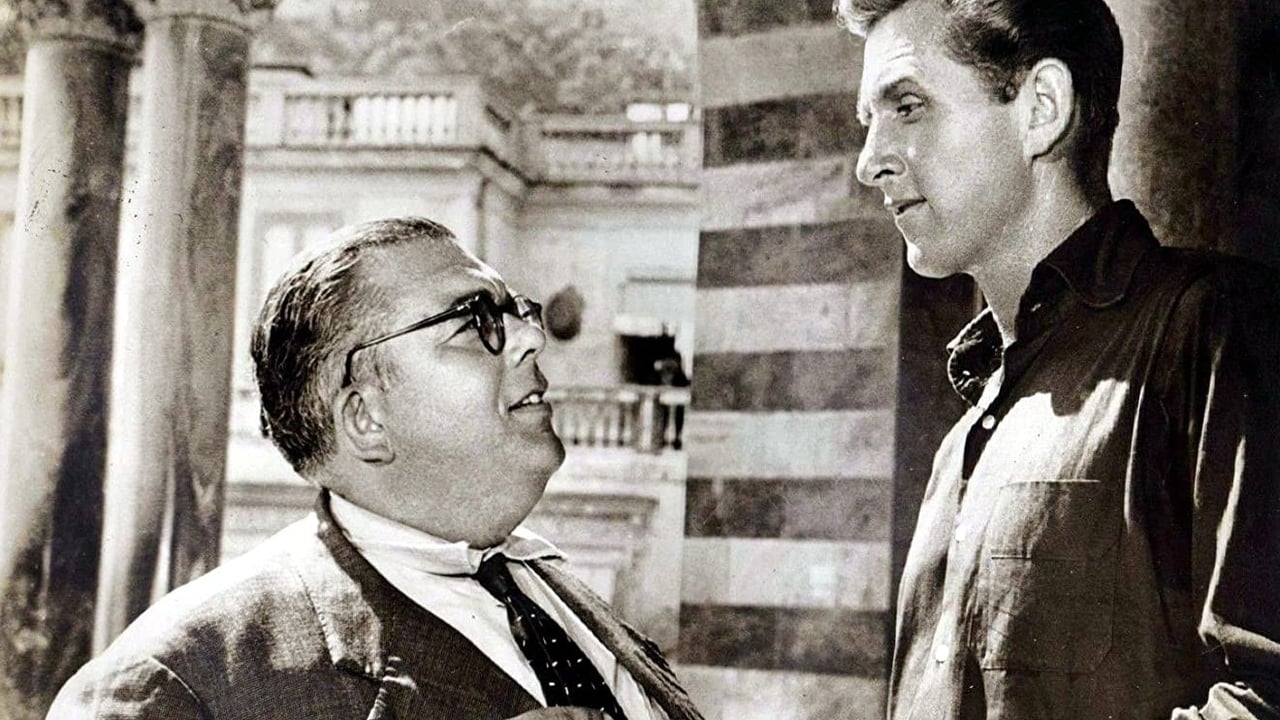
Three Steps North occupies a modest but legitimate position in the international noir cycle of the early 1950s, a period when American producers discovered that location shooting in postwar Europe offered both budgetary advantages and a ready-made atmosphere of displacement and moral ambiguity. W. Lee Wilder, working in the long shadow of his more celebrated brother Billy, was a reliable craftsman without distinctive authorial presence, and this film reflects that plainly: the construction is competent, the pacing controlled, and the dramatic ironies are legible without being subtle. What distinguishes the film is its setting and its Italian cast – Lea Padovani brings a grounded intelligence to Elena that resists the femme fatale convention, and Aldo Fabrizi, better known for his work with Rossellini, lends Pietro an earthy opacity that serves the film's interest in moral ambiguity. Lloyd Bridges holds the center with the kind of taut, economical performance that suits a character whose calculations are always one variable short. As a document of its moment – American genre filmmaking transplanted into a recovering Europe – the film reveals as much about postwar geopolitics as it does about noir convention.
– Classic Noir
Aldo Giordani frames the exchange in a narrow Roman courtyard where the last available light falls at a steep lateral angle, catching the edges of faces and leaving midsections in shadow. The camera holds at a medium distance, refusing close-ups that would clarify expression, so that the transaction reads spatially rather than psychologically – bodies arranged in a loose triangle, each at a remove from the others, the geometry of distrust made literal. When one figure moves, the frame does not follow immediately, letting the new position settle before recomposing.
The scene crystallizes the film's argument that knowledge, not money, is the true currency in Keeler's situation. Everyone in the courtyard knows something the others do not, and the refusal of close-ups denies the audience the reassurance of readable motive. What the staging reveals is that Keeler's control of the situation is already fictive – he is the only one operating on a plan, which makes him the least adaptable person present.
Aldo Giordani's work on Three Steps North makes purposeful use of the tension between location authenticity and noir's preference for controlled shadow. Shooting on actual Roman streets and interiors gives the film a textural credibility that studio-bound productions of the period rarely achieved, but Giordani does not simply document locations – he imposes a lighting logic that keeps the moral atmosphere consistent across exteriors and interiors alike. His approach favors a single dominant source in interior scenes, often positioned to split the frame between illumination and absence, a setup that keeps characters visually unstable even in stationary compositions. On location, he exploits the deep shadows of narrow streets and colonnaded spaces to achieve a comparable effect without artificial means. The lens choices tend toward a moderate focal length that preserves spatial relationships without the distortion that might aestheticize the environment, keeping the setting functional rather than expressionist. The cumulative effect aligns cinematography with the film's moral logic: clarity is withheld not for style but because no character in this story merits an unobstructed view.
The film is available in the public domain on Archive.org; print quality varies by upload, so compare available versions before settling on one.
TubiFreeTubi has carried public domain titles of this vintage and may offer a more stable streaming experience than Archive.org, though availability should be confirmed.
Amazon Prime VideoSubscriptionClassic noir titles of this era occasionally appear through Prime's rotating catalog or via third-party channels; availability is not guaranteed.