Films People Pull a Fast One Night Beat Reading Room On TV Shop
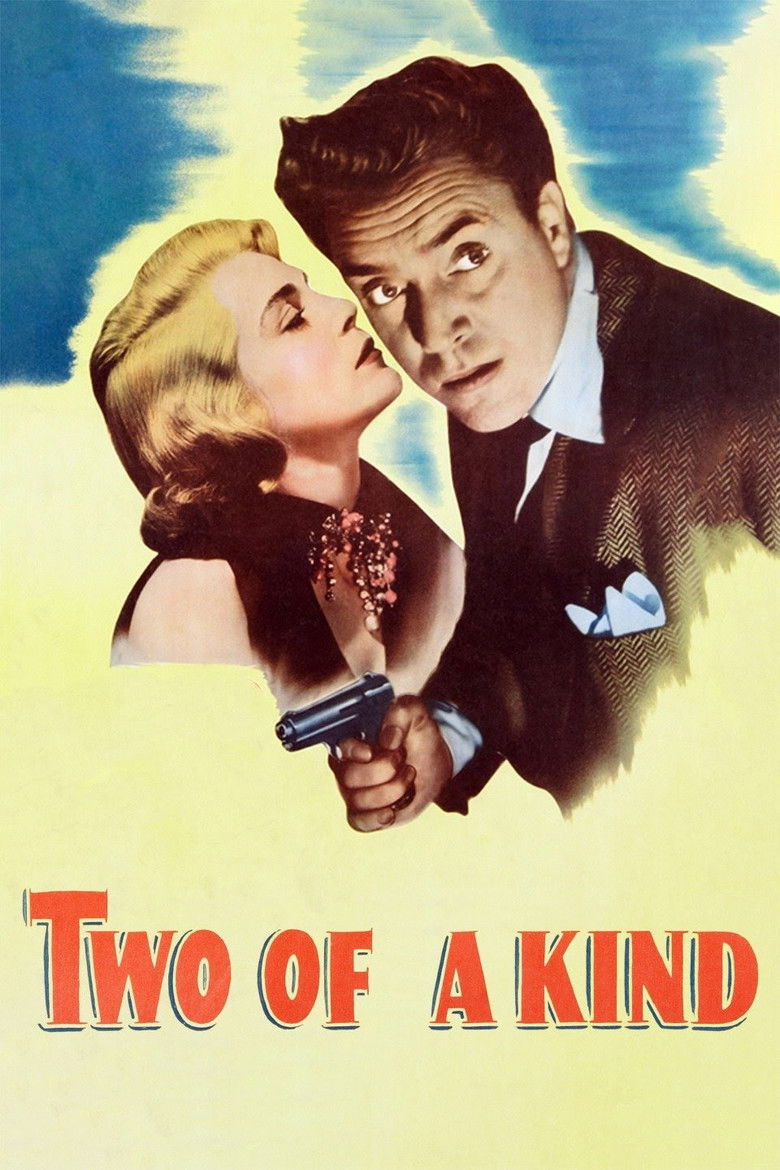
Two of a Kind 1951
1951 Columbia Pictures
★★★☆☆ Notable
Film Noir · 75 minutes · Black & White

Two of a Kind

Directed by Henry Levin
Year 1951
Runtime 75 min
Studio Columbia Pictures
TMDB 6.8 / 10
"Two strangers and a dead man's fortune – loyalty is the first thing to go."

Michael 'Lefty' Farrell is a small-time grifter with a convincing face and no particular future. When a pair of attorneys approach him with an unusual proposition – impersonate the long-lost son of a wealthy elderly couple, the McIntyres, and collect a substantial inheritance – Lefty takes the job. The scheme is engineered by Vincent Mailer, a lawyer of cold calculation, and his associate Brandy Kirby, a woman whose motives run deeper than she reveals. The McIntyres, aging and desperate to believe, are the marks.

The plan begins to fracture once Lefty meets Kathy McIntyre, the family's actual ward, whose sincerity threatens to complicate his detachment. What was designed as a clean confidence operation acquires moral weight Lefty had not anticipated. Brandy watches the drift with suspicion, and Mailer tightens his grip. Allegiances among the conspirators shift as the question of what Lefty is willing to do – and what he is no longer willing to do – moves from background to foreground.

Two of a Kind belongs to a strand of early-fifties noir in which the criminal scheme is less a heist than a slow psychological unraveling. The film is less concerned with whether the fraud succeeds than with what it costs each participant to sustain it. Against a cast carrying the weight of postwar moral ambiguity, the film asks how far ordinary self-interest can carry a person before it meets something that stops it cold.
Classic Noir

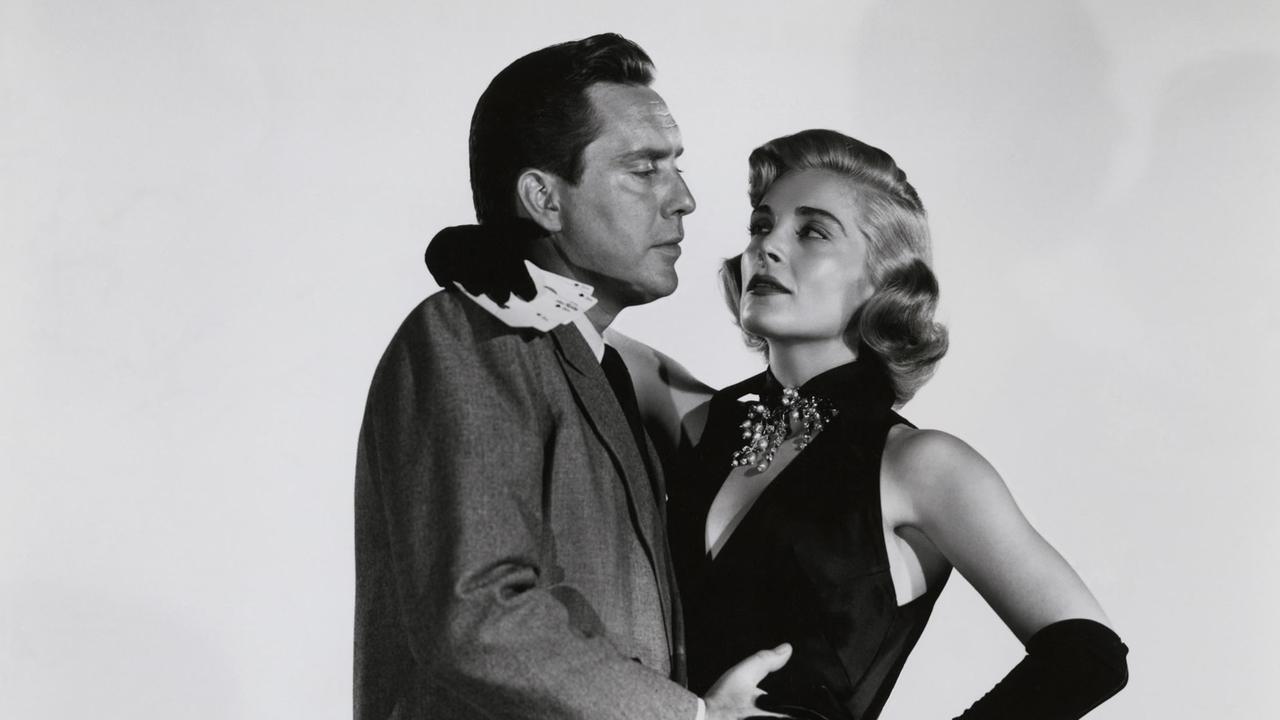
Two of a Kind occupies a modest but legitimate place in Columbia's early-fifties noir output – a programmers' film that knows precisely what it is and uses its 75 minutes without waste. Henry Levin directs without flourish, which is not the same as directing without intelligence; the film's pacing is controlled, and its refusal to inflate the material serves it well. Edmond O'Brien brings his characteristic quality of pressured ordinariness to Lefty, a man whose street-level pragmatism is slowly compromised by something resembling conscience. Lizabeth Scott, working in a register cooler than femme fatale convention typically allows, makes Brandy a study in self-interest that is recognizably human rather than merely schematic. Alexander Knox's Mailer is the film's most purely noir figure – a man for whom other people are instruments. What the film captures, without laboring the point, is the era's particular anxiety about identity and legitimacy: who one is allowed to be, and at what cost.

– Classic Noir
3 ★★★☆☆ Notable
Credits

The Crew

DirectorHenry Levin
ScreenplayJames Gunn
CinematographyBurnett Guffey
MusicGeorge Duning
EditingCharles Nelson
ProducerWilliam Dozier
Performances

The Cast

Close Reading

The Signature Scene

Two of a Kind – scene
The McIntyre Parlor Recognition Across the Room

Burnett Guffey lights the McIntyre parlor in a way that separates the domestic warmth of the elderly couple from the cooler zone where Lefty stands. Key light falls on William and Maida McIntyre from a source suggesting a table lamp – soft, amber-edged, the grammar of home. Lefty is held in a slightly flatter field, enough separation to register without announcing itself. The camera holds in medium shot as the old man studies the stranger's face, and Guffey resists cutting; the sustained take places the weight of the moment on performance and framing rather than editorial punctuation.

The scene operates as the film's moral pivot. Lefty has been reading faces for a living, but here the face reading reverses direction – he is the one being read, and the McIntyres' willingness to believe becomes the scene's uncomfortable center. What the shot construction makes clear is that the fraud is not simply a crime against property; it is a crime against longing. The old couple's need to find their son is as legible as their faces, and Lefty's awareness of that need – visible in the slight hesitation O'Brien builds into his posture – begins the process that will pull him out of the scheme.

Visual Language

The Cinematography

🎞️
Burnett Guffey – Director of Photography

Burnett Guffey's work on Two of a Kind is characteristic of his Columbia house style in the early fifties – economical, precise, and quietly expressive without advertising itself. Shooting largely on studio sets, Guffey constructs depth through layered shadow rather than elaborate staging: doorframes cut the frame, venetian blind patterns press down on interiors, and the transition from controlled domestic lighting to the harder edges of street or office scenes tracks the film's moral geography. He favors a moderately long lens for the closer dialogue passages, which flattens space slightly and keeps performers in the same focal plane – useful for scenes where power between characters is contested or ambiguous. The cinematography does not reach for the extreme angles and expressionist excess of noir's more operatic examples, and that restraint is appropriate; this is a film about ordinary corruption, and Guffey's camera treats it with corresponding sobriety.

In the Catalogue

Themes & Motifs

Availability

Where to Watch

Also in the Directory

See Also