Rick Martin grows up alone on the streets, finding his only solace in music – first in a church, then under the mentorship of Art Hazzard, a Black jazz trumpeter who teaches him not only technique but a philosophy of devotion to sound. By the time Rick reaches the dance-hall circuit, his playing has attracted attention, and his friendship with the easygoing pianist and narrator Smoke Willoughby gives him a foothold in the professional world. He is talented, driven, and fundamentally isolated from ordinary human connection.
Rick's entanglement with Amy North, a sophisticated and emotionally remote woman who moves in literary and artistic circles, pulls him toward a life he is unequipped to navigate. Amy is drawn to Rick's intensity but incapable of reciprocating it, and the marriage that follows is a slow erosion rather than a union. Jo Jordan, a singer with genuine feeling for Rick, represents the warmth he cannot bring himself to accept. As his personal life fractures, Rick's playing grows more extreme – he pursues a note beyond the instrument's range, a private obsession that becomes the film's central metaphor for perfectionism as self-destruction.
Young Man with a Horn belongs to a strain of postwar Hollywood noir in which the enemy is internal rather than criminal – no murder, no syndicate, only the slow collapse of a man undone by his own absolutes. Adapted from Dorothy Baker's 1938 novel, itself a loose reimagining of Bix Beiderbecke's life, the film uses the jazz world as a moral landscape where authenticity and commercial compromise are in permanent conflict. The trumpet solos on the soundtrack, performed by Harry James for Douglas, carry the film's emotional argument where the script sometimes cannot reach.
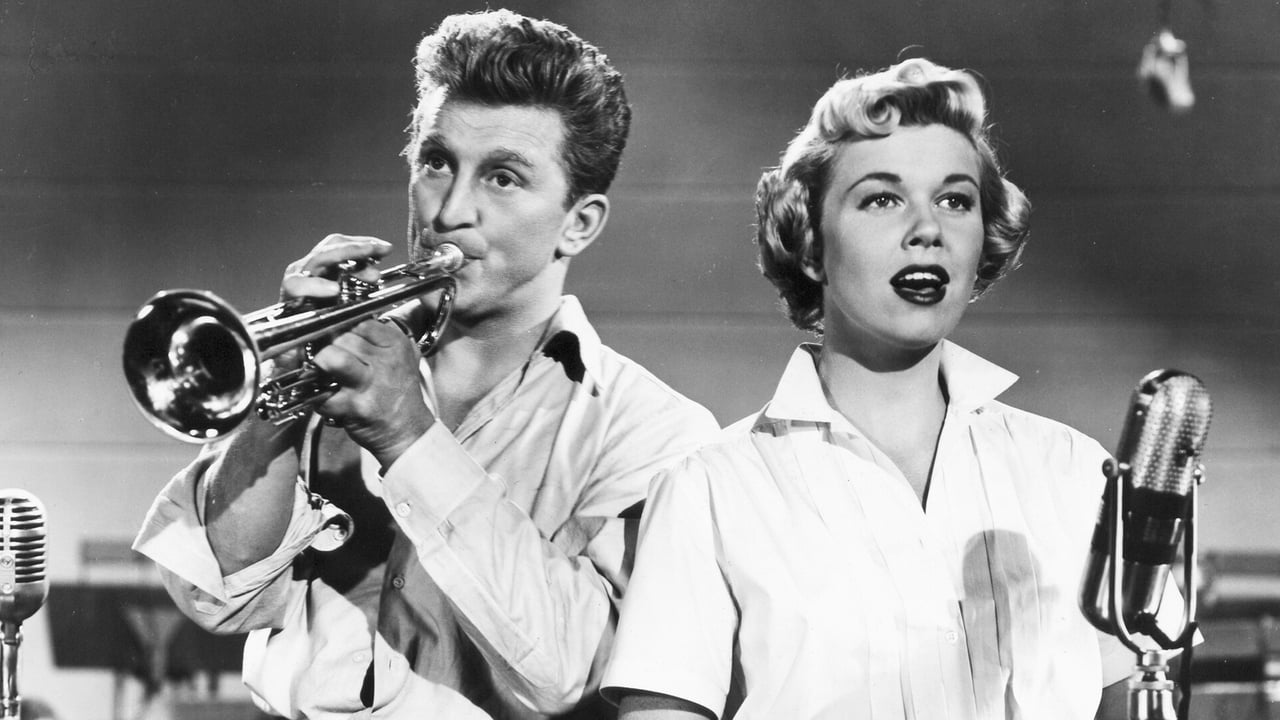
Young Man with a Horn occupies an uneasy position in the Warner Bros. noir canon – it lacks the criminal architecture of the studio's harder genre work, yet it shares noir's core preoccupation with a man in free fall, unable to halt what he has set in motion. Michael Curtiz directs with discipline, never sentimentalizing Rick's deterioration, and Kirk Douglas finds in the role the same coiled, self-defeating energy he would deploy more famously elsewhere. Lauren Bacall's Amy is one of the era's more complex portrayals of sexual ambiguity, suggested rather than stated, which is itself a measure of what Hollywood could say in 1950 and how it had to say it. What the film achieves most plainly is a portrait of artistic obsession as a form of violence – against relationships, against the body, against everything that is not the pursuit. Juano Hernández brings a dignity to Art Hazzard that the script does not always earn, and his scenes with Douglas carry a weight the romantic plot rarely matches. The film is not fully resolved, but its irresolution feels earned.
– Classic Noir
Ted D. McCord frames Rick alone at the lip of a small stage, the club emptied of everyone but a few figures held in the middle distance by shadow. The key light is narrow and slightly harsh, catching the bell of the trumpet and the sweat on Douglas's face while leaving the room itself in gradated darkness – walls dissolving, exits invisible. McCord holds the camera at a low angle, which inflates Rick's isolation rather than his authority, making the gesture of raising the horn look less like triumph than compulsion.
The scene makes visible the film's central argument: Rick is not performing for anyone present, and perhaps has never been. The pursuit of the note – higher than the instrument can cleanly produce – reads not as artistic courage but as a refusal to accept limitation, which is to say a refusal to accept reality. That the note cannot be played cleanly, that the attempt itself is what undoes him, concentrates everything the film wants to say about perfectionism as its own form of self-abandonment.
Ted D. McCord's cinematography on Young Man with a Horn resists the more expressionist extremes the subject might have invited, working instead in a controlled low-key register that keeps psychological pressure implied rather than announced. McCord uses tight pools of practical-source light – club fixtures, desk lamps, the ambient glow of a recording booth – to naturalize what is in fact a carefully constructed moral grammar: the brighter the environment, the more Rick is exposed and vulnerable rather than empowered. Studio interiors are dressed to suggest depth without opening up space, and McCord's lens choices favor a moderate focal length that keeps faces legible without flattening the surrounding darkness into backdrop. Shadow work is most precise in the scenes of marital deterioration, where Bacall and Douglas are frequently lit from opposing sources, each figure coherent within their own pool of light and irreconcilable within the shared frame. It is a visual argument for incompatibility made without a line of dialogue.
Warner Bros. titles of this era appear regularly on Max, making it the most likely home for a stable streaming presentation of this film.
TCMSubscriptionTCM broadcasts Young Man with a Horn periodically in its classic Hollywood programming and remains the most reliable source for an uncut, correctly framed presentation.
TubiFreeAvailability on Tubi fluctuates and print quality may vary, but it has appeared there as a no-cost option worth checking.