Films People Pull a Fast One Night Beat Reading Room On TV Shop
City of Fear 1959
1959 Columbia Pictures
★★★☆☆ Notable
Film Noir · 81 minutes · Black & White

City of Fear

Directed by Irving Lerner
Year 1959
Runtime 81 min
Studio Columbia Pictures
TMDB 6.3 / 10
"A man carries a canister of death through a city that doesn't know it's already dying."

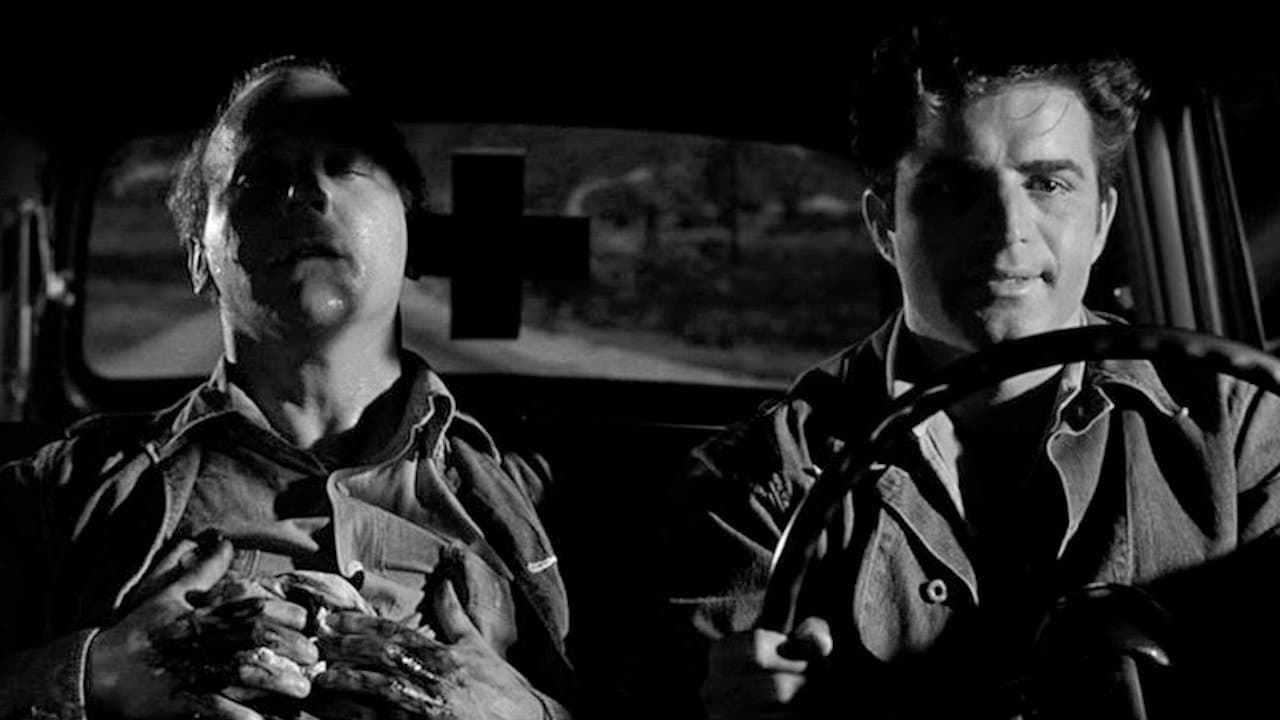
In 1959 Los Angeles, convict Vince Ryker breaks out of prison carrying what he believes is a container of heroin – a score he intends to leverage into a new life. His escape partner Eddie Crown is killed in the getaway, leaving Ryker alone with the canister and a tenuous connection to his former girlfriend, June Marlowe. What neither Ryker nor anyone around him knows is that the container holds not heroin but cobalt-60, a stolen radioactive isotope lethal enough to irradiate an entire metropolitan area. Lt. Mark Richards of the Los Angeles Police Department leads the manhunt, working against a clock the fugitive himself cannot see.

As Ryker moves through the city's margins – cheap rooming houses, back streets, the cautious hospitality of people who owe him nothing – he begins to feel ill, attributing his deteriorating condition to stress and exertion. Dr. John Wallace is brought in by the authorities not merely as a scientific consultant but as the film's moral center, the man who understands the true dimensions of what is being carried through crowded streets. The investigation tightens around Ryker while the city proceeds in ordinary ignorance, and Richards must weigh the need for public warning against the risk of mass panic – a calculation the film renders with unusual procedural sobriety.

City of Fear belongs to the cycle of late-fifties procedurals that grafted Cold War anxieties onto the noir framework, replacing the femme fatale and the corrupt institution with invisible, impersonal threat. Ryker is neither a calculating villain nor a wronged innocent but something the genre rarely produced: a man whose destruction is entirely self-administered, ignorance functioning here as the cruellest form of fate. The film's tension derives not from whether he will be caught but from what catching him will cost everyone involved.
Classic Noir

City of Fear occupies a specific and underexamined position within the late noir cycle: the point at which the genre absorbed the postwar nuclear anxiety that had been building in American culture since Hiroshima and redirected it through the machinery of the police procedural. Irving Lerner, working economically and without sentimentality, constructs a film whose central conceit – the criminal as unwitting carrier of mass destruction – strips away whatever romance the fugitive life retained in earlier noirs. Vince Edwards, better known for his later television work, brings a coiled physicality to Ryker that serves the film's logic well; this is a body already condemned, though it doesn't know it. The film's real argument is civic rather than moral: institutions function, specialists are consulted, decisions are weighed. That sobriety, unusual for the genre, reflects 1959 America's complicated relationship with technocratic authority – a faith simultaneously earnest and uneasy. Jerry Goldsmith's early score, his first for a feature of this kind, complements the procedural rhythm without overreaching.

– Classic Noir
3 ★★★☆☆ Notable
Credits

The Crew

DirectorIrving Lerner
ScreenplaySteven Ritch
CinematographyLucien Ballard
MusicJerry Goldsmith
EditingRobert Lawrence
ProducerLeon Chooluck
Performances

The Cast

Close Reading

The Signature Scene

City of Fear – scene
The Hotel Room, Late Night The Canister on the Table

Lucien Ballard frames the canister in medium close-up at the center of a cheap hotel room, the light source a single practical lamp that throws hard shadows across the tabletop and leaves the room's corners entirely unresolved. Ryker moves in and out of the lit zone, the camera holding on the object more steadily than it holds on the man – a compositional choice that quietly reassigns narrative authority from the human figure to the thing he carries. The walls press in at the edges of the widescreen frame, the geometry of the room made to feel smaller than its dimensions.

The scene argues, without dialogue, that Ryker has already ceased to be the protagonist of his own story. He examines the canister with the proprietary attention of a man inventorying his assets, and the camera's refusal to share his confidence – its insistence on holding the object at a remove that feels almost clinical – establishes the film's central irony in purely visual terms. What he treats as currency is already a sentence. The light that falls on the canister is the same light that falls on him, and neither is warm.

Visual Language

The Cinematography

🎞️
Lucien Ballard – Director of Photography

Lucien Ballard, shooting for Lerner on a constrained Columbia budget, uses Los Angeles locations with the documentary precision that defined the late-fifties procedural aesthetic while inflecting that realism with the shadow work that remains his signature. Ballard favors longer lenses that compress the city's depth, flattening Ryker against backgrounds that seem to close behind him rather than recede. Interior work relies on high-contrast single-source lighting – practicals augmented to emphasize rather than naturalize – that keeps the moral environment of each space legible without overstatement. The widescreen frame, which a lesser operator might have filled symmetrically, is used here to isolate figures in corners and edges, the empty space around Ryker functioning as a visual register of his unknowing jeopardy. Ballard never aestheticizes the threat; the cobalt-60 looks like what it is – a dull industrial container – and that refusal to glamorize the MacGuffin aligns the cinematography precisely with the film's procedural, disenchanted worldview.

In the Catalogue

Themes & Motifs

Availability

Where to Watch

Also in the Directory

See Also