Films People Pull a Fast One Night Beat Reading Room On TV Shop
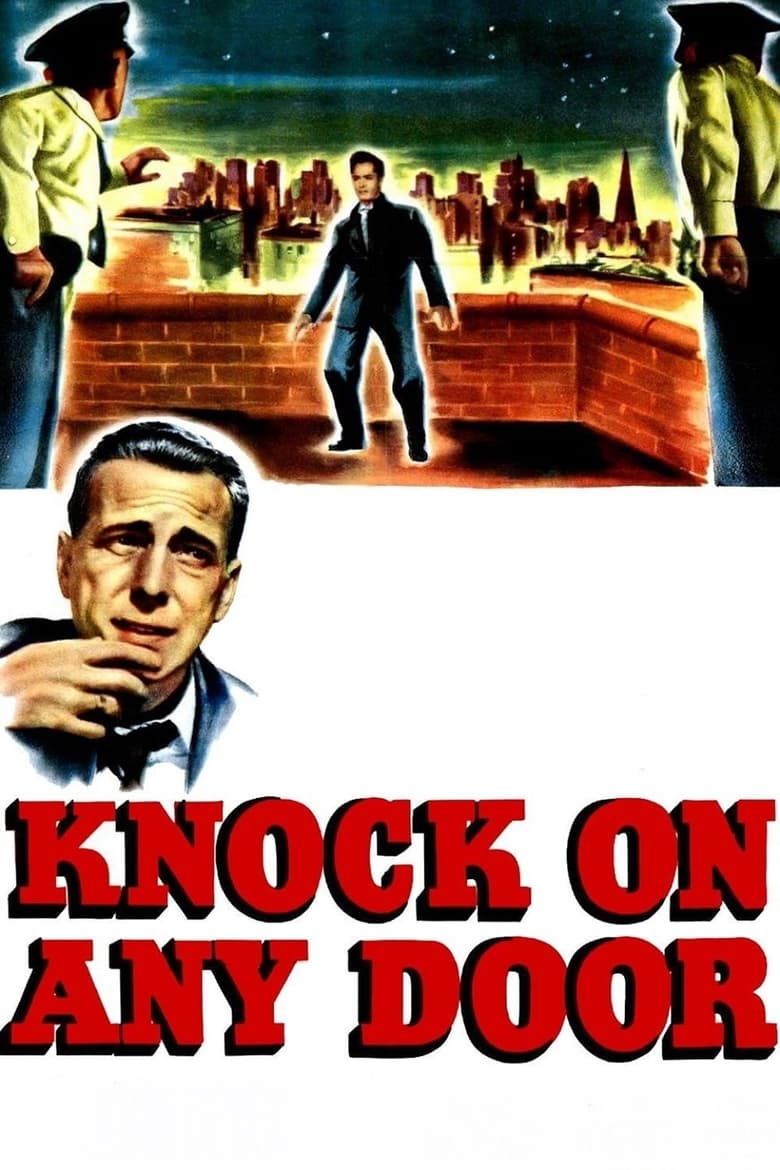
Knock on Any Door 1949
1949 Santana Pictures Corporation
★★★☆☆ Notable
Film Noir · 100 minutes · Black & White

Knock on Any Door

Directed by Nicholas Ray
Year 1949
Runtime 100 min
Studio Santana Pictures Corporation
TMDB 6.2 / 10
"A lawyer fights for a young man the streets already condemned."

Chicago attorney Andrew Morton (Humphrey Bogart) agrees to defend Nick Romano (John Derek), a slum-raised youth charged with the murder of a police officer. Morton knows Nick from the old neighborhood and believes the system, not the boy, bears the deeper guilt. District Attorney Kerman (George Macready) intends to send Romano to the electric chair, and the courtroom becomes the arena where two incompatible views of American society collide.

Through a long series of flashbacks, the film traces Nick's path from a reform-school boy to a small-time criminal drifting between petty theft and the company of street toughs like Vito (Mickey Knox). A brief marriage to the devout Emma (Allene Roberts) offers Nick a foothold in ordinary life, but the pressures of poverty and his own restlessness erode it. When Emma dies, Nick's remaining resistance collapses, and he slides toward the act that lands him in Morton's courtroom.

Knock on Any Door belongs to a strand of late-1940s noir shaped as much by social conscience as by shadow and menace. It presses on questions of culpability and environment that the genre would typically leave implicit, placing its fatalistic machinery inside a courtroom framework that demands explicit moral argument. The film sits at the intersection of crime picture and reform drama, and that tension – unresolved and purposeful – gives it its particular weight.
Classic Noir

Nicholas Ray's first collaboration with Humphrey Bogart, produced through Bogart's own Santana Pictures, carries the social-protest energies of Willard Motley's 1947 source novel into a genre framework that both supports and strains under the weight of its argument. The film is less interested in suspense than in indictment: the city itself is on trial as much as Nick Romano. Ray's characteristic sympathy for the dislocated young male is present throughout, and in John Derek's performance he finds a figure simultaneously charismatic and self-defeating. Bogart's Morton is an idealist using the adversarial machinery of the law against the very conditions that produced it – a contradiction the screenplay leaves productively unresolved. What the film reveals about its era is the degree to which postwar liberalism sought to channel systemic critique through individual cases, mapping social failure onto a single body. Burnett Guffey's photography keeps the courtroom sequences austere while the flashback streets carry a documentary texture that sharpens the contrast between argument and experience.

– Classic Noir
3 ★★★☆☆ Notable
Credits

The Crew

DirectorNicholas Ray
ScreenplayDaniel Taradash
CinematographyBurnett Guffey
MusicGeorge Antheil
EditingViola Lawrence
Art DirectionRobert Peterson
CostumesJean Louis
ProducerRobert Lord
Performances

The Cast

Close Reading

The Signature Scene

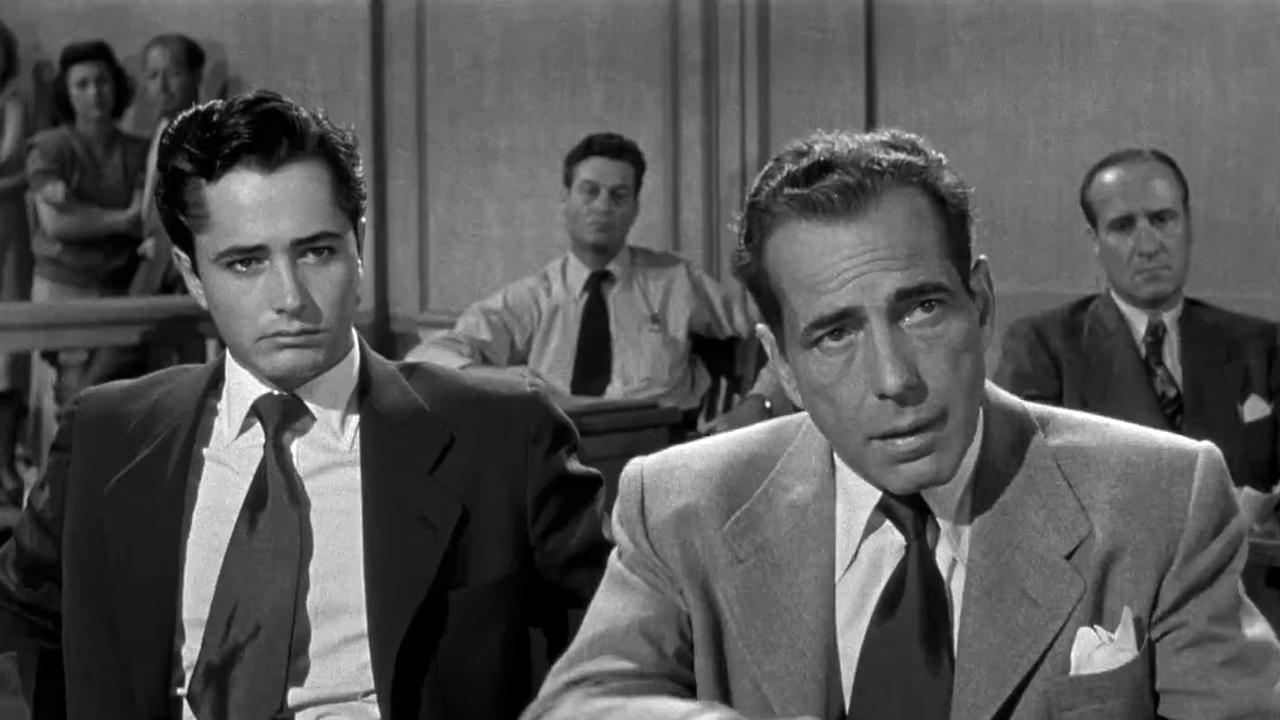
Knock on Any Door – scene
The Courtroom Summation Morton Speaks for the Streets

Guffey holds Morton in a sustained medium shot as he addresses the jury, the frame keeping the courtroom gallery visible as a soft mass behind him. Light falls hard and even from above, stripping the space of shadow and denying the scene the noir atmosphere that surrounds it elsewhere – a deliberate flatness that places the visual weight entirely on the spoken argument. The camera moves closer only when Morton names the slum conditions that shaped Nick, the compression of the frame matching the compression of a case being built sentence by sentence.

The scene makes explicit what the rest of the film communicates through environment and incident: that the justice system is being asked to adjudicate a verdict already rendered by geography and poverty. Morton's summation is not triumph but exposure, and the jury's attention – rendered in cut-away reaction shots that refuse to editorialise – leaves the moral burden exactly where Ray intends it: distributed across a society that would rather punish than examine itself.

Visual Language

The Cinematography

🎞️
Burnett Guffey – Director of Photography

Burnett Guffey, who would later shoot In a Lonely Place for Ray and eventually Bonnie and Clyde for Arthur Penn, brings a controlled economy to Knock on Any Door that reflects the film's dual identity as courtroom procedural and street-level social document. The flashback sequences use a slightly cooler, harder light to suggest the institutional texture of reform schools and cheap rooming houses, while the trial scenes are lit with a deliberate overhead severity that reads as institutional rather than expressionist. Guffey avoids the deep-focus baroque that characterises some period noir, preferring mid-range focal lengths that keep characters legible within their social space rather than isolated against it. Shadow work is reserved and purposeful: the poolroom scenes and night streets carry enough darkness to locate the film within the genre, but Guffey never lets atmosphere substitute for the documentary pressure the story requires. The result is a visual language in which moral argument and physical environment remain in productive friction throughout.

In the Catalogue

Themes & Motifs

Availability

Where to Watch

Also in the Directory

See Also