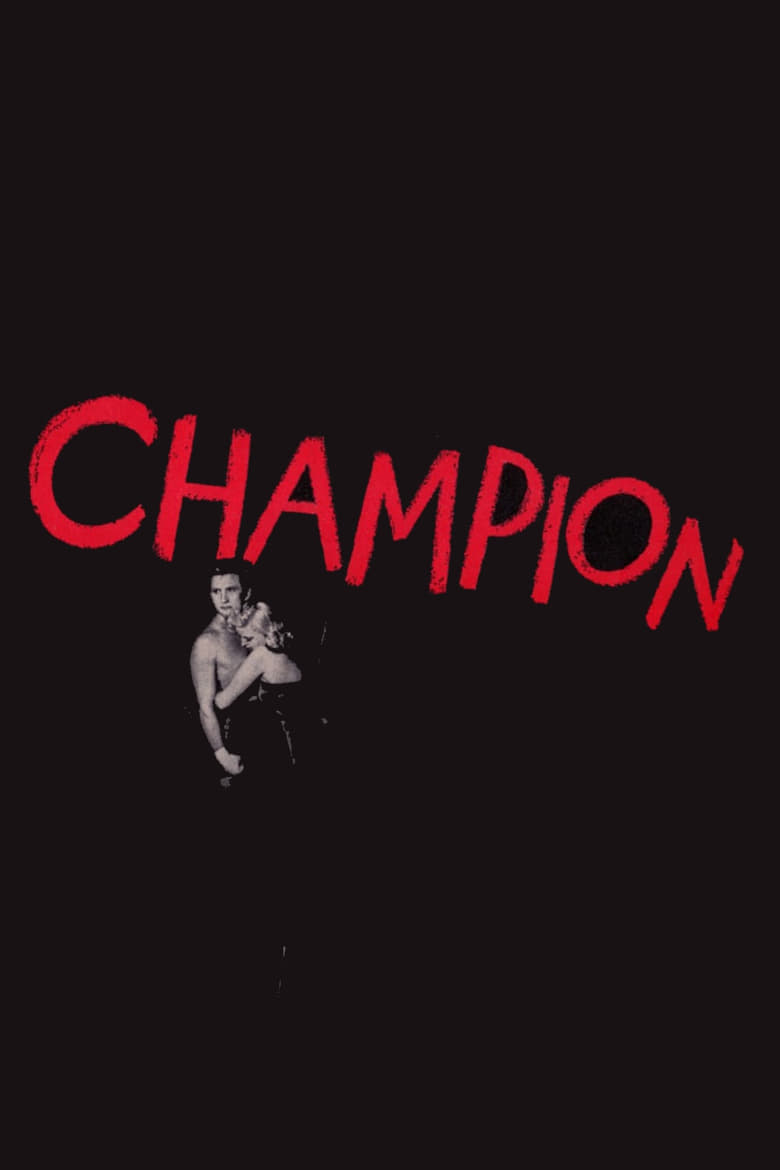
Midge Kelly (Kirk Douglas) arrives in California broke and hungry with his crippled brother Connie (Arthur Kennedy) in tow, a pair of drifters with no prospects and less luck. When a chance encounter lands Midge a job at a roadside diner owned by Lew (Harry Shannon), he marries Lew's daughter Emma (Ruth Roman) out of expedience rather than affection – a transaction disguised as a romance. His fists, it turns out, are his only genuine asset, and when former manager Tommy Haley (Paul Stewart) recognizes his raw talent, Midge steps into the ring and discovers the one arena where his ruthlessness is not a liability.
As Midge climbs the ranks of professional boxing, he sheds every loyalty that might slow his ascent. Emma is abandoned without ceremony. Connie, who sacrificed his own ambitions to follow his brother, is kept close only when useful. Midge pursues singer Grace Diamond (Marilyn Maxwell) and later the married Palmer Harris (Lola Albright), each relationship another instrument of self-advancement rather than genuine feeling. Tommy Haley watches the corruption deepen, unable to stop a man who has confused hunger with purpose. The promoters and fixers who surround the sport – including the calculating Jerry Harris (Luis van Rooten) – recognize in Midge a fellow traveler and move to exploit what they cannot quite contain.
Champion belongs to a strand of postwar noir concerned less with crime procedurals than with the anatomy of ambition – films that diagnose something corrosive in the American appetite for success. Adapted from a Ring Lardner short story, it uses the boxing world as a closed moral ecosystem in which every relationship has a price and sentiment is the first casualty. The film's interest lies not in whether Midge will win or lose in the ring, but in what the winning costs and who pays the bill.
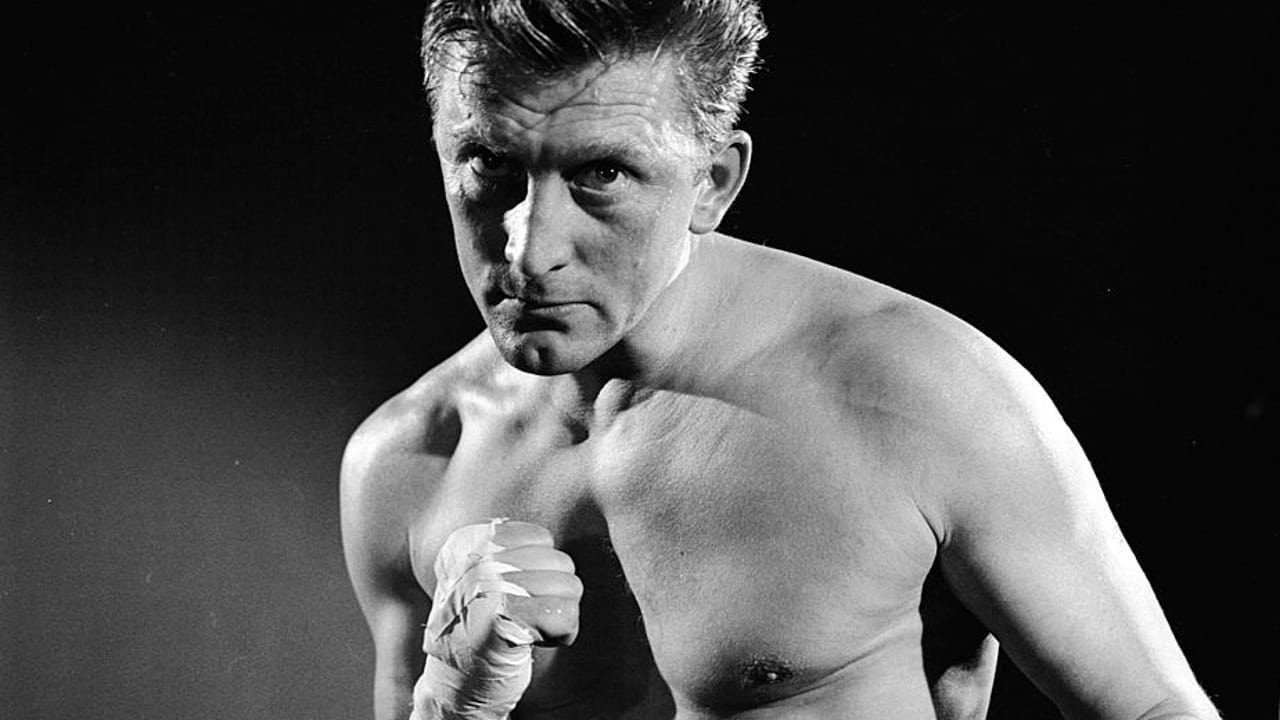
Champion arrived in 1949 as one of the more honest American films about the sport it depicts, though the sport is finally a vehicle for a character study of considerable severity. Kirk Douglas, in the role that established him as a major screen presence, plays Midge Kelly not as a villain decorated with charm but as a man whose charm is itself the instrument of damage – persuasive, physically forceful, constitutionally incapable of gratitude. Mark Robson, working from Carl Foreman's taut screenplay, keeps the film moving at the pace of its protagonist, which means there is rarely time to mourn what Midge destroys before he has destroyed something else. The film sits alongside Body and Soul (1947) and The Set-Up (1949) in the postwar cycle of boxing noirs, but its argument is bleaker than either: where those films locate some residual moral agency in their fighters, Champion treats Midge's self-knowledge as irrelevant to his behavior. Stanley Kramer's production brings a social-realist economy to the material that keeps the film from tipping into melodrama, and Arthur Kennedy's quietly anguished performance as Connie functions as a moral register against which every one of Midge's choices can be measured.
– Classic Noir
The camera holds Midge in a dressing room stripped of any flattering light – Franz Planer positions a single overhead source that carves deep shadows beneath the brow and jaw, reducing the face to planes of exhaustion and damage. The frame is tight, excluding the trainers and handlers who move at the periphery, so that Douglas appears essentially alone even in a crowded room. The mirror behind him doubles the image without providing any revelation; what Midge sees in his own reflection is no more legible to him than it is to the audience.
The scene crystallizes the film's central argument: that success in this world produces not satisfaction but a kind of vacancy. Midge has won, the crowd has gone, and the physical cost of the victory is laid out in clinical detail. Robson refuses to aestheticize the damage. What remains is a man with no interior life adequate to the ambition that drove him here, sitting in silence with a bruised face and nothing particular to feel. The mirror – that standard noir device for fractured selfhood – offers no insight because Midge has never looked at himself with enough honesty to register the fracture.
Franz Planer brings to Champion a visual language that resists the expressionist excesses available to a boxing film, choosing instead a controlled, almost clinical severity that mirrors the film's moral argument. Working largely on studio interiors, Planer uses low-key lighting not for atmosphere's sake but to establish social stratification: the further Midge climbs, the more shadowless and exposed the photography becomes, as though success strips away the protective darkness available to men who matter less. His coverage of the ring sequences favors mid-range lenses that preserve spatial relationships between fighter and crowd, refusing the distorted close-up heroics that might inadvertently glamorize the violence. Shadow work in the domestic scenes – particularly those involving Emma and Connie – tends toward soft fill that emphasizes their vulnerability against the harder, higher-contrast treatment reserved for Midge himself. Throughout, Planer's choices serve the screenplay's insistence that what looks like a rise is in fact a form of excavation: the brighter the frame around Midge Kelly, the less of him there is left to see.
The Criterion Channel periodically carries Champion as part of its postwar American noir programming and is likely to offer the best available transfer for home viewing.
TCMBroadcast / SubscriptionTCM has broadcast Champion with some regularity; the film is available via TCM's on-demand library to Max subscribers, though scheduling should be confirmed.
TubiFreeTubi has made Champion available in its classic film library at no cost, though print quality may vary from the best archival sources.