Films People Pull a Fast One Night Beat Reading Room On TV Shop
Ruthless 1948
1948 Arthur S. Lyons Productions
★★★☆☆ Notable
Film Noir · 104 minutes · Black & White

Ruthless

Directed by Edgar G. Ulmer
Year 1948
Runtime 104 min
Studio Arthur S. Lyons Productions
TMDB 5.7 / 10
"A man without conscience climbs until there is nowhere left to fall."

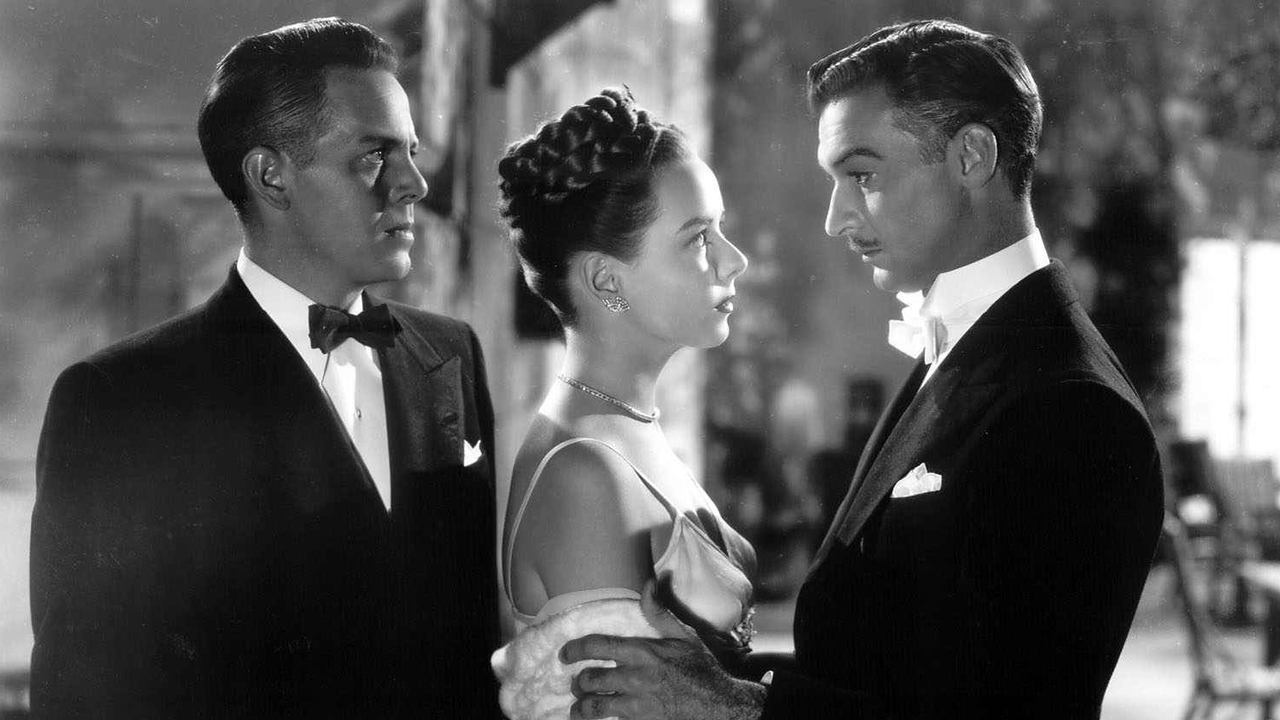
Ruthless (1948) unfolds through a fractured chronology, tracing the rise of Horace Woodruff Vendig – known to nearly everyone as Woody – from Depression-era poverty to the summit of American financial power. The film opens with Vic Lambdin, Woody's oldest friend, arriving at a party hosted by the ruthless industrialist Buck Mansfield, only to discover that Woody has taken Mansfield's wife, Christa, as his companion. What follows is a series of flashbacks that reconstruct how Woody got here: a calculating, cold-eyed boy who learned early that sentiment is a liability and that other people exist primarily as instruments of his advancement.

Each chapter of Woody's past introduces a new victim of his ambition. Martha Burnside, the girl who first offered him genuine affection, is discarded when she ceases to be useful. Susan Duane becomes another rung on his ladder. Vic, the one man who has known Woody longest and retains some purchase on his conscience, watches the transformation with mounting unease. Buck Mansfield, a titan whose own career was built on comparable ruthlessness, recognises in Woody a mirror image – and the recognition carries no warmth. Christa moves between these men as both prize and pawn, her position illustrating how thoroughly Woody has come to regard human relationships as transactions.

Ruthless belongs to that strain of late-1940s noir preoccupied less with crime procedurals than with the pathology of ambition itself. Director Edgar G. Ulmer, working here with a larger cast and a longer runtime than he typically commanded, constructs a portrait of American capitalism as a system that selects for the morally hollow. The film's structure – memory as accusation, the past refusing to stay buried – places it alongside other noir meditations on the cost of getting exactly what one wants.
Classic Noir

Ruthless occupies an unusual position in Ulmer's filmography: it is his most expensive and elaborately cast production, yet it retains the director's characteristic interest in characters who are complicit in their own destruction. Zachary Scott, whose features suggest charm and menace in equal measure, is well-suited to a protagonist for whom empathy was never an available option. The film's debt to Citizen Kane is frequently noted – the non-linear structure, the inquiry into a powerful man's moral vacancy – but Ruthless is more explicit in its indictment. Where Kane invites ambiguity, Ulmer and screenwriters Alvin Toma and Gordon Kahn offer a verdict: the system that rewards Woody is as corrupt as Woody himself. Sydney Greenstreet, in one of his final major roles, brings a weary authority to Mansfield that complicates any simple reading of the villain's singularity. The film arrived at a moment when Hollywood was testing how far it could push structural critique under the cover of melodrama, and Ruthless pushes with more conviction than it is usually given credit for.

– Classic Noir
3 ★★★☆☆ Notable
Credits

The Crew

DirectorEdgar G. Ulmer
ScreenplayGordon Kahn
CinematographyBert Glennon
MusicWerner Janssen
EditingFrancis D. Lyon
Art DirectionFrank Paul Sylos
CostumesDon Loper
ProducerArthur S. Lyons
Performances

The Cast

Close Reading

The Signature Scene

Ruthless – scene
The Waterfront Confrontation Two Men, One Shore

Bert Glennon frames the late confrontation between Woody and Buck Mansfield at the water's edge with a deliberate flatness of light – no dramatic chiaroscuro here, but a grey, diffuse illumination that strips both men of the shadows they have used as cover throughout the film. The camera holds at a middle distance, refusing close-ups that would invite identification, while the water behind them functions as a visual terminus: there is no further to go. Glennon's composition places both figures at roughly equal height in the frame, a rare formal equity in a film otherwise structured around dominance and subordination.

The scene makes explicit what the film has argued by accumulation: Woody and Mansfield are not antagonists but equivalents, and the struggle between them is not moral but territorial. The water – still, reflective, indifferent – carries the film's central metaphor to its conclusion. Whatever goes under here does not come back. The confrontation does not resolve the film's tension so much as confirm that the tension was never really between two men, but between a man and the logic of the world he chose to inhabit.

Visual Language

The Cinematography

🎞️
Bert Glennon – Director of Photography

Cinematographer Bert Glennon brings to Ruthless a visual grammar calibrated to institutional rather than street-level noir. Where many films of the cycle depend on wet pavements and deep-focus expressionism, Glennon – working on studio interiors that simulate Long Island estates and financial boardrooms – opts for a controlled, almost clinical use of diffused key lighting that exposes rather than conceals. Shadow work is present but strategic: it accumulates around Woody in his moments of calculation and retreats when he performs warmth, suggesting that darkness is not his condition but his instrument. Glennon's lens choices favour moderate focal lengths that keep faces readable without flattering them, and his compositional habit of placing Woody slightly off-centre in group shots reinforces the character's fundamental displacement from any community he inhabits. The period interiors are rendered with a depth and texture that grounds the film's social argument: this is a world of things, and Woody's tragedy – if it can be called that – is that he has made himself into one of them.

In the Catalogue

Themes & Motifs

Availability

Where to Watch

Also in the Directory

See Also