In a county hospital on the margins of a mid-century American city, Dr. Luther Brooks – one of the first Black physicians on staff – is assigned to treat two wounded brothers brought in after a gas station robbery gone wrong. One of the brothers, Ray Biddle, is a virulent racist who refuses care from a Black doctor. The other, Johnny Biddle, dies during a spinal tap procedure. Ray, unable to accept any version of events that does not confirm his hatreds, immediately accuses Luther of deliberate murder.
With the support of his supervisor Dr. Dan Wharton, Luther requests an autopsy to establish the true cause of death – a preexisting brain tumor that no procedure could have corrected. But Ray, working from inside a jail cell, reaches out to Edie Johnson, his dead brother's ex-wife and a woman with complicated ties to the Biddle family and the white slum community they inhabit. Edie is drawn reluctantly into Ray's scheme to incite a race riot, even as her own conscience begins to fracture under the weight of what she is being asked to do. Luther's wife Cora and her community organize in parallel, and the film opens onto a city poised between controlled institutional procedure and street-level violence.
No Way Out operates at the intersection of the social-problem film and noir, deploying the genre's characteristic fatalism not around a femme fatale or a heist gone wrong but around institutional racism and the question of whether a just system can protect one of its own against mob psychology. The film refuses the easy consolations of either pure procedural drama or melodrama, positioning its protagonist in a trap constructed from prejudice, professional vulnerability, and the structural indifference of the city around him.
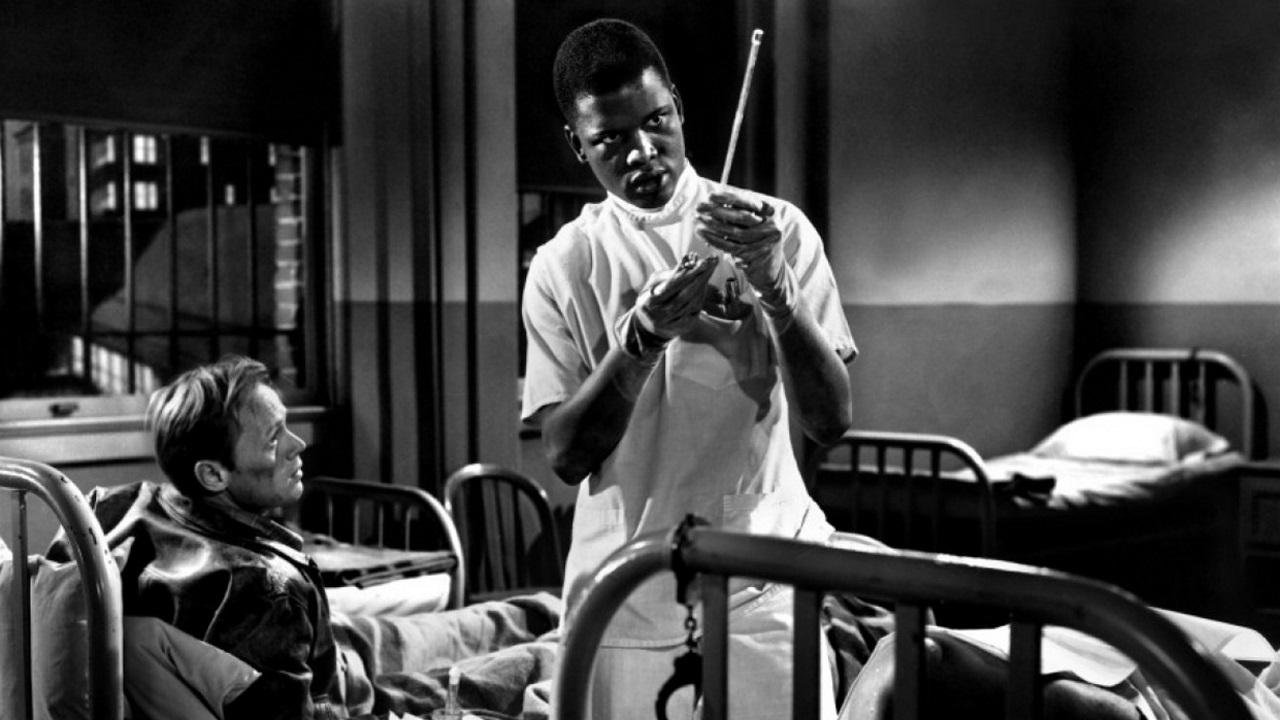
No Way Out arrives in 1950 as one of the most direct confrontations with American racism that the studio system had yet permitted, and it uses the conventions of noir – the enclosed institution, the predatory antagonist, the city as pressure chamber – to frame that confrontation without sentimentality. Mankiewicz, working from a script he co-wrote with Lesser Samuels, gives Richard Widmark's Ray Biddle the full venom of the genre's most dangerous criminals, while refusing to make Sidney Poitier's Luther Brooks a passive symbol. Luther is a man under professional and psychological siege, and the film's tension derives from watching him attempt to hold the ethical high ground while the ground itself keeps shifting. Milton Krasner's photography reinforces this moral architecture through institutional whites and deep corridor shadows that make the hospital feel simultaneously like a sanctuary and a cell. The film is not without its compromises – the Black community's response to violence is handled with some caution – but as an artifact of its moment and a work of genre filmmaking with genuine moral purpose, it remains a film that repays serious attention.
– Classic Noir
Krasner frames the confrontation between Luther and the hospital administration in a corridor drained of warmth – overhead fluorescent light flattens faces into institutional pallor, while the depth of the hallway behind each figure suggests a perspective that offers no exit. The camera holds on Luther at a slight low angle, granting him presence without heroism, while the men across the desk from him occupy the upper portion of the frame with the casual authority of people who have never had to argue for their own credibility.
The scene crystallizes the film's central argument: that the structures ostensibly designed to produce fairness – the hospital, the law, the chain of professional command – are themselves threaded through with the assumptions they are meant to adjudicate. Luther's request for an autopsy is not just a medical procedure; it is a demand that the institution actually function as it claims to. The hesitation on the other side of that request tells the audience everything about where real power resides.
Milton Krasner, working under Mankiewicz at 20th Century Fox, builds the film's visual language around the tension between controlled institutional space and the chaos pressing in from outside. His lighting in the hospital sequences is deliberately cold – high-key fluorescents that deny shadow the comfort it normally offers in noir, exposing faces with a clinical flatness that mirrors the bureaucratic indifference Luther must navigate. When the film moves into the slum neighborhoods and the nighttime streets, Krasner shifts to harder contrasts, deeper blacks, and the kind of location-adjacent studio work that gives the city a texture of accumulated grime. He uses medium focal lengths that keep actors embedded in their environments rather than isolated from them, so that the architecture of poverty and segregation reads as a continuous pressure on the characters rather than a backdrop. The effect is a film that looks, at every moment, like a world in which the wrong outcome is the most probable one.
The most reliably curated streaming home for this title, with a transfer that preserves Krasner's high-contrast institutional photography.
TCMSubscriptionTCM broadcasts the film periodically as part of its classic Hollywood programming; check the schedule for upcoming airings.
TubiFreeAvailability on Tubi fluctuates; confirm current listings before seeking it out here, as print quality may vary.