Films People Pull a Fast One Night Beat Reading Room On TV Shop
So Dark the Night 1946
1946 Columbia Pictures
★★★☆☆ Notable
Film Noir · 71 minutes · Black & White

So Dark the Night

Directed by Joseph H. Lewis
Year 1946
Runtime 71 min
Studio Columbia Pictures
TMDB 6.1 / 10
"A detective solves every crime but his own."

Henri Cassin, Paris's most celebrated detective, takes his first vacation in years at a quiet French country inn run by the Michaud family. Exhausted and quietly melancholic, he is drawn to Nanette, the innkeeper's daughter, and proposes marriage. Her parents accept, and for a brief interval the village offers Cassin something his career never has: the illusion of ordinary life.

When Nanette vanishes on the eve of the wedding – and her former suitor Georges disappears alongside her – both are found murdered in a nearby field. Cassin throws himself into the investigation with professional precision, but the evidence refuses to resolve cleanly. Suspicion moves across the village like weather, settling on the bereaved, the jealous, and the inconvenient, while Cassin's own composure begins to fracture under the pressure of personal grief.

The film belongs to a compact tradition of noir that turns detective logic against itself, using the genre's procedural machinery to expose psychological collapse rather than restore order. Within its 71-minute frame, Lewis constructs a portrait of a man whose entire identity rests on rational mastery, and then removes that foundation piece by piece.
Classic Noir

So Dark the Night is a minor Columbia programmer that punches well above its budget and running time. Joseph H. Lewis, working before his reputation was secured by Gun Crazy, demonstrates here the same instinct for concentrated atmosphere and psychological pressure that would define his better-known work. Steven Geray's performance as Cassin is the film's center of gravity: a small, precise man whose professional pride reads, in the film's disturbing final movement, as something closer to dissociation. The script, credited to Dwight Babcock and Martin Berkeley, is economical to the point of severity, offering almost no exposition that does not carry thematic weight. What distinguishes the film within the noir cycle is its willingness to hollow out the detective figure entirely – not the corrupt investigator of later noirs, but one whose competence is itself the pathology. Produced in the immediate postwar moment, the film carries a residual anxiety about identity and self-knowledge that the rural French setting, rendered entirely on Columbia studio lots, makes oddly timeless.

– Classic Noir
3 ★★★☆☆ Notable
Credits

The Crew

DirectorJoseph H. Lewis
ScreenplayMartin Berkeley
CinematographyBurnett Guffey
MusicHugo Friedhofer
EditingJerome Thoms
ProducerTed Richmond
Performances

The Cast

Close Reading

The Signature Scene

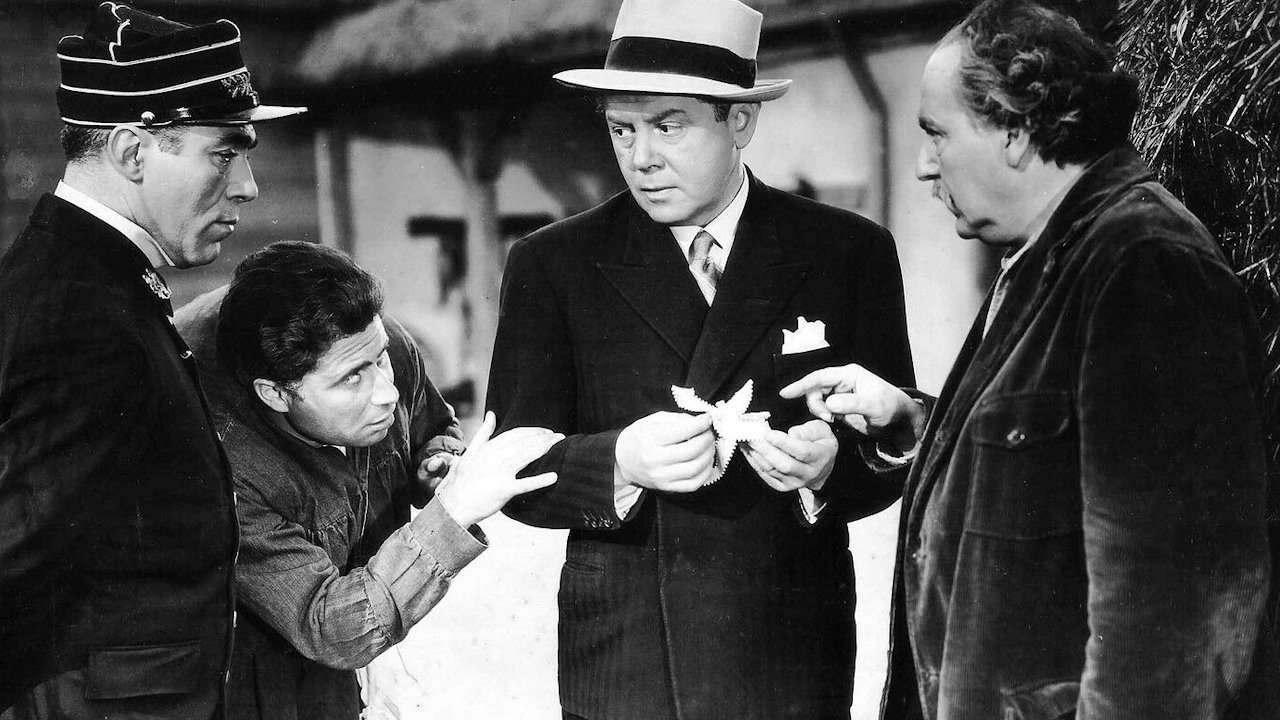
So Dark the Night – scene
The Field at Dawn Two Bodies, One Shadow

Burnett Guffey frames the discovery of the bodies in a wide, flat field with the camera positioned low, the horizon line bisecting the frame at precisely the midpoint. The light is diffuse and directionless, neither sunrise nor overcast, draining the landscape of depth. As the figures converge on the site, Guffey pulls no dramatic close-ups; the bodies remain at middle distance, objects in a composition that refuses to grant them the dignity of individual attention. The effect is cold and geometric.

The restraint of the staging does the scene's real work. By refusing to permit the emotional release of a conventional discovery scene, Lewis positions Cassin – and the audience – as witnesses rather than mourners. The scene argues, quietly, that Cassin's professional habit of detachment has already made him incapable of grief. The formal coldness of the image is not style imposed on content; it is the content.

Visual Language

The Cinematography

🎞️
Burnett Guffey – Director of Photography

Burnett Guffey, who would later shoot From Here to Eternity and Bonnie and Clyde, brings a disciplined restraint to So Dark the Night that suits the film's psychological interiority. Working entirely on Columbia studio sets dressed to evoke rural France, he uses shallow depth of field to compress space and isolate Cassin within his surroundings rather than place him comfortably inside them. Shadow work is precise rather than expressionistic: pools of darkness mark doorways and interior corners without the operatic chiaroscuro of more self-conscious noirs. Guffey's lighting in the interior sequences tends toward flat, even sources that then fall sharply at the edges of the frame, a technique that registers normalcy and threat simultaneously. The camera movement is minimal but deliberate – holds that last a beat longer than comfort permits, and slow tracks that follow Cassin through the village with something closer to surveillance than accompaniment. The visual language serves a film about a man who sees everything except himself.

In the Catalogue

Themes & Motifs

Availability

Where to Watch

Also in the Directory

See Also