Frank Enley is a World War II veteran turned successful housing developer in a California suburb, living quietly with his wife Edith and their young son. His ordered life fractures without warning when Joe Parkson arrives in town – a former POW comrade who walks with a pronounced limp and carries a pistol. Parkson has spent years tracking Enley down, and his purpose is not reconciliation.
The reason for Parkson's vendetta surfaces slowly: during the war, Enley betrayed the location of their escape tunnel to the Germans to save his own life, and the men who died in the resulting massacre included Parkson's closest friend. As Enley flees south to Los Angeles, the film's moral architecture shifts. He falls into the orbit of Pat, a world-weary woman of the streets, and her associate Johnny, a hired killer – forcing Enley to weigh one crime against another and implicating people who have no stake in his guilt.
Act of Violence uses the pursuit thriller as a framework to examine postwar moral compromise, placing the returning veteran not as hero but as a man whose survival came at a price he has suppressed rather than settled. The film belongs to a cluster of late-1940s noirs that interrogate what the war made of ordinary men, refusing both easy condemnation and easy absolution.
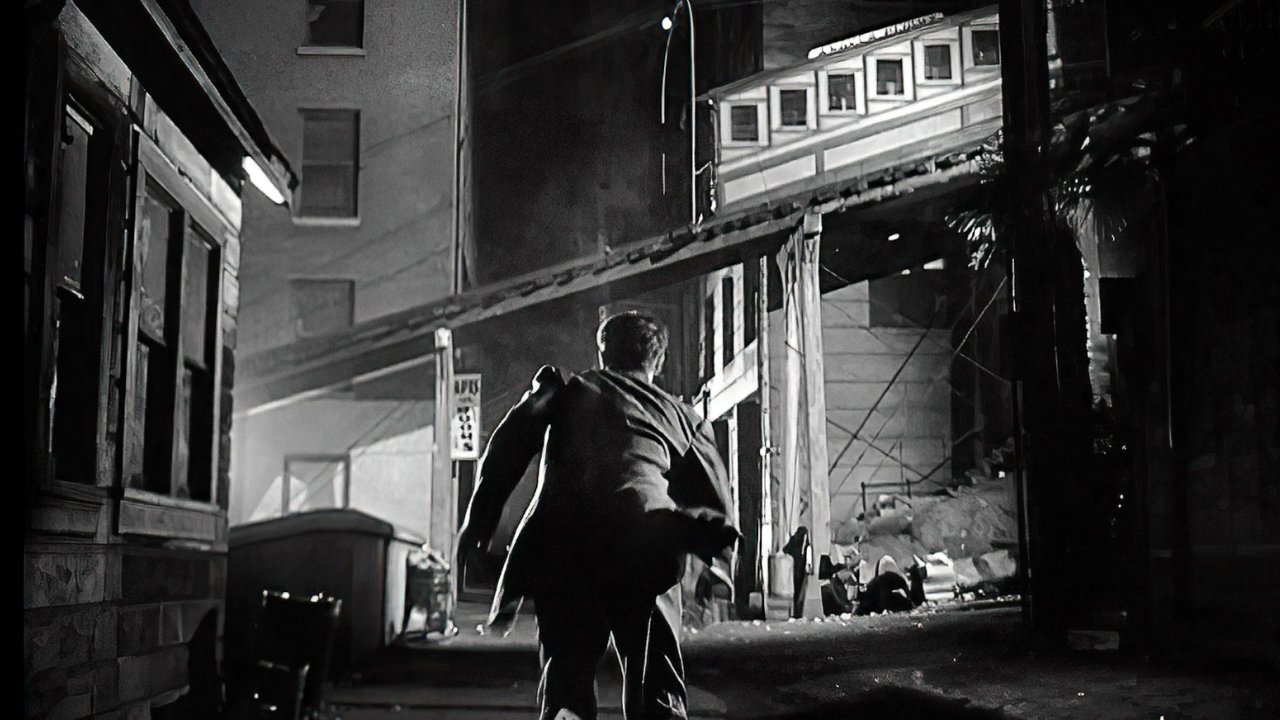
Fred Zinnemann was not a director associated primarily with noir – his career would move toward High Noon and From Here to Eternity – and that outsider quality gives Act of Violence an unusual sobriety. The film refuses the genre's more seductive pathologies: there is no femme fatale engineering destruction, no labyrinthine plot twisting back on itself. Instead, Zinnemann and screenwriter Robert L. Richards build a moral case study about complicity and survival guilt that feels almost European in its restraint. Van Heflin's performance is central to this: Enley is not a villain and not a victim, and Heflin holds that ambiguity without flinching. Robert Ryan, whose screen presence could tip easily into menace, keeps Parkson sympathetic – a man deformed by a legitimate grievance. Mary Astor's Pat, aging and pragmatic in the film's Los Angeles passages, carries the weight of a life lived on the margins in just a handful of scenes. For a studio-era MGM production, the film takes real risks with its protagonist's culpability, and it earns them.
– Classic Noir
Zinnemann and cinematographer Robert Surtees frame the hotel lobby as a field of ambient threat: overhead lighting flattens the crowd into an undifferentiated mass while Enley is picked out in a medium shot that isolates him even in company. When Parkson appears at the far edge of the frame, Surtees allows him to occupy the background without emphasis, as though the danger is simply part of the environment. The cut between the two men is held just long enough to register recognition before the crowd closes again.
The scene crystallizes the film's central argument about guilt as a spatial condition – that what Enley has suppressed cannot be contained by geography or social performance. The lobby, site of civic celebration and professional accomplishment, becomes the place where his constructed postwar identity begins to come apart. Parkson does not need to speak or act; his presence alone is sufficient indictment.
Robert Surtees, whose range across this period extended from musicals to prestige drama, brings to Act of Violence a discipline that suits Zinnemann's preference for psychological legibility over expressionist atmosphere. The film's early California sequences are shot in clean, high-key light that reads as deliberate normalcy – the Enley household has nothing visually wrong with it, and that orderliness makes Parkson's intrusion more unsettling when the shadows begin to accumulate. The Los Angeles night sequences shift register: Surtees moves to tighter lens choices that compress the frame, placing figures against wet pavement and neon reflection without overstating the technique. Location shooting anchors the film in a recognizable postwar California that studio interiors alone could not provide. Throughout, Surtees keeps the camera at human eye level, resisting canted angles and expressionist distortion – a choice that forces the film's moral discomfort onto character and performance rather than visual rhetoric.
TCM holds regular broadcast rights to this MGM title and it appears periodically in themed noir programming; streaming access is available via the TCM app with a cable authentication.
Amazon Prime VideoRental / PurchaseAvailable for digital rental or purchase in standard definition; the most reliable on-demand option outside a cable subscription.
KanopyFree via libraryAvailability varies by library system, but Kanopy has carried MGM titles of this vintage; worth checking with a library card before paying elsewhere.