Films People Pull a Fast One Night Beat Reading Room On TV Shop
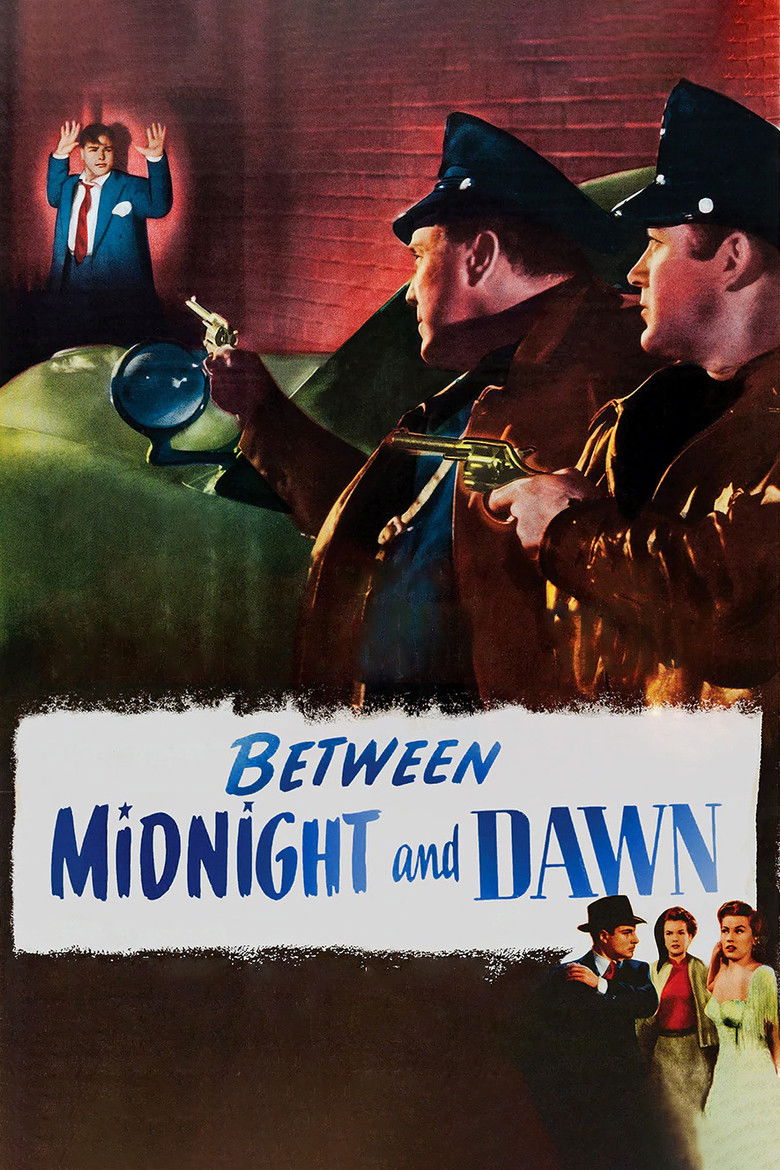
Between Midnight and Dawn 1950
1950 Columbia Pictures
★★★☆☆ Notable
Film Noir · 89 minutes · Black & White

Between Midnight and Dawn

Directed by Gordon Douglas
Year 1950
Runtime 89 min
Studio Columbia Pictures
TMDB 5.7 / 10
"Two cops, one woman, and a city that keeps its debts in blood."

Rocky Barnes and Dan Purvis are patrol officers working the night shift in an unnamed American city, partners bound by the easy familiarity of men who have shared a squad car long enough to finish each other's sentences. Their working lives are shaped by radio calls, stakeouts, and the slow grind of a city that never fully sleeps. When both men fall for Kate Mallory, the daughter of a retired cop, the partnership absorbs the tension without breaking – at least for a time.

The situation hardens when the pair become entangled with Ritchie Garris, a syndicate figure with a talent for exploiting procedural gaps and a contempt for the men who enforce the law. Garris is not a figure of operatic menace but of calculated, institutional malice – the kind who understands that legal systems have seams. As his criminal operations draw police attention, the pressure he applies moves beyond intimidation into something irreversible, and the triangle between Rocky, Dan, and Kate shifts from romantic rivalry into something with genuine consequences.

Between Midnight and Dawn belongs to a strain of postwar noir that roots itself in police procedure rather than private detection, grounding moral ambiguity inside an institution nominally aligned with order. The film is less interested in corruption than in the cost exacted from men who remain honest – and in the particular vulnerability of those who believe that doing the job correctly constitutes sufficient protection.
Classic Noir

Between Midnight and Dawn arrives at a moment when the police procedural and the noir thriller were actively negotiating their shared territory. Gordon Douglas, a director whose strengths ran toward economy and pace rather than expressionist flourish, keeps the film anchored in the mechanics of patrol work – radio dispatch, foot pursuit, jurisdictional friction – in ways that feel less like authenticity signaling and more like structural argument. The film posits the night shift as a moral environment in its own right, one that operates outside domestic normalcy and imposes its own logic on the men who inhabit it. Edmond O'Brien and Mark Stevens generate a credible partnership without softening the competition between them, and Donald Buka's Garris functions as an effective antagonist precisely because he is conceived as systematic rather than spectacular. George Diskant's photography keeps the city present as texture rather than backdrop. The film does not reach for the psychological depth of the era's best work, but it handles its procedural framework with discipline and earns its darker turns.

– Classic Noir
3 ★★★☆☆ Notable
Credits

The Crew

DirectorGordon Douglas
ScreenplayGerald Drayson Adams
CinematographyGeorge E. Diskant
MusicGeorge Duning
EditingGene Havlick
ProducerHunt Stromberg
Performances

The Cast

Close Reading

The Signature Scene

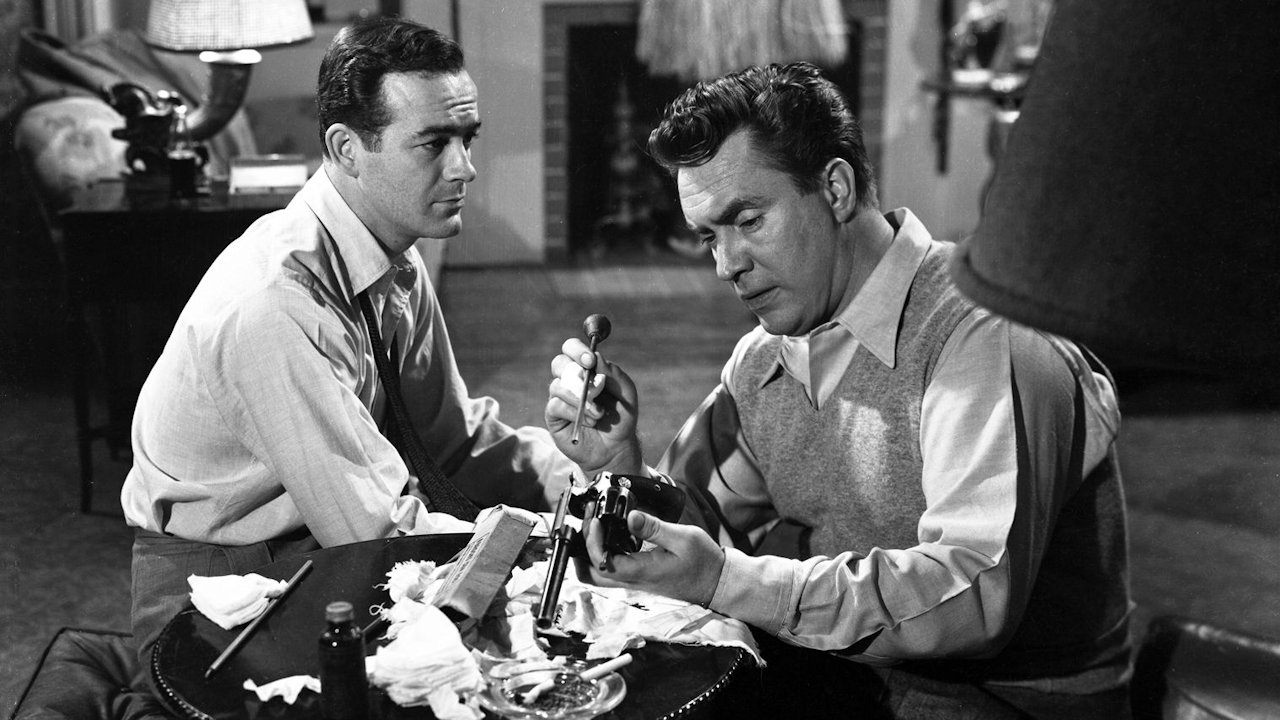
Between Midnight and Dawn – scene
The Tenement Stairwell Shadow at the Landing

Diskant compresses the stairwell into a near-vertical shaft of alternating light and shadow, the practical fixtures on each landing casting hard pools that the officers move through rather than inhabit. The camera holds at a low angle, elongating the figures and flattening depth so that danger reads as proximity rather than distance. Walls press in at the frame's edges; the geometry of the location becomes an argument about confinement.

The staging forces the officers to proceed without tactical advantage – the architecture itself has sided with the man they are pursuing. What the scene discloses is not simply physical danger but the way institutional authority dissolves in spaces the institution does not control. The stairwell is Garris's terrain, and the sequence makes that territorial logic visible.

Visual Language

The Cinematography

🎞️
George E. Diskant – Director of Photography

George E. Diskant, who had already brought a cold, observational precision to films like Caught and The Narrow Margin, works here within the constraints of a mid-budget Columbia production and turns limitation into method. His lighting favors hard single-source setups that produce deep shadows without the baroque excess that occasionally tips noir photography into self-parody. Night exteriors use available urban geometry – storefronts, alley walls, the underside of fire escapes – to fragment and compress the frame, suggesting a city that has organized itself against clarity. Interior sequences in the precinct and in Garris's operations maintain a cooler, more diffuse light that registers institutional spaces as neither safe nor threatening but simply indifferent. The cumulative effect is a visual grammar in which moral ambiguity is expressed through the unreliability of illumination: what is visible is not always what matters, and what is hidden is not always what threatens.

In the Catalogue

Themes & Motifs

Availability

Where to Watch

Also in the Directory

See Also