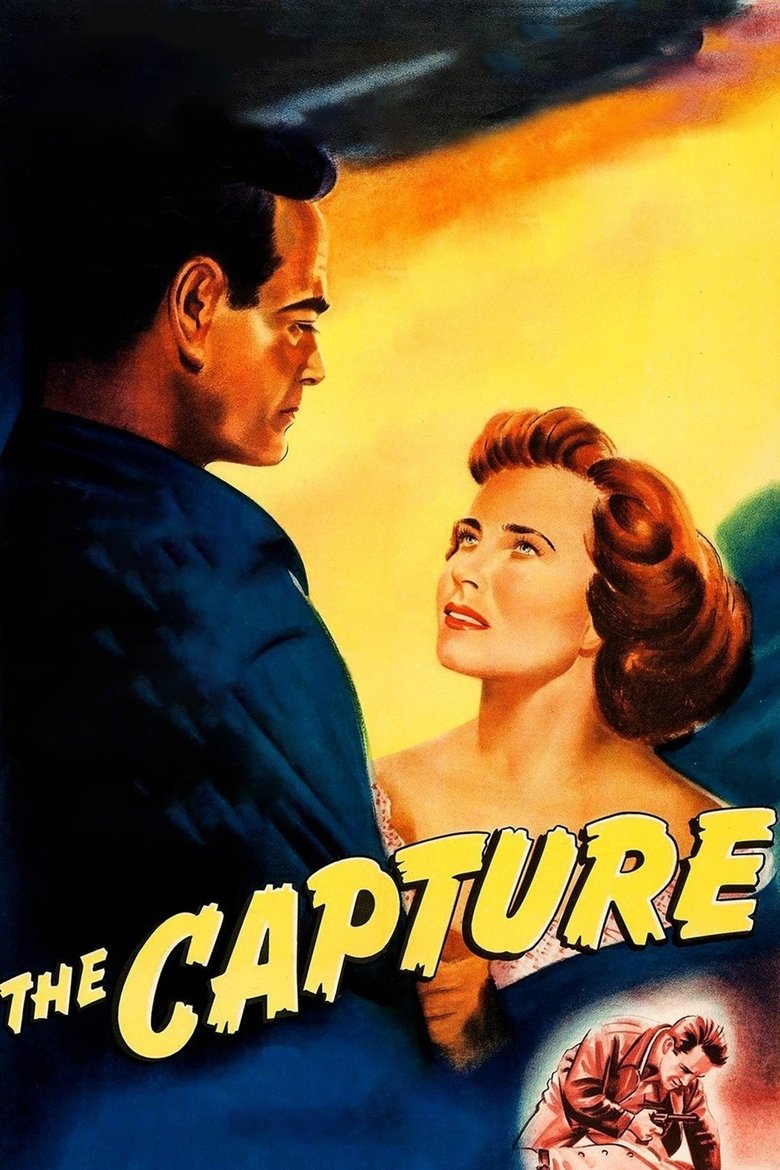
In the oil fields of the American Southwest, Lin Vanner works as a roughneck with something to hide. When a payroll robbery goes wrong and a guard is killed, Vanner – implicated by circumstance rather than guilt – flees the scene and vanishes into a new identity, adopting the name Lindley Brown and settling in a remote Mexican border community where no one asks questions. He finds work, quiet, and the companionship of Ellen Tevlin, a widow raising a young son alone.
What Vanner cannot outrun is the original crime's gravitational pull. Earl Mahoney, a finance company executive with reasons of his own to pursue the case, begins closing in. Father Gomez, the local priest, observes Vanner's mounting unease with the patience of a confessor who already suspects the answer. Ellen, drawing closer to the man she knows as Brown, remains unaware that her trust is built on a fabrication – and that the murdered guard whose death haunts Vanner was the husband she buried.
Capture works the wrong-man scenario from an unusual angle: its protagonist is neither fully innocent nor fully guilty, and the film uses that moral ambiguity to probe what guilt, identity, and atonement mean in postwar America. The narrative tightens into a trap of the protagonist's own construction, with a confessional structure – the story told in retrospect to Father Gomez – lending the whole enterprise the weight of a man accounting for himself before judgment arrives.
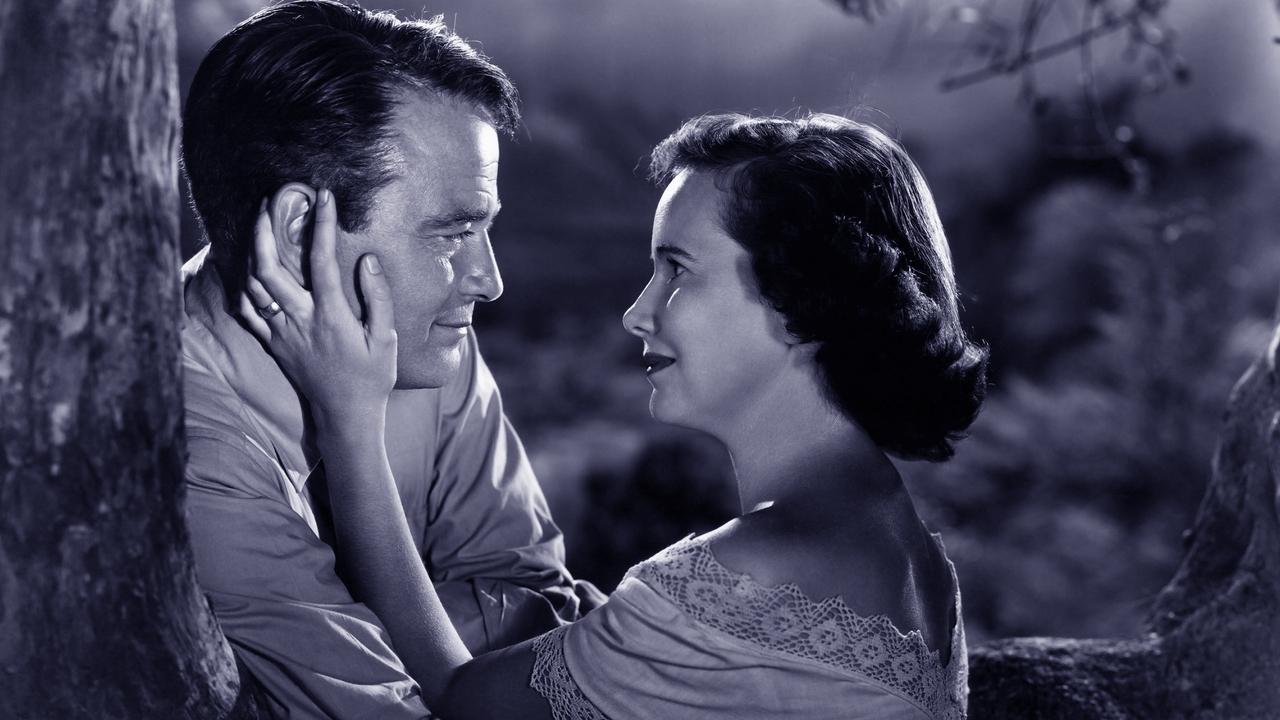
Capture occupies a modest but genuine position in early-1950s American noir, distinguished less by formal invention than by its willingness to pursue psychological consequence with patience. John Sturges, two years before his reputation solidified with Jeopardy and Bad Day at Black Rock, keeps the film anchored in performance rather than style, drawing from Lew Ayres a portrait of a man worn thin by sustained deception. Teresa Wright brings her characteristic economy to a role that might otherwise have remained passive, and Victor Jory's Father Gomez provides a structural intelligence the film needs – a confessor whose moral authority is never coercive. The film's most notable decision is its use of the retrospective frame: by opening after the central events have already shaped the protagonist, Capture establishes fatalism as a given rather than a destination. What the film reveals about its era is the particular postwar condition of men who returned – or hoped to return – to lives that no longer fit, and found that self-reinvention carries a cost measured in other people's grief.
– Classic Noir
The scene is composed with deliberate stillness: Vanner sits across from Father Gomez in a space defined by half-light, the frame organized so that shadow claims more of the image than illumination. Edward Cronjager holds the camera at a moderate distance, resisting close-up insistence, allowing the space between the two men to register as moral interval. Light falls obliquely on Ayres's face, enough to read expression, not enough to dispel the surrounding dark.
The scene announces the film's central argument before the story proper begins: this is not a crime narrative but an accounting. The physical positioning of Vanner – leaning forward, hands open, voice low – codes the gesture as surrender rather than strategy. Father Gomez listens without comment, and his stillness communicates that absolution is neither promised nor withheld. The noir frame is present but stripped of menace; what remains is the simpler, older structure of a man trying to explain himself to someone who will not look away.
Edward Cronjager brings to Capture a visual discipline suited to its confessional ambitions. Working largely on studio sets dressed to suggest the sun-bleached severity of the Southwest borderlands, Cronjager avoids the high-contrast expressionism that defines metropolitan noir, opting instead for a more diffuse but no less deliberate chiaroscuro. Interiors are lit with practical-source logic – windows casting directional bars, lamplight concentrating on faces while walls recede – which keeps the moral atmosphere close rather than operatic. His lens choices favor moderate focal lengths that flatten depth just enough to trap characters in the frame without distorting them, a technique that reinforces the story's sense of enclosure. Exteriors, particularly the oil-field sequences and the dusty village surroundings, are shot with sufficient contrast to feel airless under open sky, making physical freedom appear illusory. The cinematography's consistent contribution is to suggest that the landscape itself has no refuge to offer – that wherever the camera finds Vanner, the accounting has already begun.
Tubi has carried a number of low-profile 1950s noirs from smaller studios; check current availability as catalogues shift.
Archive.orgFreePublic domain prints of Capture have circulated here; image quality varies but the film is viewable without cost.
Amazon Prime VideoSubscriptionPeriodically available through Prime's rotating classic-film holdings; confirm before seeking.