Films People Pull a Fast One Night Beat Reading Room On TV Shop
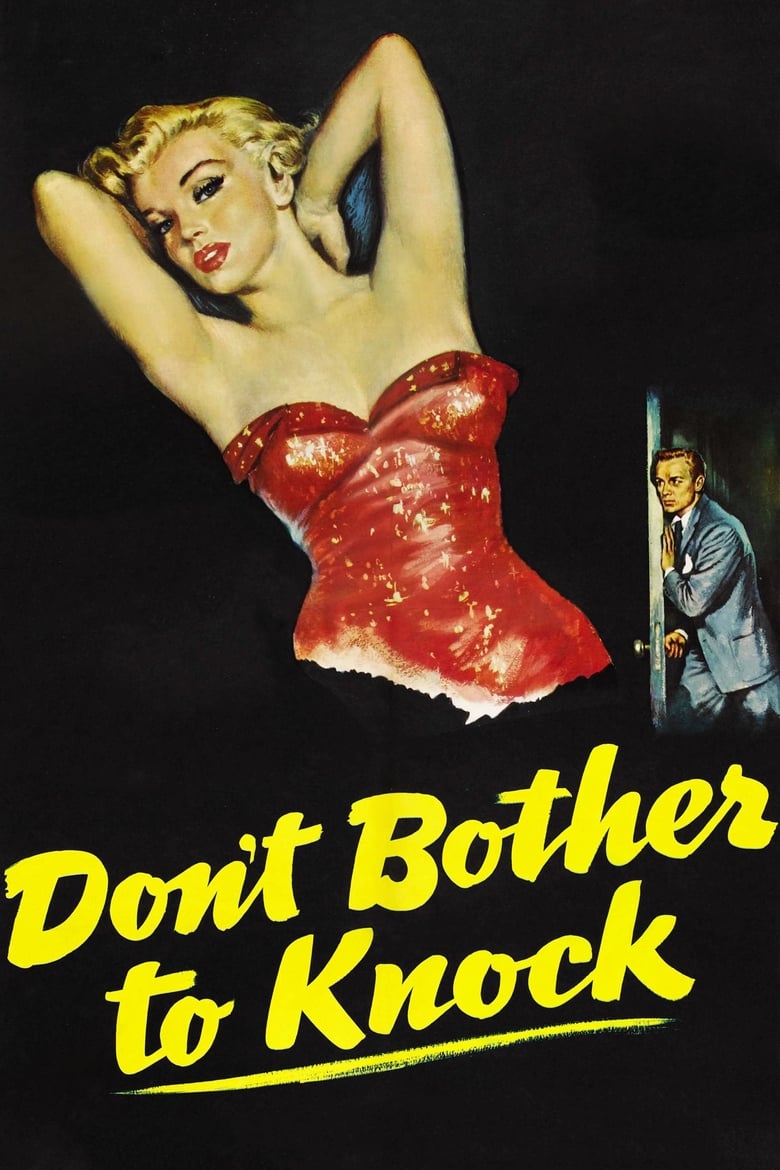
Don't Bother to Knock 1952
1952 20th Century Fox
★★★☆☆ Notable
Film Noir · 76 minutes · Black & White

Don't Bother to Knock

Directed by Roy Ward Baker
Year 1952
Runtime 76 min
Studio 20th Century Fox
TMDB 6.6 / 10
"A stranger babysits in a hotel corridor, and a man who thinks himself hollow discovers he is not."

At a mid-range Manhattan hotel, airline pilot Jed Towers nurses a broken heart after receiving a letter from Lyn Lesley, the lounge singer downstairs, ending their relationship. Across the airshaft, through the window of a guest room, he notices Nell Forbes – a young woman brought in to babysit the daughter of hotel regular Peter Jones. Nell is quiet, oddly still, and watching her from his room Jed crosses the corridor to introduce himself, drawn by something he cannot yet name.

What begins as a distraction from Jed's self-pity hardens into something far more dangerous. Nell is not simply nervous or lonesome – she is mentally fragile, recently released from an institution following a breakdown tied to a dead lover, a trauma her uncle Eddie Forbes, a hotel elevator operator, has tried to conceal from the management that hired her. As Jed pushes closer, Nell's grip on the present loosens, and the child Bunny becomes a pawn in Nell's private, dissolving reality. Lyn, performing below, remains an uncomfortable moral counterweight to whatever Jed is becoming involved in upstairs.

Don't Bother to Knock works against the standard noir template: there is no crime plot, no femme fatale engineering a man's ruin, no investigator closing in. Instead, the film stages its tension inside a single building over a single night, using the hotel's sealed geography to trap its characters in proximity and force a reckoning that is psychological rather than criminal. It is less a thriller than a case study in how damaged people recognize damage in one another.
Classic Noir

Don't Bother to Knock occupies an unusual position in the early 1950s Fox noir cycle: it is almost entirely without plot in the conventional sense, and is stronger for it. Roy Ward Baker, working from Daniel Taradash's script adapted from Charlotte Armstrong's novel, keeps the camera inside a single hotel and trusts that confinement to generate pressure. What the film actually examines is the cost of emotional withdrawal – Widmark's Jed is as psychically estranged as Monroe's Nell, and the film's implicit argument is that his detachment makes him briefly complicit in the danger she poses to the child. Monroe's performance, frequently underestimated, is careful and genuinely unnerving: she does not play Nell as monstrous but as someone for whom the boundary between memory and the present has simply ceased to hold. Bancroft, in her screen debut, anchors the film's moral centre with economy. The film is a minor entry by the standards of classic noir but not a careless one; its claustrophobic structure and its refusal of easy resolution place it closer to the cycle's psychological fringe than its marketing suggested.

– Classic Noir
3 ★★★☆☆ Notable
Credits

The Crew

DirectorRoy Ward Baker
ScreenplayDaniel Taradash
CinematographyLucien Ballard
MusicLionel Newman
EditingGeorge A. Gittens
Art DirectionRichard Irvine
CostumesTravilla
ProducerJulian Blaustein
Performances

The Cast

Close Reading

The Signature Scene

Don't Bother to Knock – scene
Room 809 – the corridor confrontation Nell at the Window

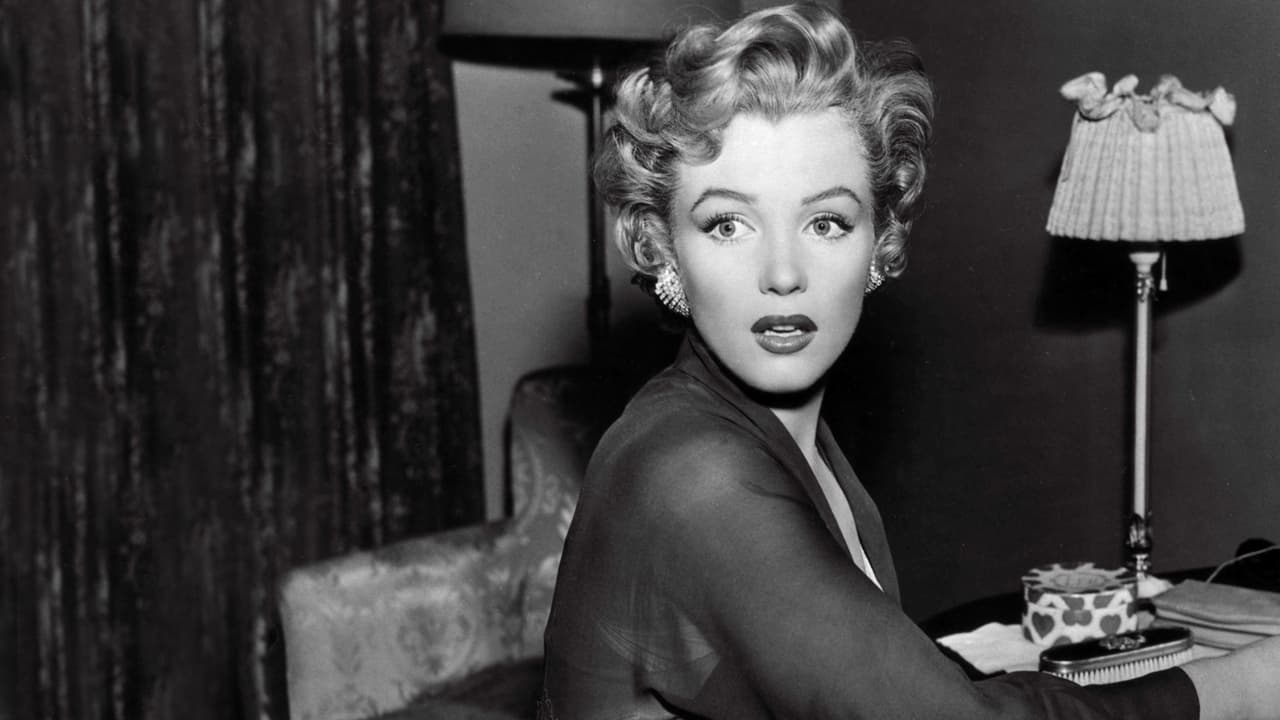
Lucien Ballard frames Monroe in medium close-up against the hotel room window, the city a smeared darkness behind the glass. The key light falls from a slight low angle, catching the planes of her face while leaving her eyes intermittently in shadow as she turns. The room itself is dressed in the flat, impersonal geometry of mid-range hotel furniture – a bed, a lamp, a dresser mirror that Ballard uses to split the frame and suggest the doubling at the core of Nell's psychology. When Jed appears in the doorway, Ballard cuts to a two-shot that keeps significant negative space between them, the corridor light behind him hard and institutional against the softer, almost amber glow of the room.

The scene establishes the film's central moral problem before any threat has been made explicit: Jed is drawn to Nell not despite her vacancy but because of it, and the camera's stillness around Monroe makes that vacancy readable as an invitation for projection. What the film argues here, quietly and without dialogue to underscore it, is that men who have abandoned feeling are not safe observers of women who have lost their hold on it.

Visual Language

The Cinematography

🎞️
Lucien Ballard – Director of Photography

Lucien Ballard, working in tight studio conditions on a modest Fox budget, uses the hotel's vertical and horizontal geometry as a visual system rather than mere backdrop. Shooting largely on constructed interior sets, he establishes distinct light registers for each floor and zone: the lounge where Bancroft performs is lit with the diffuse warmth of commercial space, the upper corridors with the flat overhead fluorescence of institutional anonymity, and Room 809 with a practitioner's lamp scheme that keeps Monroe in selective, unstable illumination. Ballard avoids the deep-shadow expressionism associated with harder noir entries; instead he works in a mid-key register that makes the film feel observed rather than stylised, which serves the psychological subject matter more honestly than dramatic chiaroscuro would. His lens choices favour normal focal lengths that keep the confined spaces from feeling artificially cramped, and his rare uses of a slightly longer lens in the mirror compositions create compression that registers as psychological pressure without announcing itself as technique.

In the Catalogue

Themes & Motifs

Availability

Where to Watch

Also in the Directory

See Also