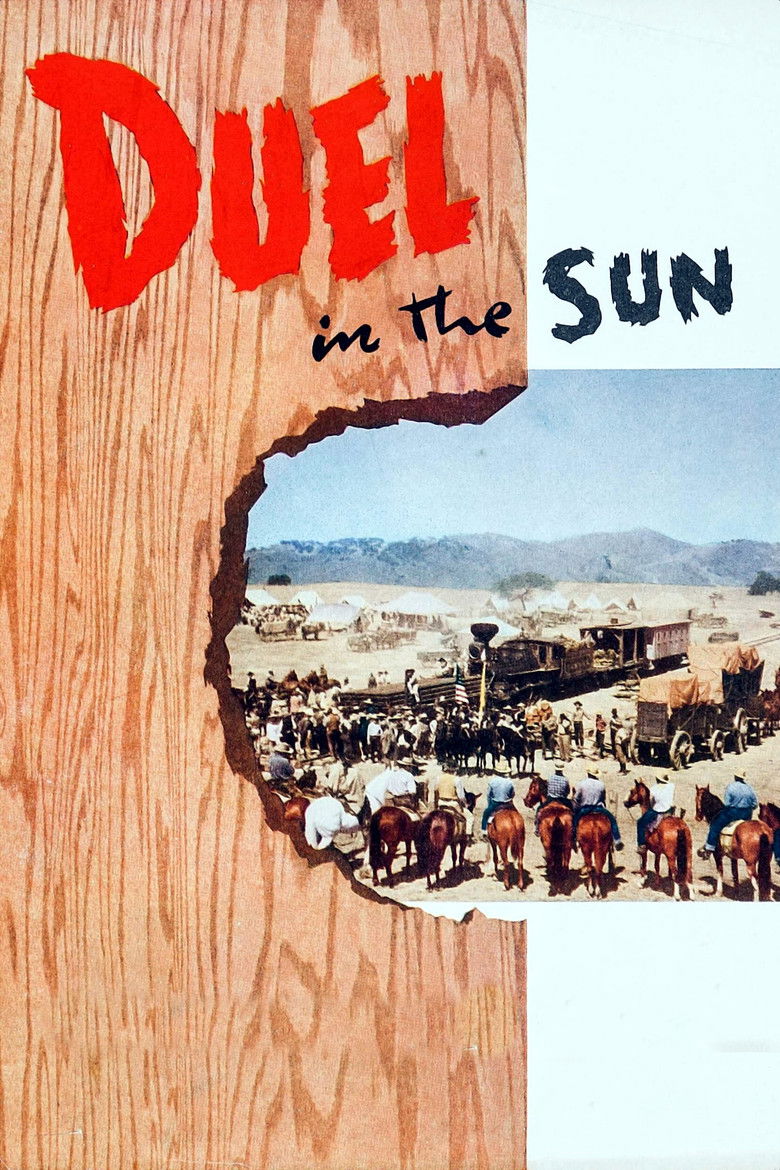
Pearl Chavez, the mixed-race daughter of a Southern gentleman and the woman he kills in a jealous rage, is sent to live at the Texas ranch of a distant relation, Senator Jackson McCanles, a wheelchair-bound patriarch whose empire sprawls across the open range. His household is fractured: his gentle wife Laura Belle harbors old regrets, his eldest son Jesse is principled and quietly kind, and his younger son Lewt is reckless, magnetic, and morally hollow. Pearl arrives displaced and unmoored, carrying the stigma of her mother's reputation and her father's crime.
The McCanles household becomes the arena for competing claims on Pearl's soul. Jesse offers respect and the prospect of a decent life, but Lewt – volatile, sensual, careless of consequences – exerts a pull Pearl cannot reason her way out of. Lewt's seduction shades into possession, then into a pattern of cruelty and abandonment that Pearl cannot simply leave behind. The Senator's hostility toward her hardens the social pressure, while a land war with neighboring cattlemen raises the stakes beyond any single family drama and draws Jesse into a conflict that separates him permanently from the ranch.
Duel in the Sun occupies an unusual position at the edge of noir: a western by setting and scale, it operates by noir's interior logic – desire as entrapment, the past as sentence, the body as its own undoing. David O. Selznick's production aspires to epic grandeur, but the film's pulse is closer to the fever of a late-night confession than to the sweep of the frontier myth. The violence that the story has been building toward arrives not as resolution but as a kind of terrible symmetry.
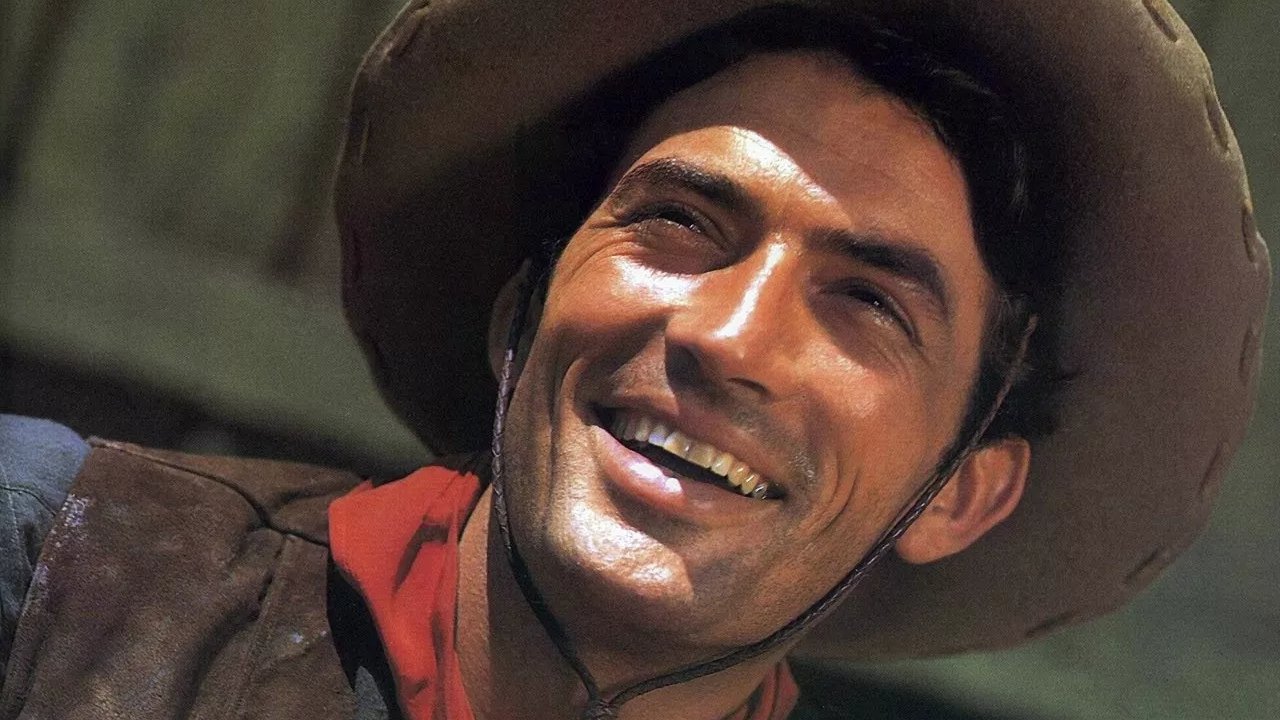
Duel in the Sun sits uncomfortably in genre taxonomy, which is precisely what makes it worth sustained attention. Selznick's ambition to manufacture a successor to Gone with the Wind produced instead something stranger and more unstable: a western that cannibalizes itself, driven by a sexuality the Production Code could barely contain and a racial undercurrent the film never fully confronts. Jennifer Jones's performance is the engine of whatever darkness the film achieves – physically committed, emotionally raw, and finally tragic in the classical sense: Pearl is destroyed not by villains but by her own capacity for feeling in a world that has assigned her no legitimate place for it. Gregory Peck's Lewt is one of the period's more genuinely unsettling romantic leads, charming in exact proportion to his willingness to harm. King Vidor directs with scale but not always with control, and the film's tonal inconsistencies are real. What survives those inconsistencies is a portrait of passion as a form of self-destruction that aligns the film, however loosely, with noir's central preoccupation.
– Classic Noir
Harold Rosson photographs the final sequence in blazing, near-abstract light – the Arizona rock formations bleached to near-white, shadow pooled only in the crevices between boulders. The camera holds wide long enough to reduce both figures to silhouettes against the sky, then closes in to register each wound, each crawling advance across stone. The color work, lurid by design, strips the landscape of any pastoral comfort: this is terrain that produces nothing and forgives nothing.
The scene makes the film's thesis visible: Pearl and Lewt are not destroyed by circumstance or by each other in any simple sense, but by a dynamic that was always tending toward this. The crawl toward each other across the rocks – each shot, each still moving – is staged as an embrace deferred so long it can only arrive as annihilation. Selznick and Vidor want it read as doomed romance; the images themselves are colder, suggesting two people for whom no other outcome was ever structurally possible.
Harold Rosson, working within Selznick's insistence on Technicolor spectacle, makes choices that cut against the film's epic pretensions and push it toward something more claustrophobic. His lighting in the interior sequences – Laura Belle's parlor, the ranch at night – uses hard source light and deep shadow in ways that recall the monochrome noir work of the period, importing a moral atmosphere that Technicolor was not supposed to carry. For the exterior sequences Rosson uses the Arizona landscape not as backdrop but as a thematic surface, draining warmth from the sky and burning out detail in the midground to create an environment hostile to human presence. The recurring close-ups of Jones are lit to emphasize instability rather than glamour, the key light shifting between scenes in ways that refuse to settle her face into a stable identity. The result is a visual language divided against itself – spectacular where the production demands it, severe where the story's logic takes over.
TCM screens Duel in the Sun periodically in its original Technicolor presentation and is the most reliable broadcast source for the complete 144-minute cut.
TubiFreeA free streaming version is available on Tubi, though print quality may vary; adequate for a first viewing.
Amazon Prime VideoRentalAvailable to rent in HD; a reasonable option when broadcast schedules are inconvenient and a clean transfer matters.