Films People Pull a Fast One Night Beat Reading Room On TV Shop
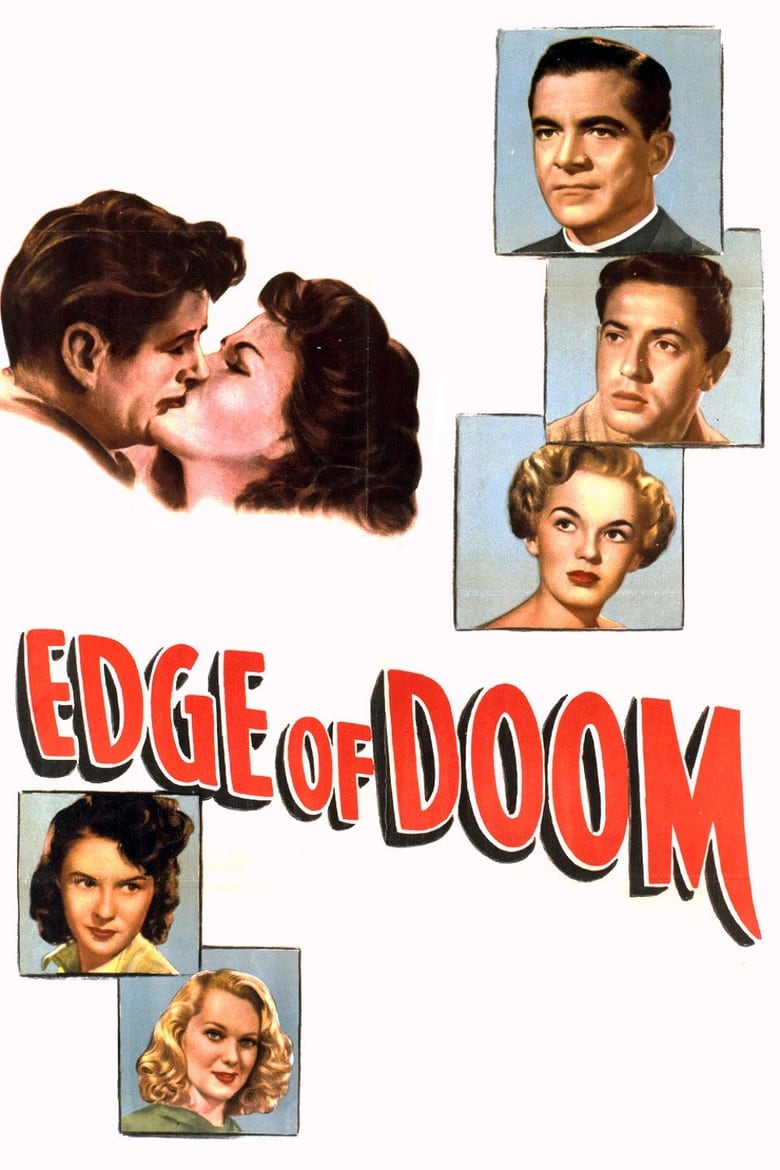
Edge of Doom 1950
1950 Samuel Goldwyn Productions
★★★☆☆ Notable
Film Noir · 99 minutes · Black & White

Edge of Doom

Directed by Mark Robson
Year 1950
Runtime 99 min
Studio Samuel Goldwyn Productions
TMDB 6.1 / 10
"A young man's desperation hardens into something the law cannot overlook."

In a decaying urban parish, Martin Lynn is a bitter young man ground down by poverty, a failed mother, and a church he feels has abandoned his family. When the local priest refuses to grant his mother a proper funeral on the grounds that her burial fees have gone unpaid, Martin's resentment ignites into violence. He kills the priest in a moment of savage impulse, then moves through the city attempting to conceal the act while his conscience erodes beneath the pressure. The film is framed by Father Thomas Roth, a more worldly cleric, who pieces together Martin's story through confession and investigation.

As Roth pursues the truth, the film draws in a surrounding cast of figures from Martin's neighborhood: Rita, the decent young woman who represents the life Martin might have had; Craig, a cynical newspaper man who senses a story; and Irene, a woman whose careless glamour briefly distracts Martin from his spiral. Each relationship clarifies the distance between who Martin wanted to be and what he has become. The investigation is less procedural than moral, with Roth functioning not as a detective but as a confessor-turned-witness forced to balance institutional obligation against private conscience.

Edge of Doom situates itself at the intersection of social-problem drama and Catholic guilt melodrama, a configuration that marks it as distinctly postwar in its anxieties. It shares with other films of the cycle a preoccupation with economic despair as a breeding ground for violence, but it resists the genre's usual fatalism in ways that complicate its noir credentials while not eliminating them. The tension between redemption and condemnation is never fully resolved, and the film is more interesting for it.
Classic Noir

Edge of Doom arrives at a curious angle to classical noir. Samuel Goldwyn's production is visually and thematically darker than his house style typically permitted, yet the film carries the marks of studio compromise, including a framing device that softens the story's bluntest implications. What survives intact is Farley Granger's performance: coiled, self-pitying, and capable of sudden violence in a way that feels psychologically earned rather than melodramatic. Mark Robson directs with disciplined restraint, keeping the Catholic setting from becoming allegory while still allowing it to generate genuine moral unease. The film belongs to a postwar strain of American cinema that treated urban poverty as a pathology requiring institutional response rather than individual punishment, and in this sense it anticipates the social-conscience films of the following decade. Dana Andrews, in the framing role, functions more as structural device than character, but the film does not require him to be more than that. What it offers is a portrait of irreversible momentum: a man who does one terrible thing and watches every available exit close behind him.

– Classic Noir
3 ★★★☆☆ Notable
Credits

The Crew

DirectorMark Robson
ScreenplayCharles Brackett
CinematographyHarry Stradling Sr.
MusicHugo Friedhofer
EditingDaniel Mandell
Art DirectionRichard Day
CostumesMary Wills
ProducerSamuel Goldwyn
Performances

The Cast

Close Reading

The Signature Scene

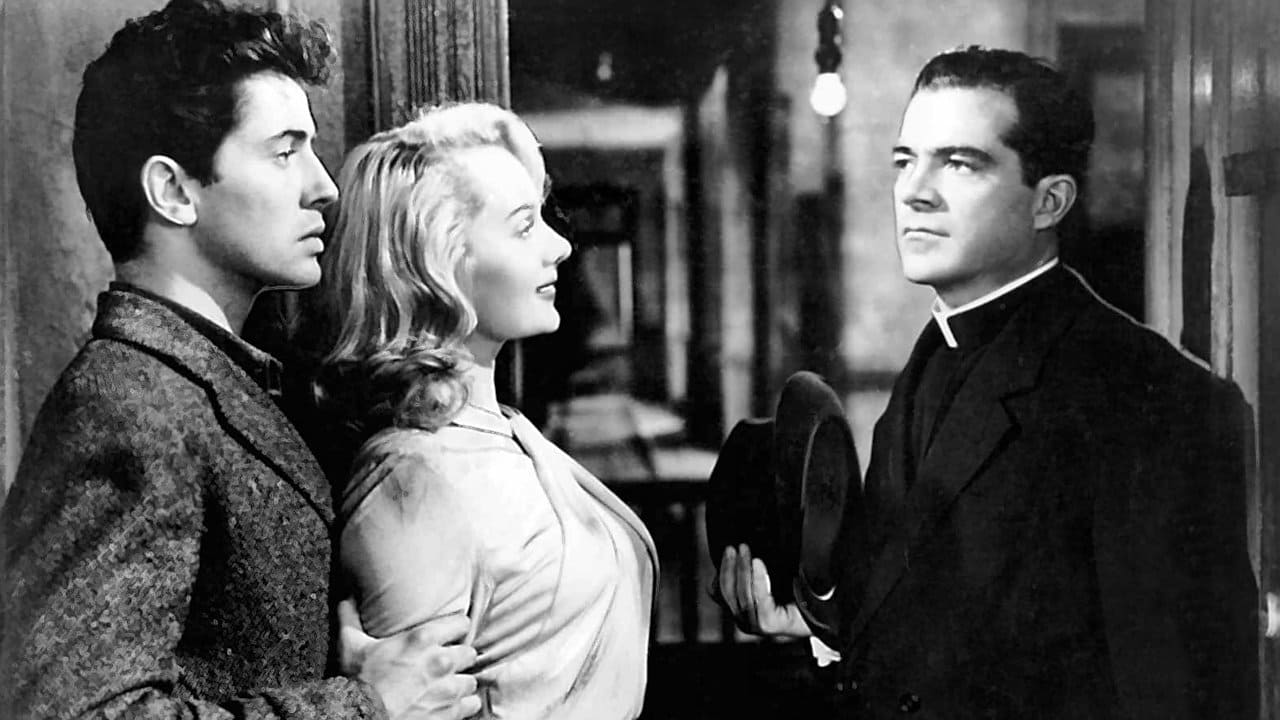
Edge of Doom – scene
The Rectory Confrontation Candlelight Before the Blow

Harry Stradling frames the scene in tight, asymmetric compositions that give Father Kirkman the spatial authority of the room while pressing Martin into the lower corners of the frame. The rectory is lit with a single practical source – candlelight reinforced by a narrow window – casting half of each face into shadow. The camera holds close on Granger's hands, which move with a restless, barely-contained energy that the dialogue alone does not convey. As the argument escalates, Stradling's camera drifts incrementally closer, refusing to cut away, so that the violence, when it comes, feels like an accumulation rather than an event.

The scene is the film's moral fulcrum: it establishes that Martin's violence is not the act of a calculating criminal but of a man whose capacity for self-control has been worn to nothing by accumulated humiliation. Kirkman's refusal is not cruel by institutional standards, and the film knows this, which makes the confrontation tragic rather than simply dramatic. What the scene argues, through Stradling's patient framing and Granger's physical specificity, is that the line between containment and collapse can be invisible until it has already been crossed.

Visual Language

The Cinematography

🎞️
Harry Stradling Sr. – Director of Photography

Harry Stradling Sr. brings to Edge of Doom a lighting grammar rooted in deep shadow and constrained natural sources that suits the film's moral terrain. Working predominantly on studio sets dressed to suggest a working-class urban parish rather than shooting on location, Stradling builds environments where light is always partial – falling on half a face, striping a wall through venetian blinds, pooling on a single object in an otherwise dark room. His lens choices favor moderate telephoto compressions that flatten the space between characters, reducing the psychological distance between hunter and hunted, confessor and criminal. The shadow work is not expressionist in the German tradition but is closer to a documentary realism filtered through controlled studio conditions, which suits the film's social-problem ambitions. Where the cinematography most directly serves the story's moral logic is in its treatment of the church interiors: spaces that should offer solace are instead rendered in deep chiaroscuro, making sanctuary look indistinguishable from entrapment.

In the Catalogue

Themes & Motifs

Availability

Where to Watch

Also in the Directory

See Also