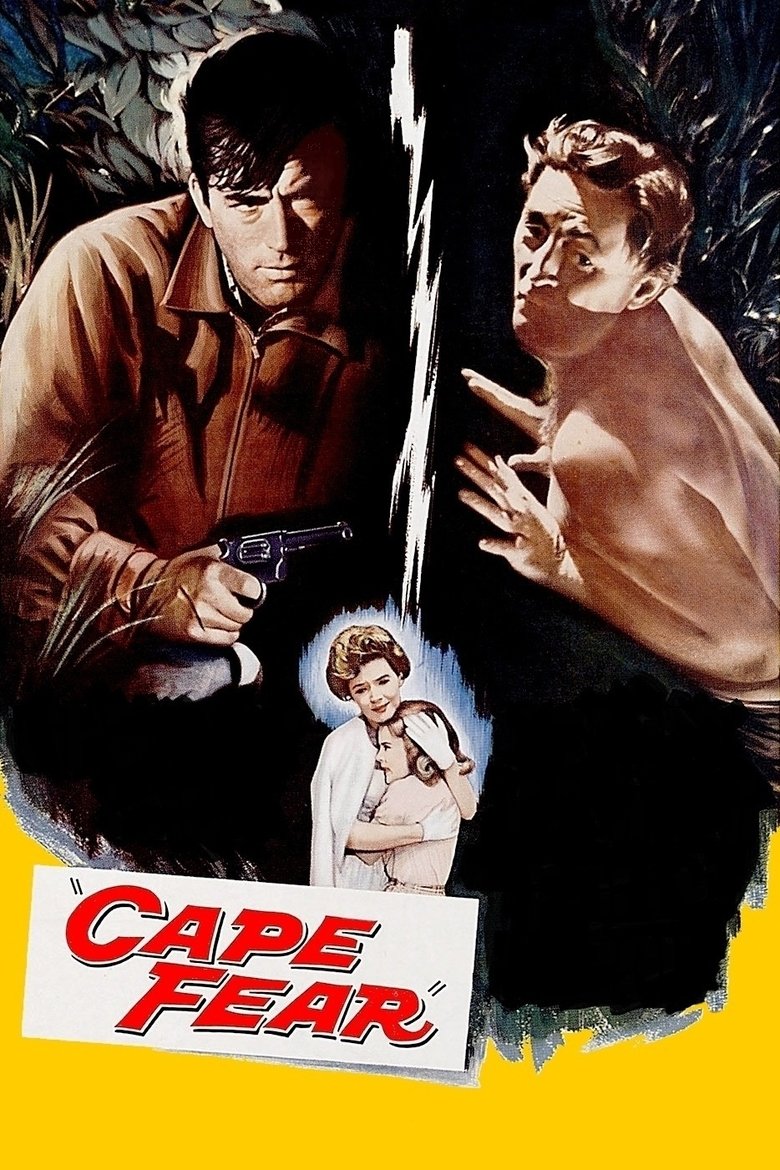
Sam Bowden is a respected attorney living with his wife Peggy and teenage daughter Nancy in a quiet Southern coastal town. His ordered life fractures when Max Cady, a man Bowden testified against years earlier, arrives following his release from prison. Cady is not a fugitive or a criminal in any actionable sense – he is simply present, watching, circling the edges of the Bowden family's existence with a patience that makes his intent unmistakable and his conduct legally untouchable.
Bowden appeals to Police Chief Mark Dutton and consults his attorney Dave Grafton, but Cady has broken no law. A private investigator, Charles Sievers, is hired to dig into Cady's past, and Bowden eventually crosses ethical and legal lines of his own in an attempt to drive Cady away – moves that compromise his standing as an officer of the court and begin to corrode his identity as a man who believes in due process. Cady, meanwhile, escalates his psychological campaign, targeting not just Bowden but the women in his life.
Fear operates as a legal thriller and a domestic nightmare simultaneously, using the architecture of the law to expose its own limits. The film belongs to the cycle of postwar noir concerned less with crime than with the vulnerability of bourgeois order, films in which respectability becomes a trap and the institutions meant to guarantee safety reveal themselves as inadequate to the violence that waits just outside the light.
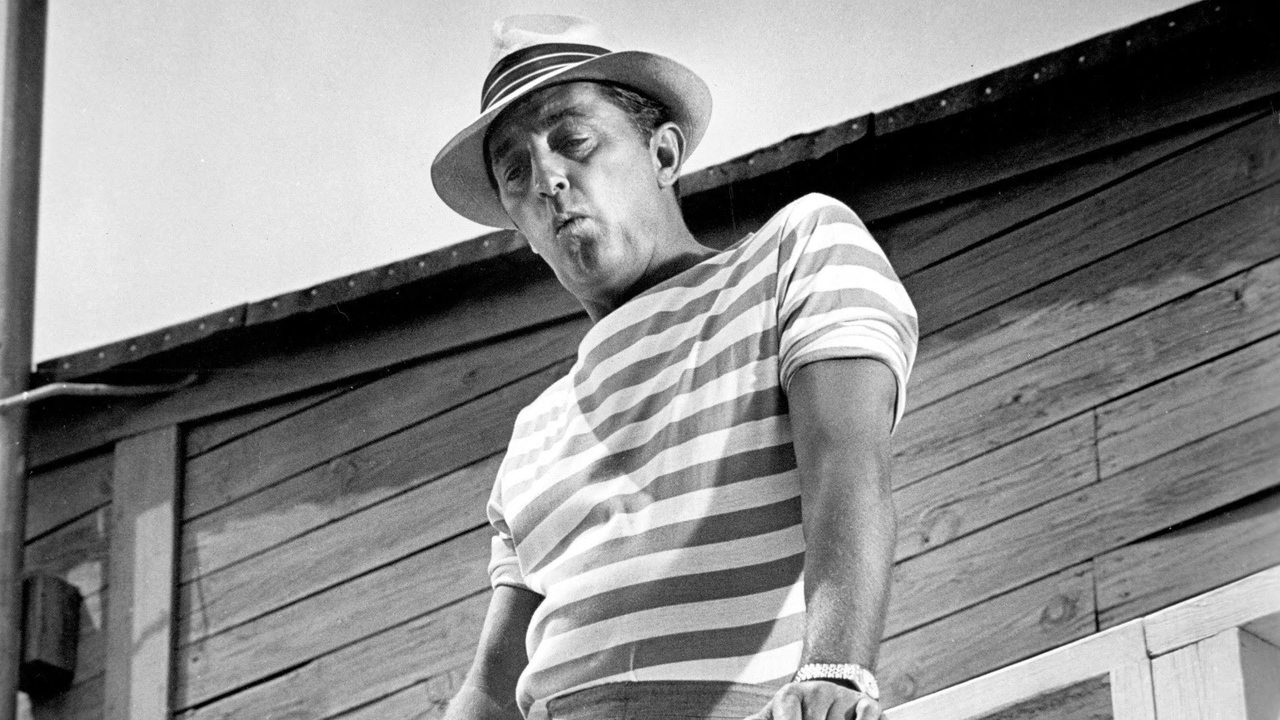
The 1962 production – released under the title Cape Fear in most markets – arrived at the precise moment American cinema was testing how much psychological menace a mainstream studio picture could sustain. J. Lee Thompson, working from James R. Webb's adaptation of John D. MacDonald's novel, constructs a film whose central argument is structural: the law is a system designed for ordinary circumstances, and Max Cady is not an ordinary circumstance. Robert Mitchum's performance is the engine of that argument. He plays Cady not as a snarling villain but as a man of deliberate intelligence, which makes him genuinely more disturbing than the genre's conventional antagonists. Gregory Peck's Bowden is equally important – a liberal professional whose belief in legal procedure is dismantled by its own insufficiency. Bernard Herrmann's score, among his most aggressive, refuses to allow the audience any distance from the mounting dread. The film does not resolve its central contradiction so much as push it to a physical confrontation that feels both inevitable and morally unresolved.
– Classic Noir
Sam Leavitt shoots the houseboat sequence with available darkness treated as a positive element rather than a void to be filled. The frame fragments into panels of black water, pale dock timber, and the harsh geometry of the boat's cabin. When Cady emerges from the river, Leavitt holds the camera low, letting the water surface catch what little light exists so that Mitchum seems to rise out of the image itself rather than enter it from the side. The editing slows here – cuts lengthen, held shots accumulate pressure – and the darkness between figures becomes spatial rather than merely atmospheric.
The scene crystallizes the film's central argument: Bowden has abandoned the law to face Cady on Cady's terms, which means descending to a register of pure physical violence. The setting – black water, no witnesses, no institutions – strips away everything Bowden has used to define himself. That the confrontation ends as it does does not feel like justice; it feels like survival, which the film carefully refuses to frame as the same thing.
Sam Leavitt, who had shot Anatomy of a Murder for Otto Preminger three years earlier, brings to this film a rigorous understanding of how high-contrast monochrome can function as moral argument rather than decoration. Leavitt and Thompson chose to shoot extensively on location in Savannah, Georgia and on the Cape Fear River, and that decision registers throughout: the light is Southern and humid, falling unevenly through Spanish moss and waterfront structures in ways a studio set could not replicate. Leavitt uses long lenses to compress space and close distances that Cady should not be able to cross, making his appearances feel like violations of physical law. Interior sequences favor single-source lighting that leaves faces half-resolved, particularly in scenes where Bowden is attempting something morally compromised. The visual grammar consistently rewards Cady with full clarity – he is never obscured – while Bowden is increasingly caught in shadow, a reversal of the standard noir distribution of light and darkness that quietly registers how the two men's positions have exchanged.
Criterion's presentation offers the cleanest available transfer of the original 1962 cut with proper aspect ratio and contrast levels suited to Leavitt's high-key monochrome work.
TubiFree (Ad-supported)A free option for US viewers, though transfer quality varies and should be verified against current catalogue listings.
Amazon Prime VideoRental/PurchaseAvailable for digital rental or purchase in HD; a reliable fallback if streaming subscriptions are unavailable.