Films People Pull a Fast One Night Beat Reading Room On TV Shop
No Questions Asked 1951
1951 Metro-Goldwyn-Mayer
★★★☆☆ Notable
Film Noir · 80 minutes · Black & White

No Questions Asked

Directed by Harold F. Kress
Year 1951
Runtime 80 min
Studio Metro-Goldwyn-Mayer
TMDB 6.1 / 10
"A man who asks no questions finds that the answers come looking for him."

Steve Keiver is a young insurance attorney in New York who discovers that his firm's policies can be exploited from the inside. When his socialite girlfriend Ellen Sayburn leaves him for the wealthier Gordon Jessman, Steve nurses his wounded pride and his grievance against a world that rewards appearance over substance. Presented with the opportunity to earn substantial money by recovering stolen goods for insurers – no questions asked, no police involvement required – he takes it, convincing himself that the arrangement is morally neutral.

The scheme functions smoothly until the recovered merchandise begins to implicate Steve in something far darker than property crime. Ellen reappears in his orbit, now married but restless, and her presence complicates his judgment precisely when clarity is most necessary. His partner in the operation, Harry Dycker, is a small-time operator whose loyalties shift with the money, while Police Inspector Matt Duggan – an old acquaintance – circles closer, patient and deliberate. Joan Brenson, a woman of genuine feeling who has attached herself to Steve, watches the situation deteriorate with the particular helplessness of someone who sees the outcome before the protagonist does.

No Questions Asked belongs to the MGM cycle of procedurally grounded noirs that root moral failure in professional complicity rather than outright criminality. Steve Keiver is not a killer or a thug; he is a man who agrees, incrementally, to look away – and the film is interested in precisely how that incremental surrender operates. The studio's characteristic polish works both for and against the material, lending the film a surface respectability that mirrors Steve's own self-deception while occasionally blunting the harder edges the story requires.
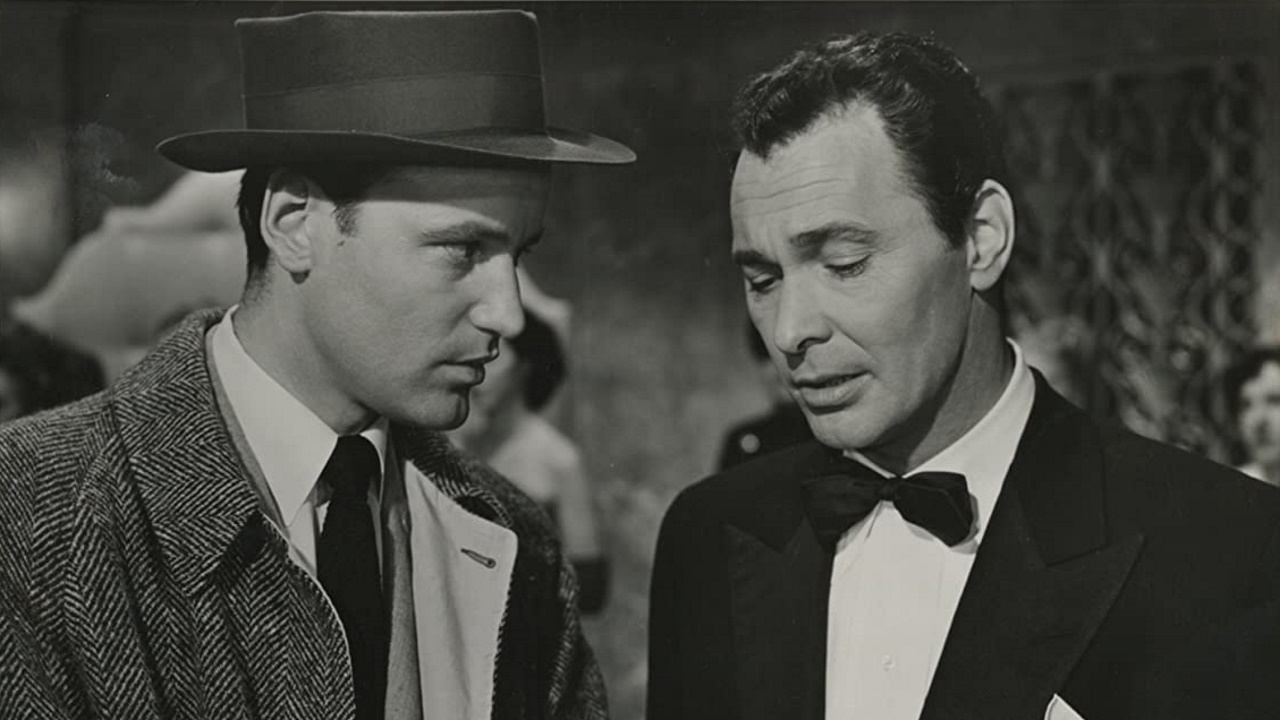
Classic Noir

No Questions Asked occupies a revealing corner of the MGM noir output: films that dress professional corruption in respectable clothes and examine how men of ambition rationalize their descent. Harold F. Kress, primarily known as a film editor of considerable distinction, directs with efficiency rather than idiosyncrasy, which suits the material more than one might expect – the film's argument is precisely about the absence of visible wrongdoing. Barry Sullivan brings the right quality of controlled resentment to Steve Keiver, a man whose crime is fundamentally one of omission. Arlene Dahl's Ellen functions less as femme fatale than as catalyst: she does not destroy Steve so much as reveal that he was already willing to be destroyed. Jean Hagen, so memorably effective in The Asphalt Jungle the year before, brings a quiet moral authority to Joan that the script does not always deserve. The film is not among the period's essential works, but it documents, with some precision, how postwar prosperity created new vocabularies for old corruptions.

– Classic Noir
3 ★★★☆☆ Notable
Credits

The Crew

DirectorHarold F. Kress
ScreenplaySidney Sheldon
CinematographyHarold Lipstein
MusicLeith Stevens
EditingJoseph Dervin
Art DirectionCedric Gibbons
CostumesHelen Rose
ProducerNicholas Nayfack
Performances

The Cast

Close Reading

The Signature Scene

No Questions Asked – scene
The Warehouse Handoff Money Crossing Hands at Midnight

Harold Lipstein lights the interior with a single high-angle source that falls across stacked crates and leaves the peripheral figures in graduated shadow. The camera holds a medium two-shot as the exchange is made, refusing to cut away or provide the relief of reaction shots; the static frame forces the viewer to watch the transaction complete itself without interruption. Steve's face is half-lit, the illuminated side composed and professional, the shadowed side withheld – a compositional argument about what he is choosing not to examine.

The scene crystallizes the film's central proposition: that corruption, at the operational level, looks indistinguishable from routine business. No one raises a voice. No weapon appears. The money moves from one set of hands to another and the warehouse returns to silence. Steve walks out into a street that looks exactly as it did before, and that visual continuity – the city unchanged, indifferent – is the film's most honest statement about how men persuade themselves that they have done nothing wrong.

Visual Language

The Cinematography

🎞️
Harold Lipstein – Director of Photography

Harold Lipstein, who shot a number of MGM's mid-tier productions during this period, works within the studio's disciplined house style while finding room for the occasional expressionist gesture. The film is largely studio-bound, and Lipstein uses that controlled environment to regulate light with precision: interior scenes favor side-lighting that divides faces along a consistent moral axis, while the few location sequences in New York streets are shot with a flatter, more documentary quality that briefly introduces the world Steve is insulating himself from. Lipstein does not reach for deep shadow as reflexively as some of his contemporaries – the film's visual restraint matches its thematic argument that Steve's world is not obviously dark but merely selective. Lens choices remain conservative, with normal focal lengths dominating; there are no distorting wide angles to signal menace. The danger in this film lives in the well-lit room, which is exactly where Lipstein places his camera.

In the Catalogue

Themes & Motifs

Availability

Where to Watch

Also in the Directory

See Also