Films People Pull a Fast One Night Beat Reading Room On TV Shop
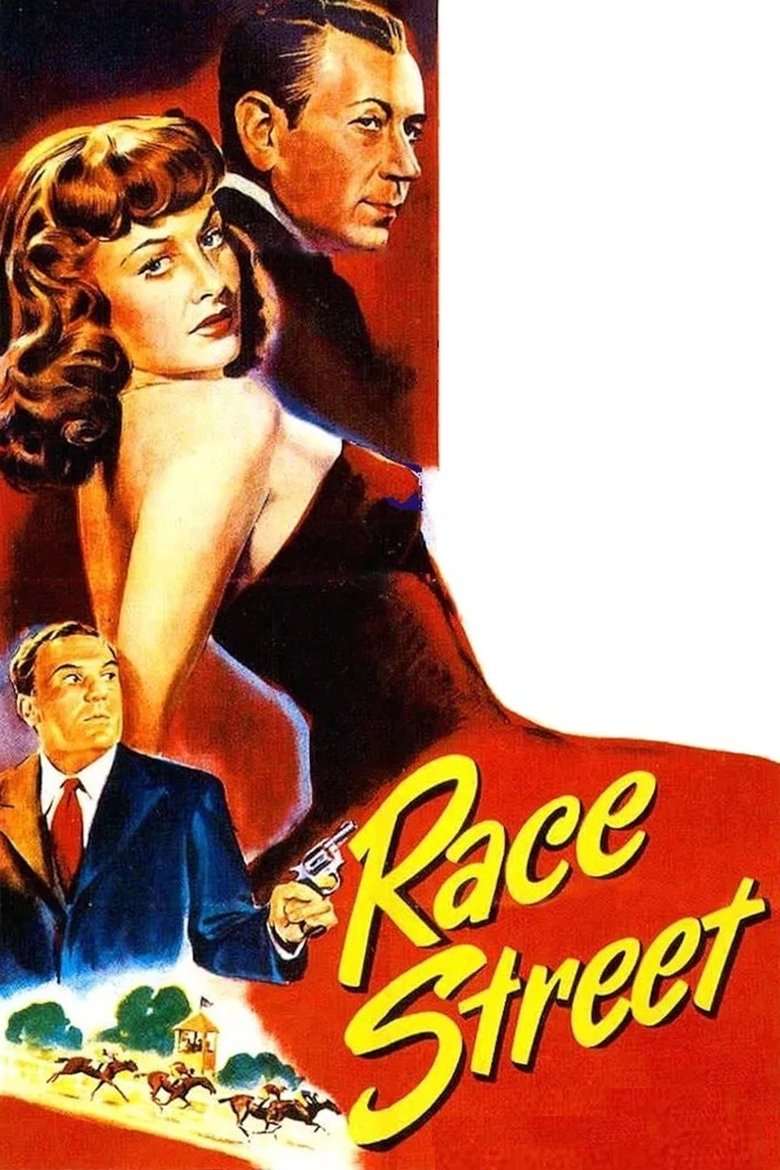
Race Street 1948
1948 RKO Radio Pictures
★★★☆☆ Notable
Film Noir · 79 minutes · Black & White

Race Street

Directed by Edwin L. Marin
Year 1948
Runtime 79 min
Studio RKO Radio Pictures
TMDB 6.0 / 10
"A bookie's loyalty to a dead friend pulls him toward the syndicate's shadow."

Dan Gannin (George Raft) runs a modest bookmaking operation in San Francisco, content to keep his business small and his exposure limited. When his closest friend is murdered by an extortion ring muscling in on independent bookies across the city, Dan finds himself unable to walk away from the killing despite the practical wisdom of doing exactly that. Into this volatile situation steps Barney Runson (William Bendix), a police detective who has known Dan long enough to read his silences, and Robbie Lawrence (Marilyn Maxwell), a singer whose connection to Dan is warm but unresolved.

The extortion syndicate, led by the cold-efficient Hal Towers (Harry Morgan), continues to collect its tribute from frightened bookmakers while Dan edges closer to a confrontation the law cannot deliver for him. Phil Dickson (Frank Faylen) works the investigation from inside the department, navigating the boundary between legal authority and Dan's more direct intentions. The film complicates its moral geometry by placing Dan in the position of grieving friend, criminal operator, and de facto avenger simultaneously, a triple alignment that the script refuses to resolve cleanly.

Race Street belongs to a cycle of late-1940s RKO noirs in which the world of small-time gambling serves as a lens for examining the syndicate's encroachment on individual enterprise, a subject with obvious postwar resonance. The film is less interested in procedural mechanics than in the ethical costs exacted from men who operate in the space between the law and the underworld, and it uses Raft's characteristic stillness to articulate that pressure without melodrama.
Classic Noir

Race Street is a competent, unpretentious entry in the RKO noir stable, and its modesty is both its limitation and its integrity. Edwin L. Marin directs without flourish, keeping the film's moral argument legible without foregrounding technique. George Raft's performance is often undervalued in retrospective assessments of the period; his refusal of expressiveness suits a character defined by suppressed grief and habitual caution. William Bendix brings genuine ambiguity to Barney Runson, a cop whose affection for Dan never quite resolves into either complicity or condemnation. The film's treatment of the syndicate as an economic force rather than a dramatic abstraction connects it to contemporaneous noirs like Force of Evil and Johnny O'Clock, though it lacks the formal ambition of either. What Race Street does well is locate its violence in a social milieu – the independent bookie, the neighborhood singer, the small-time operator – that the postwar crime film understood to be vanishing. In that sociological attentiveness, the film earns its place in the canon even when its execution falls short of distinction.

– Classic Noir
3 ★★★☆☆ Notable
Credits

The Crew

DirectorEdwin L. Marin
ScreenplayMaurice Davis
CinematographyJ. Roy Hunt
MusicRoy Webb
EditingSamuel E. Beetley
Art DirectionAlbert S. D'Agostino
CostumesEdward Stevenson
ProducerNat Holt
Performances

The Cast

Close Reading

The Signature Scene

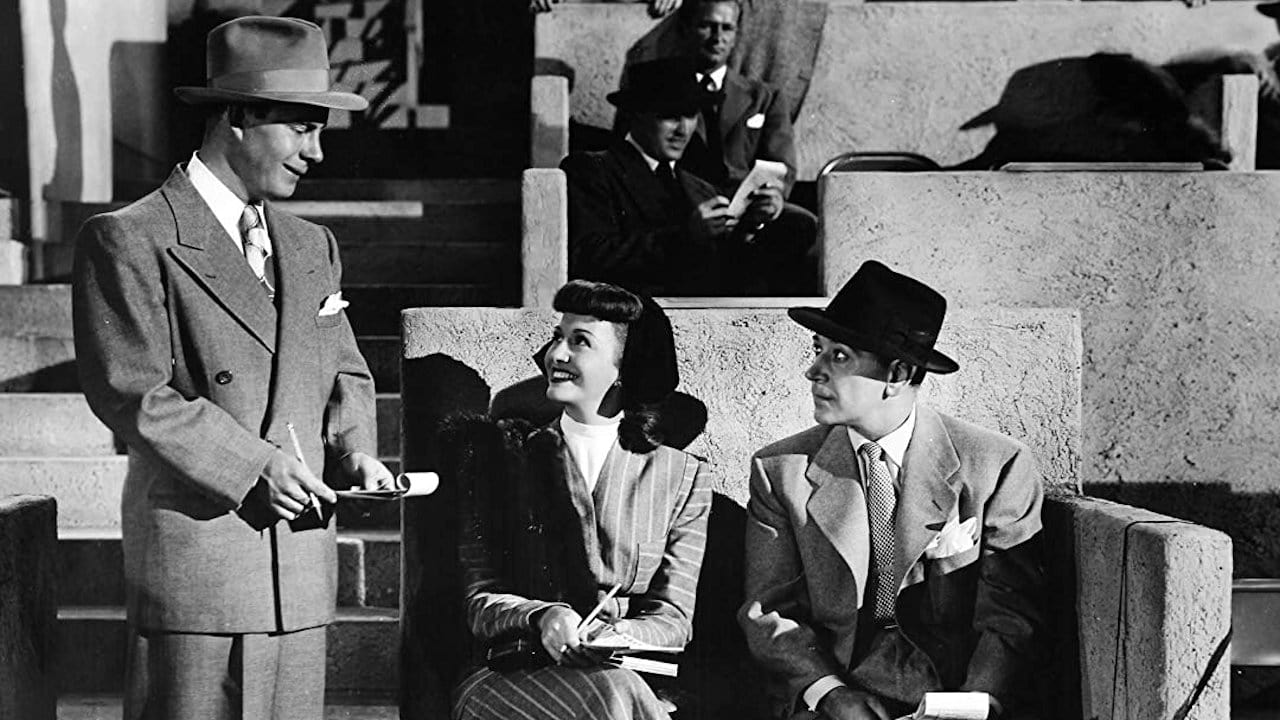
Race Street – scene
The Racetrack Confrontation Crowds Hiding a Reckoning

J. Roy Hunt frames the confrontation against the ambient noise and lateral movement of a crowded racetrack, using the public setting to isolate the two figures at its center. The camera maintains a medium distance that keeps both men fully visible while the background churns with indifferent motion. Light falls flat and institutional across the open exterior, stripping away the expressionist shadow that the film deploys more sparingly indoors. The composition insists on exposure: there is nowhere to retreat, no convenient darkness.

The scene crystallizes the film's central argument about the cost of conducting private grievances in a world that continues indifferently around them. Dan's controlled affect – Raft barely raises his voice – reads not as calm but as the specific discipline of a man who has learned that the wrong setting can extinguish him. The racetrack crowd, oblivious and purposeful, functions as an index of how little the machinery of ordinary life accommodates the moral crisis unfolding within it.

Visual Language

The Cinematography

🎞️
J. Roy Hunt – Director of Photography

J. Roy Hunt's cinematography on Race Street operates within the disciplined economy of mid-budget RKO production, drawing on the studio's established noir grammar without merely repeating it. Hunt, a veteran whose career stretched back to the silent era, favors tight interior setups in which a single practical source – a desk lamp, a bar backlight – is used to model faces against deep shadow, anchoring characters in pools of visibility that shrink as the narrative tightens. The exterior sequences at the racetrack and on San Francisco streets are photographed with a flatter, more naturalistic exposure that functions as tonal counterpoint to the compressed studio interiors, reinforcing the film's suggestion that danger is most legible indoors, in rooms where choices have already been made. Hunt does not employ extreme wide-angle distortion or the vertiginous low angles associated with more expressionist noir, a restraint that suits Marin's procedural approach. The visual register remains controlled throughout, using shadow less as atmosphere than as moral notation.

In the Catalogue

Themes & Motifs

Availability

Where to Watch

Also in the Directory

See Also