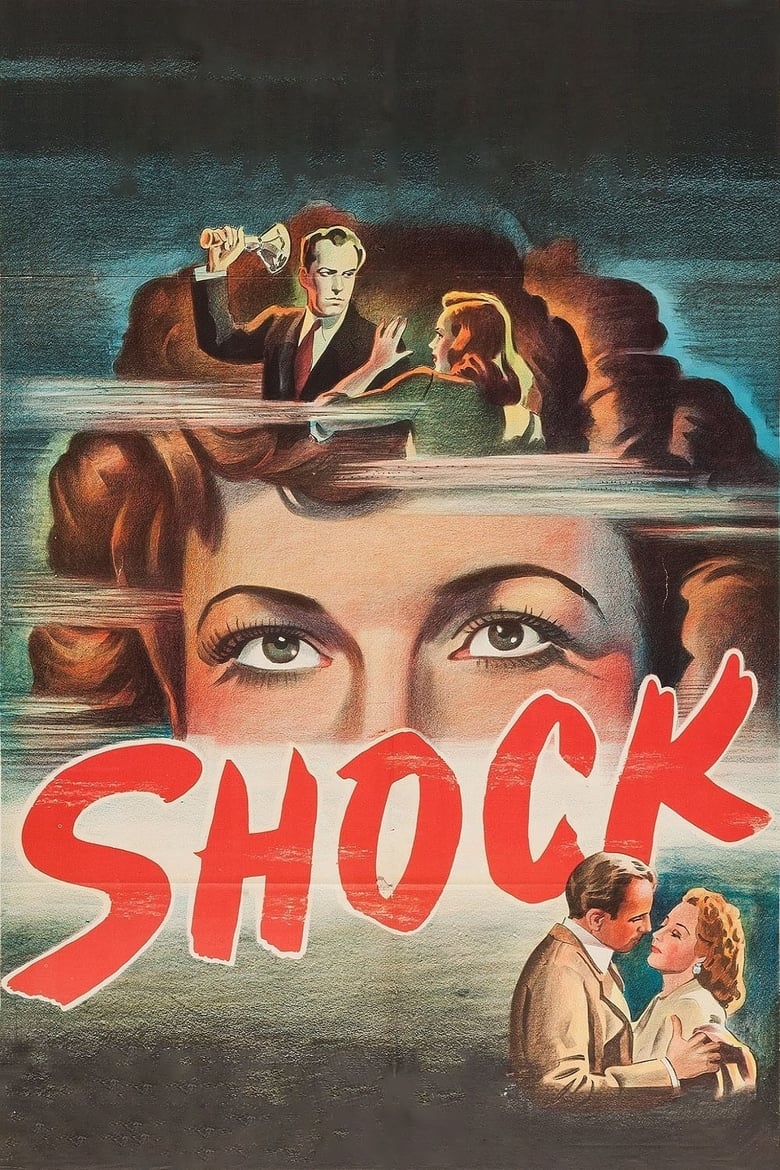
Janet Stewart, a young woman awaiting her husband's return from the war, checks into a San Francisco hotel. Unable to sleep, she witnesses through a window a violent argument in a neighboring room – a man kills his wife in a rage. The shock renders Janet catatonic, and she is transferred to a private psychiatric clinic run by Dr. Richard Cross, the very man she saw commit the murder.
Cross, accompanied by his calculating mistress and head nurse Elaine Jordan, quickly grasps the danger Janet represents. Rather than treat her toward recovery, he manipulates her fragile mental state, deepening her confusion and dependency. When Janet's husband, Lt. Paul Stewart, arrives and begins pressing for answers, Cross maneuvers between professional authority and quiet menace, using the apparatus of medicine itself as a weapon of concealment.
Shock belongs to a cycle of postwar noir films that locate danger not in shadowed alleys but inside institutions of care and expertise. The film's central anxiety – that the figure entrusted with healing may be the source of harm – gives it a colder edge than its modest runtime suggests. Vincent Price and Lynn Bari play their roles with controlled calculation, and the clinic setting transforms routine medical procedure into an architecture of dread.
Shock arrives at an interesting intersection in Vincent Price's career, just before he fully inhabited the horror register he would later own. Here he plays Dr. Cross with a clipped, rational authority that makes the character's corruption more disturbing than any outward menace would. Alfred L. Werker works efficiently within Fox's B-unit constraints, and the film is more disciplined than its brief runtime might imply. What Shock captures with some precision is a postwar suspicion of professional authority – the doctor as predator, the clinic as trap – that runs through a number of 1940s noirs without being named so directly. Lynn Bari's Elaine is arguably the more dangerous figure, her pragmatic ruthlessness less conflicted than Cross's. The film does not transcend its formula, and its resolution is tidier than the material warrants, but as a document of mid-decade studio noir it is purposeful, compact, and worth closer attention than its reputation has received.
– Classic Noir
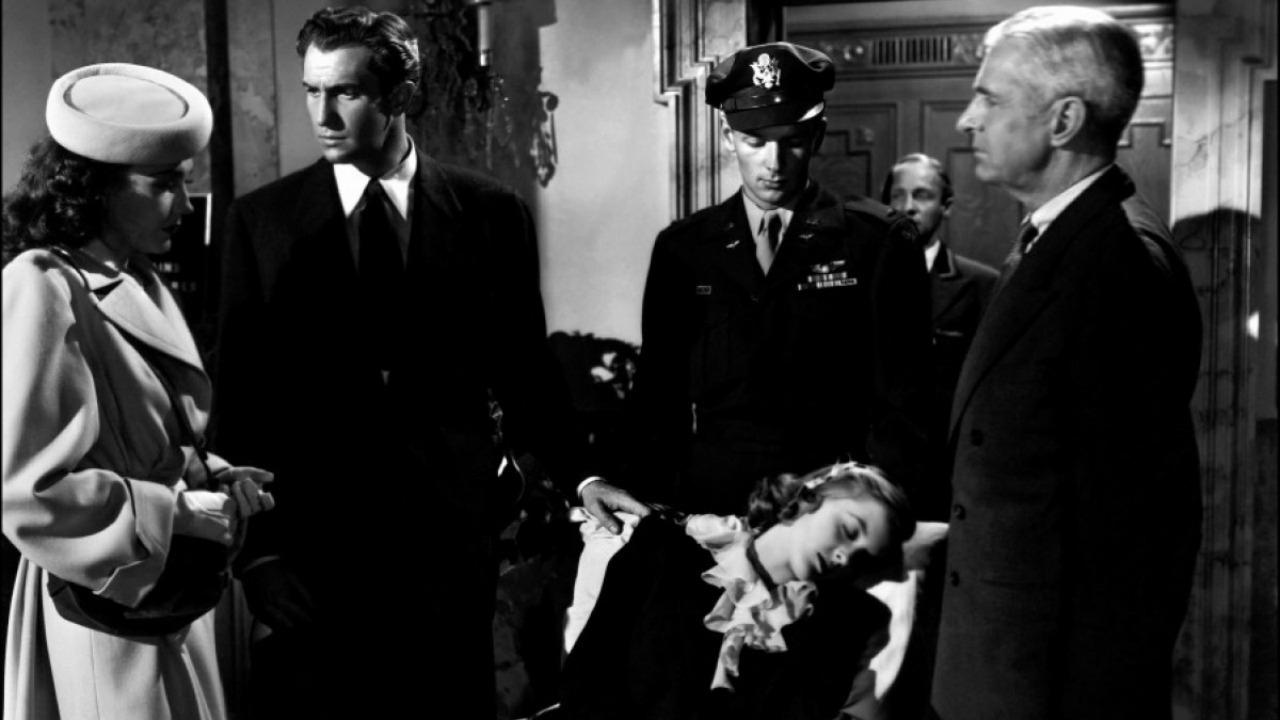
Joseph MacDonald frames Cross in a narrow corridor outside Janet's room, the light falling from a single overhead source that catches the upper half of his face and leaves his jaw in shadow. The composition places him between two institutional walls, the geometry tight and slightly asymmetrical, so that his stillness reads as surveillance rather than concern. The camera holds at a slight distance, refusing the close-up that would invite identification, keeping the audience in the position of observer rather than confidant.
The scene crystallizes the film's moral argument in visual terms: the man of medicine occupying a threshold, neither inside with his patient nor outside in the open, suspended in a zone of professional ambiguity that he has deliberately constructed. His posture is attentive, almost tender, and that surface care is precisely what makes the image unsettling. The clinic's authority is shown to be indistinguishable from its danger.
Joseph MacDonald, who would go on to shoot Panic in the Streets and Pickup on South Street for Elia Kazan and Samuel Fuller respectively, brings a crisp institutional coldness to Shock that suits the material well. Working within Fox's studio soundstage constraints, MacDonald uses hard overhead lighting to flatten the clinic interiors into something close to abstraction – walls and corridors become planes of grey, and faces emerge from or recede into them depending on the moral weight of a given scene. There is little of the expressionist shadow play common to Universal noir; instead MacDonald opts for an almost bureaucratic brightness in the clinic scenes that makes the underlying menace feel more credible. The hotel room sequence that opens the film uses a higher contrast ratio, with deep shadows framing Janet's point-of-view angle through the window – a deliberate visual shift that marks her witnessed knowledge as something that does not belong in the lit, rational world of the clinic she will soon enter.
Tubi has carried Shock in its public-domain library; picture quality varies but the film is complete and accessible at no cost.
Archive.orgFreeA public-domain print is available for streaming or download, making this the most archivally direct option for researchers.
Amazon Prime VideoSubscriptionAvailability shifts, but the film has appeared in Prime's classic library; check current listings before accessing.