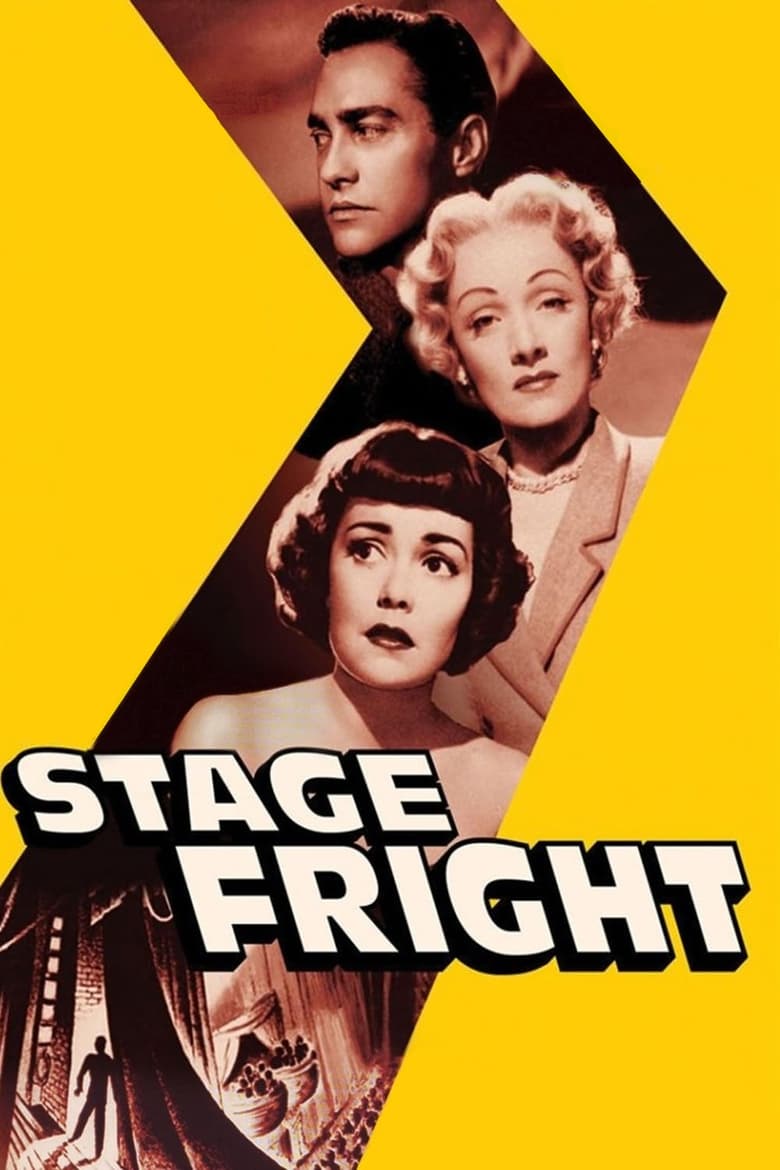
When drama student Eve Gill agrees to hide her friend Jonathan Cooper, she accepts his account of events at face value: that he stumbled upon the body of Charlotte Inwood's husband, that Charlotte herself is the killer, and that he is an innocent man in desperate need of shelter. Eve's father, the eccentric Commodore Gill, installs Jonathan in a safe house while Eve devises a plan to expose Charlotte – the celebrated West End actress who has continued performing each night as though nothing has occurred.
To get close to Charlotte, Eve infiltrates her household by posing as a maid, maneuvering herself into the orbit of the star's inner circle and, unavoidably, into contact with Detective Inspector Wilfried Smith, the quietly observant officer assigned to the case. Eve and Smith begin a cautious courtship conducted under false pretenses on her side, which becomes increasingly difficult to sustain as Smith's investigation tightens and as Eve's own certainty about Jonathan's innocence begins to develop hairline fractures.
Stage Fright operates within the tradition of the wrong-man thriller while systematically undermining its own conventions. The theatrical world of the West End – dressing rooms, curtain calls, costumes, and rehearsed performances – becomes the film's governing metaphor: nearly every character is performing something for someone else's benefit, and the question of which performance conceals the truth drives the narrative toward a resolution that rewards careful attention to what Hitchcock has chosen to show and what he has elected to withhold.

Stage Fright occupies an unusual position in the Hitchcock catalogue – respected but rarely celebrated, defended more often than loved. Its central formal gambit, presenting a lying flashback as though it were reliable testimony, disturbed audiences in 1950 and has divided critics ever since. The controversy is legitimate but also distracts from what the film accomplishes on its own terms. Marlene Dietrich's Charlotte Inwood is one of the period's most precisely observed studies in celebrity as armor: every gesture is performed, every emotion calibrated for effect, and the film is intelligent enough to render that quality both menacing and genuinely sympathetic. Jane Wyman's Eve, by contrast, is a character learning that sincerity is not the same as perception. The theatrical milieu is not decorative; it frames the film's actual argument, which concerns the unreliability of first-person narrative and the particular dangers of believing someone simply because they appear to be telling the truth.
– Classic Noir
The camera holds at a respectful distance as Charlotte sits before a backstage mirror, its frame of bulbs throwing a flat, even light across her face – a light that is deliberately unglamorous, clinical in the way that only theatrical dressing-room lighting can be. The composition places Charlotte between her reflection and the room behind her, so that she is watched from two directions simultaneously. Hitchcock and cinematographer Wilkie Cooper resist any impulse to flatter; the scene is lit to observe rather than to enchant.
What the scene discloses is Charlotte's fundamental condition: she is most fully herself when she is preparing to become someone else. The mirror doubles her without resolving her. Whether she is a murderer, a survivor, a manipulator, or some combination of all three remains genuinely uncertain in this moment, and the film is wise enough not to dispel that uncertainty prematurely. The dressing room is the one place where her performance is visibly in preparation, which makes it, paradoxically, the space where she comes closest to transparency.
Wilkie Cooper's work on Stage Fright is disciplined in a way that the film's theatrical setting might have tempted a lesser cinematographer to abandon. Rather than exploiting the West End milieu for expressionist shadow play, Cooper keeps his lighting schemes naturalistic and socially specific: the flat bulb-ringed mirrors of backstage dressing rooms, the grey overcast light of London exteriors, the interior gloom of middle-class houses where curtains are habitually half-drawn. The studio-bound sequences are not disguised as location work but are composed to feel enclosed and slightly airless, reinforcing the film's thematic concern with entrapment and performance. Cooper reserves his most careful shadow work for interiors where characters are concealing something from one another, allowing darkness to accumulate at the edges of the frame as information accumulates in the narrative. The visual language does not announce its moral logic; it embeds it.
Stage Fright has appeared on Max as part of the Warner Bros. classic library; check current availability as catalogue rotation applies.
TCMBroadcast/SubscriptionTCM carries Stage Fright periodically as part of its Hitchcock and classic thriller programming; the TCM app allows on-demand access for subscribers.
TubiFreeTubi has carried the film in an ad-supported format; availability varies, but it represents the most accessible no-cost option when present.