When a wealthy widow is found dead in her home, suspicion falls quickly on Wallace Curtis, a young man who happens to be blind and who stands to inherit a portion of her estate. Detective Andy Doyle, a methodical and quietly stubborn investigator, is assigned to the case and finds the evidence against Curtis too convenient to trust entirely. Phyllis Baxter, a woman connected to Curtis, insists on his innocence and pushes Doyle toward questions the department would prefer to leave unasked.
As Doyle digs beneath the surface of a seemingly simple inheritance dispute, he encounters a circle of marginal figures – a suspicious bookkeeper, a landlady with selective memory, a woman named Vera whose loyalties shift with the light – each of whom knows more than they admit. The financial arrangements surrounding the dead woman grow murkier, and the possibility of an inside job begins to displace the assumption of a stranger's crime. Curtis, unable to see his accusers, becomes a figure caught between the legal machinery closing around him and the efforts of the few who believe he is being used.
Sudden Danger operates in the lower register of 1950s procedural noir, where guilt is less a matter of passion than of opportunity and calculation. The film is less interested in the spectacle of crime than in the patient, unglamorous work of disentangling a deliberate frame, and it earns its modest tension from the methodical pressure Doyle applies to people who expected the case to close quickly.
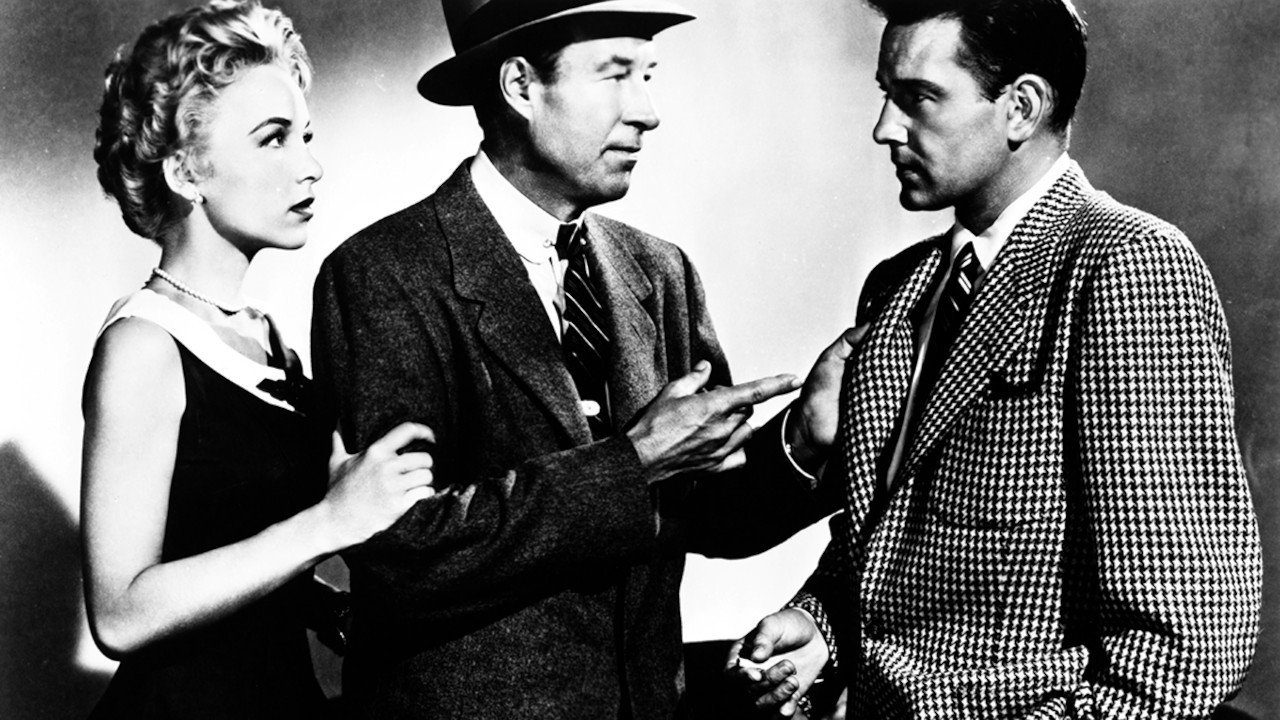
Sudden Danger belongs to the strand of Allied Artists programmers that traded prestige production values for efficiency and directness. Hubert Cornfield, still finding his voice before the more assured Pressure Point (1962), keeps the film moving at a pace that respects its 66-minute frame without feeling truncated. Bill Elliott, whose career had migrated from Westerns into B-noir, brings a useful flatness to Andy Doyle – a man who investigates not from moral outrage but from professional precision, which proves more unsettling than passion would. The blind-man-as-suspect device is handled without sentiment, and Tom Drake renders Curtis's vulnerability without leaning on it. Beverly Garland, reliably sharp in this era's second-tier productions, gives Phyllis more internal pressure than the script strictly requires. The film offers little that is formally adventurous, but it captures something accurate about mid-decade American anxiety: the fear that institutions meant to protect the innocent are simply indifferent, and that truth requires a particular, stubborn personality to survive.
– Classic Noir
Ellsworth Fredericks frames the interrogation with a low-angle setup that places the overhead fixture directly in the shot, its hard cone of light falling across the table and leaving the far corners in graduated shadow. Curtis sits with his face tilted slightly upward – the instinctive posture of the blind – while Doyle remains at the edge of the frame, partly obscured, present only as a voice and a shape. The camera holds on Curtis rather than cutting to the detective, a choice that forces the viewer into the blind man's perceptual position.
The scene encodes the film's central argument without stating it: institutional power operates most freely on those who cannot witness it working. Curtis cannot see the expressions of his interrogators, cannot read the room, cannot perform the small visual negotiations that the sighted use to negotiate threat. The sustained single-shot logic of the scene makes the audience feel the disadvantage as a structural condition rather than a personal misfortune, and gives the procedural plot a moral dimension it might otherwise lack.
Ellsworth Fredericks, who would later bring considered naturalism to Friendly Persuasion (1956) and Seven Days in May (1964), works here within severe budget constraints that he turns to modest atmospheric advantage. Shooting largely on studio interiors, Fredericks relies on hard practical sources – ceiling fixtures, desk lamps, a streetlight bleeding through venetian blinds – to build environments where shadow is not decorative but directional, steering the viewer's attention and implying concealment. His lens choices tend toward the normal range, avoiding the expressionist distortion that lesser B-noirs leaned on as shorthand for menace; the result is a visual world that feels inhabited rather than constructed. Where the cinematography most plainly serves the story's moral logic is in its treatment of threshold spaces – doorways, stairwells, the edges of rooms – where characters are caught between exposure and retreat, a visual grammar that mirrors the film's persistent concern with who controls what gets seen.
Tubi has carried Allied Artists titles from this period and is the most likely free streaming source; confirm availability before visiting.
Archive.orgFreePublic domain prints of Allied Artists B-pictures from the 1950s surface regularly here; image quality varies but access is immediate.
Amazon Prime VideoSubscription or RentalClassic B-noirs from Allied Artists have appeared intermittently on Prime; check current catalogue as availability shifts.